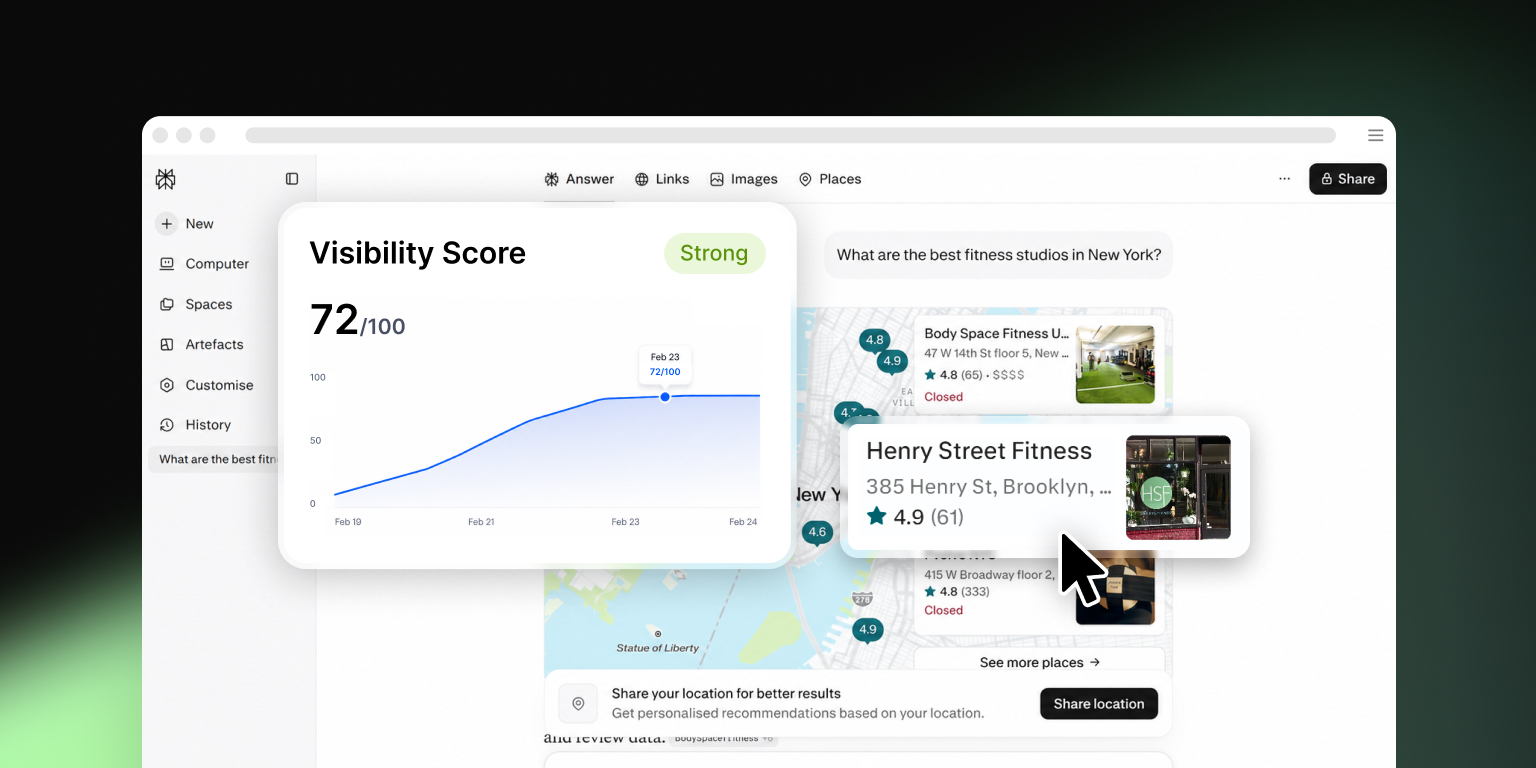
The rules of brand visibility have fundamentally changed. When someone asks ChatGPT for the best project management tool and your competitor appears while you don't, you've already lost that customer — before any traditional search ranking comes into play.
This guide walks you through everything you need to build a systematic approach to tracking and improving your brand's presence in AI-generated answers: from understanding what counts as an AI brand mention to setting up tracking systems and turning insights into action.
Why AI mention tracking matters now
AI answers now shape purchase decisions before users click anything. When a prospect asks Perplexity, "What CRM should a small consulting firm use?" and receives a detailed recommendation, that answer carries weight. The user might never visit your website, never see your carefully optimized landing page, yet form a strong opinion about whether you're worth considering.
The visibility paradox is striking: AI-cited brands generate 35% higher organic click-through rates and 91% higher paid CTR than non-cited brands on the same queries. Being mentioned by AI systems doesn't just build awareness; it dramatically improves performance when users do reach traditional search results.
Real business problems this solves
Unexplained drops in organic traffic often trace back to changes in AI visibility. When ChatGPT stops recommending you for key queries, branded searches decline weeks later. Without tracking AI brand mentions, you're left guessing why.
Brand reputation drift happens gradually and invisibly. AI systems might start including a cautionary note about your security practices or customer service — not because anything changed, but because they ingested a critical review or outdated article. By the time you notice, thousands of prospects have received that message.
Competitor displacement is perhaps the most urgent concern. Your competitor publishes a comprehensive integration guide, and suddenly, they appear in AI responses where you used to. Traditional rank tracking won't show this. You need to track AI mentions directly.
What's newly volatile
The AI search landscape changes faster than traditional SEO ever did. Model updates shift citation preferences overnight. Browsing behaviors differ across platforms: ChatGPT with web access pulls different sources than ChatGPT without web access. Google AI Overviews roll out unevenly by query type and region, meaning your brand mentions in AI search vary dramatically based on what users search and where they're located.
Most critically, LLM outputs are non-deterministic. Ask the same question twice, and you'll often get different answers. This makes single-snapshot tracking unreliable and systematic monitoring essential.
Tip: Set up a Google Alert for your brand name combined with AI-related keywords like "vs," "alternative," "review," and "best tool for." This acts as a free early warning system for major visibility changes.
What counts as an AI brand mention
Not every mention carries equal weight. Understanding the taxonomy of AI brand mentions is the foundation of actionable tracking.
Mention types to classify
Direct recommendations
When an AI says "Use Notion for team knowledge management" or "I'd recommend Stripe for payment processing," that's the gold standard. The system is actively advocating for your solution.
Neutral inclusions
"Popular project management tools include Asana, Monday, and Basecamp." You're in the consideration set, but you lack differentiation. Neutral mentions build awareness without building preference.
Negative warnings or cautions
"Brand X has limited API flexibility" or "Some users report slow customer support from Brand Y." These require immediate attention — even accurate criticism reduces conversion probability.
Comparison table mentions
AI systems frequently generate comparison tables in response to "vs" queries. Your position in these tables — first row versus last, recommended versus not recommended — significantly impacts perception even when the text appears neutral.
Cited versus uncited mentions
Citation context matters enormously. When ChatGPT says, "According to TechCrunch, Brand X leads the market," that attribution signals authority. Uncited mentions ("Brand X is popular among enterprise teams") still build awareness but carry less persuasive weight.
Position in response
A mention in the first paragraph carries more influence than the same mention buried after follow-up questions. Users skim AI responses and absorb the top content first.
Scoring framework
To make tracking actionable, apply a consistent 1–5 Mention Value Score across platforms:
| Score | Description | Example |
|---|---|---|
| 5 | Direct recommendation with citation, first position | "I recommend Figma for UI design. [Source: Design Weekly]" |
| 4 | Direct recommendation without citation, or cited neutral mention in first position | "Figma is excellent for collaborative design work" |
| 3 | Neutral inclusion in comparison, middle position | Listed third in a five-tool comparison table |
| 2 | Buried mention after follow-ups, or neutral mention without citation | Appears only when user asks "what about Figma specifically?" |
| 1 | Negative mention, or mention with inaccurate information | "Figma can be expensive for small teams" (when free tier exists) |
When scoring, weigh these factors:
- Intent match (does the query match your target customer?)
- Prominence (where in the response?)
- Sentiment (positive, neutral, negative)
- Citation quality (sourced, unsourced, linked)
- Competitive displacement (are you mentioned instead of or alongside competitors?).
Watch for edge cases: hallucinated claims (AI invents plausible-sounding details about your company), outdated product information, and brand-name ambiguity. Maintain synonym lists for spelling variants and subsidiary names, since AI systems don't always standardize formatting.
Try it on your brand
What kind of AI mentions is your brand getting?
Check the prompts that matter and capture how AI talks about your brand, not just whether your name appears.
Add your website.
Enter your website URL.
We check relevant AI prompts.
Beamtrace captures when and how your brand gets mentioned.
Understand the context.
Position, sentiment, citations, and competitor presence.
AI visibility metrics and KPIs to track
The gap between vanity metrics and actionable KPIs is where most tracking programs fail. These core metrics work regardless of which platforms you're monitoring.
Mention rate
The most fundamental metric: the percentage of tracked prompts where your brand appears.
Formula: (Queries mentioning your brand ÷ Total tracked queries) × 100
What are the benchmarks? 40%+ is strong; 60%+ is excellent. But evaluate in context — a 35% mention rate is weak if competitors average 70%, but strong if the category average sits at 20%.
Citation rate
Of all your mentions, what percentage include a cited source — a URL, domain, or attributed quote?
Formula: (Mentions with source attribution ÷ Total mentions) × 100
Cited mentions signal authority and verifiability. If your mention rate is high but your citation rate is low, AI systems may be relying on brand mentions from training data rather than current sources — a vulnerability as models update.
Share of voice
Your brand mentions as a percentage of total mentions across your competitive set.
Formula: (Your brand mentions ÷ Total mentions of you + top 3 competitors) × 100
This reveals the competitive position more clearly than the mention rate alone. When presenting to executives, use a pie chart or stacked bar chart — a visual showing your brand's slice compared to 3–4 competitors is far more impactful than a raw percentage.
Sentiment breakdown
The distribution of positive, neutral, and negative mentions across your tracked prompts. A 50% mention rate means little if 40% are cautionary or unfavorably comparative. Track sentiment shifts over time: a gradual drift toward neutral from positive might signal weakening brand perception before it affects business metrics.
Accuracy and freshness flags
Count factual errors, outdated pricing, deprecated features, or incorrect use cases mentioned by AI systems. If ChatGPT consistently states your pricing as "$99/month" when it's actually "$129/month," your conversion rate suffers. This isn't a tracking failure — it's a content and schema issue you can fix.
Prompt coverage
What percentage of your market's question space are you actually monitoring?
Formula: (Prompts you're tracking ÷ Total unique industry prompts in AI platforms) × 100
Tracking "best project management software" but missing "project management tool for nonprofits" means you're unaware of vertical-specific opportunities — or problems.
Reporting views that executives understand
Raw metrics rarely resonate in leadership meetings. Frame your reporting around:
Trendlines showing week-over-week changes in mention rate, sentiment, and share of voice. Flag inflection points — sudden drops signal content decay, competitor displacement, or model updates.
Category rollups grouping prompts by intent: "best X," "X vs Y," pricing, reviews, and troubleshooting. This reveals where you're strong versus weak and helps prioritize content investments.
Wins and losses against competitors — which prompts you're winning (appearing when competitors aren't) versus losing. These map directly to content gap opportunities.
The walkthrough below shows how prompt-level competitor analysis can reveal where other brands are appearing more often and how to trace those differences back to the original AI responses.
Set up a tracking system (step-by-step)
Most teams skip planning and jump straight to tools. That's why they struggle to get value. Before selecting software, define your scope, goals, and measurement discipline.
Step 1: Define scope and goals
Brand entities to track: Primary brand name, product names, CEO/founder name (if brand-associated), common misspellings, acronyms, and subsidiary names.
Markets to prioritize: Geographic regions (AI responses vary by location), B2B vs. B2C personas, customer journey stages, and vertical segments.
Goal definition shapes everything else:
- Top-of-funnel awareness? Focus on mention rate and share of voice across broad queries.
- Driving demos or trials? Track comparison and alternative prompts; weight sentiment in scoring.
- Brand reputation? Track negative prompts ("Is Brand safe?" "Brand lawsuit"); set real-time alerts.
- Content strategy? Track which prompts generate citations; prioritize content for high-volume, low-coverage prompts.
Step 2: Build a master prompt list
Create 30–50 prompts organized by user intent:
Discovery: "best [category] software," "top [category] tools 2026," "what [category] should I use"
Comparison: "[Your brand] vs [Competitor]," "compare [category] tools," "[Competitor] alternatives"
Pricing: "[Brand] pricing," "how much does [Brand] cost"
Review: "[Brand] reviews," "is [Brand] good," "[Brand] pros and cons"
Troubleshooting: "[Brand] not working," "how to fix [Brand]"
Integration: "does [Brand] work with [Tool]"
Risk/compliance: "is [Brand] secure," "[Brand] data privacy"
Include 5–10 negative-risk prompts ("Is [Brand] risky?" "[Brand] complaints") to catch misinformation early. Add Reddit-style phrasing too — Perplexity cites Reddit heavily, so include casual prompts like "has anyone used [Brand]?" or "thoughts on [Brand] for [use case]?"
Step 3: Choose platforms to monitor
Minimum coverage set:
- ChatGPT (GPT-4o, browsing enabled): 800 million weekly users — essential.
- Perplexity: Captures community sentiment through heavy Reddit and forum citations.
- Google AI Overviews: Appears on ~50% of Google searches.
- Gemini (optional but rising): Growing share within the Google ecosystem.
Document for consistency: model name/version, browsing state (on/off), geographic location, personalization state (logged in vs. incognito), and session rules (clear history before each batch). Without consistent documentation, you can't distinguish actual visibility shifts from testing variations.
Step 4: Establish a baseline and change log
Run your full prompt set once. For each prompt, record: mention status, position, sentiment, cited source, competitors mentioned, and the exact snippet describing your brand.
Maintain a parallel change log of external events:
| Date | Event Type | Description |
|---|---|---|
| Mar 15 | Content | Published new integration guide |
| Mar 22 | PR | CEO quoted in TechCrunch |
| Apr 1 | Competitor | Competitor launched new pricing tier |
| Apr 8 | Platform | ChatGPT model update announced |
| Apr 15 | Schema | Updated FAQ schema on pricing page |
This is how you separate signal from noise. When mentioning rate shifts, correlate with logged events rather than guessing at causes.
Step 5: Cadence, ownership, and QA
Weekly monitoring works for most businesses; it’s frequent enough to catch meaningful drops, sparse enough to smooth random variability. Increase to 3× weekly during product launches, PR campaigns, or crisis response.
Ownership matrix
SEO lead owns "best X" and alternative queries. PR/comms owns reputation queries. The product manager owns feature and integration queries. Legal owns regulatory queries and flags misinformation.
QA checklist per run
All prompts tested on the correct platform/model. Browsing state matches documentation. Chat history cleared between batches. At least 5 runs per platform to account for non-determinism. Confidence scores recorded. Outliers flagged.
How to track AI brand mentions manually
Not every team is ready for paid tools. Manual tracking is labor-intensive but functional — and teaches you how AI visibility works before you automate.
The manual process
Open each AI platform in incognito mode (prevents personalization bias). Enter prompts exactly as written in your test suite. For each response, record:
- Whether your brand appears
- Context (copy exact snippet)
- Position in response
- Whether a source is cited
- Which competitors appear?
Critical: Repeat each prompt 5 times per platform to account for non-determinism. A single test is unreliable. Perplexity's consistent citation display makes source tracing easiest; Google AI Overviews don't trigger for all queries, so document when they do and when they don't appear.
Limitations to be realistic about
Non-determinism means different results across runs — aggregate 5–10 samples and look for patterns.
Personalization persists even in incognito. Results still vary somewhat by region and device.
Citation instability means sources shift as AI systems update. Sources cited this week might not appear next week.
And labor costs scale poorly: tracking 50 prompts × 5 runs × 15 minutes per prompt = 62.5 hours monthly. Manual tracking is unsustainable past 20–30 prompts for most teams.
Manual makes sense when you have a small team, a small prompt set (under 10-20 queries), a low-stakes category, or you're piloting before tool investment. For scaling beyond that, see our AI Visibility Tool Guide.
Turn tracking into action
Tracking brand mentions without action is expensive vanity. Here's how to convert AI brand mention data into business outcomes.
Diagnostic phase
Before optimizing, understand what your data reveals:
Mention rate of 45% while competitors average 70%? Diagnose further: are you absent from comparison queries, or present but positioned weaker? This distinction changes your content strategy entirely.
Positive sentiment but low mention rate? Your brand is well-regarded when mentioned, but you're not top-of-mind. This is an awareness gap — focus on PR, thought leadership, and platform presence that AI cites heavily.
High mention rate but 60% negative sentiment? This is a reputation issue. Check for outdated product descriptions, pricing errors, or misinformation that needs correction.
Content and SEO optimization loop
Once you've diagnosed the issue, follow a systematic improvement process.
Gap analysis
Identify prompts where you're absent, but competitors appear. Create dedicated content addressing those gaps — 1,000+ words, structured with practical examples. Publish on your site and syndicate to platforms AI systems cite (Dev.to, Medium, relevant subreddits). Re-check the same prompts in 2 weeks.
Sentiment remediation
Find negative or outdated mentions and correct the source content. Update your product pages, FAQ schema, and "What's New" blog with accurate information. When updating pages, change the lastmod date in your sitemap and request re-indexing via Google Search Console.
Authority building
When you're rarely cited despite strong content, build your presence on the platforms each AI system prefers. ChatGPT favors Wikipedia and established media. Perplexity draws from Reddit, Quora, and Medium. Google AI Overviews prioritize YouTube, LinkedIn, and domain experts. Choose 1–2 aligned with your audience and build deliberately over 3–6 months.
Proving ROI
AI visibility ROI is genuinely difficult to measure: most interactions don't generate trackable clicks. But you can demonstrate impact through correlation: establish an AI visibility baseline, run an optimization campaign over 4–6 weeks, re-measure visibility, then check whether branded search volume, direct traffic, and demo requests moved during the same window. It's not proof of causation, but it's compelling evidence.
For stronger proof, run a controlled test: optimize 5–10 high-value pages while leaving others untouched. If optimized pages show a 20%+ lift in mentions while untouched pages stay flat, you've demonstrated clear ROI.
Frequently asked questions
How do I track brand mentions in AI search?
Start with a manual approach: define 20–30 prompts representing your market's key questions. Test each on ChatGPT, Perplexity, and Google AI Overviews weekly. Log mention status, sentiment, and competitors in a Google Sheet. After 4 weeks, you'll understand your baseline and can evaluate automated tools for scaling.
What metrics matter most for tracking AI brand mentions?
Mention rate — the percentage of prompts where you appear — is foundational. Layer in sentiment distribution, share of voice versus competitors, and citation rate. Track these weekly to catch 10%+ drops early enough to respond.
How often should I check AI visibility?
Weekly monitoring is the standard for most businesses. Daily is overkill — AI outputs change slowly. Weekly catches show meaningful trends without noise. Increase to 3× weekly during high-volatility situations, such as product launches or crisis response.
Can I see what ChatGPT says about my brand?
Yes. Open ChatGPT in incognito mode and ask: "What do you know about [Brand]?" or "Should I use [Brand] for [use case]?" Repeat 5 times to account for variability — single responses can be misleading. For systematic tracking, use dedicated tools or manually test your core prompts weekly.
What are the best ways to track brand mentions in AI search at scale?
Manual tracking works for 20–30 prompts, but beyond that you need automated tools. Dedicated AI visibility platforms monitor your brand across multiple AI engines, track share of voice against competitors, and alert you to changes.
Final thoughts
The companies winning AI visibility today are those treating it as a systematic discipline, not an occasional curiosity. They define tracking comprehensively, measure what matters, act on insights, and connect efforts to business outcomes.
Your next step: define 30 prompts representing your market, run one baseline week manually, and identify your first content gap to close. Measure the impact in 4 weeks. That single test will justify the full program and position you ahead of competitors still wondering whether AI mention tracking matters.