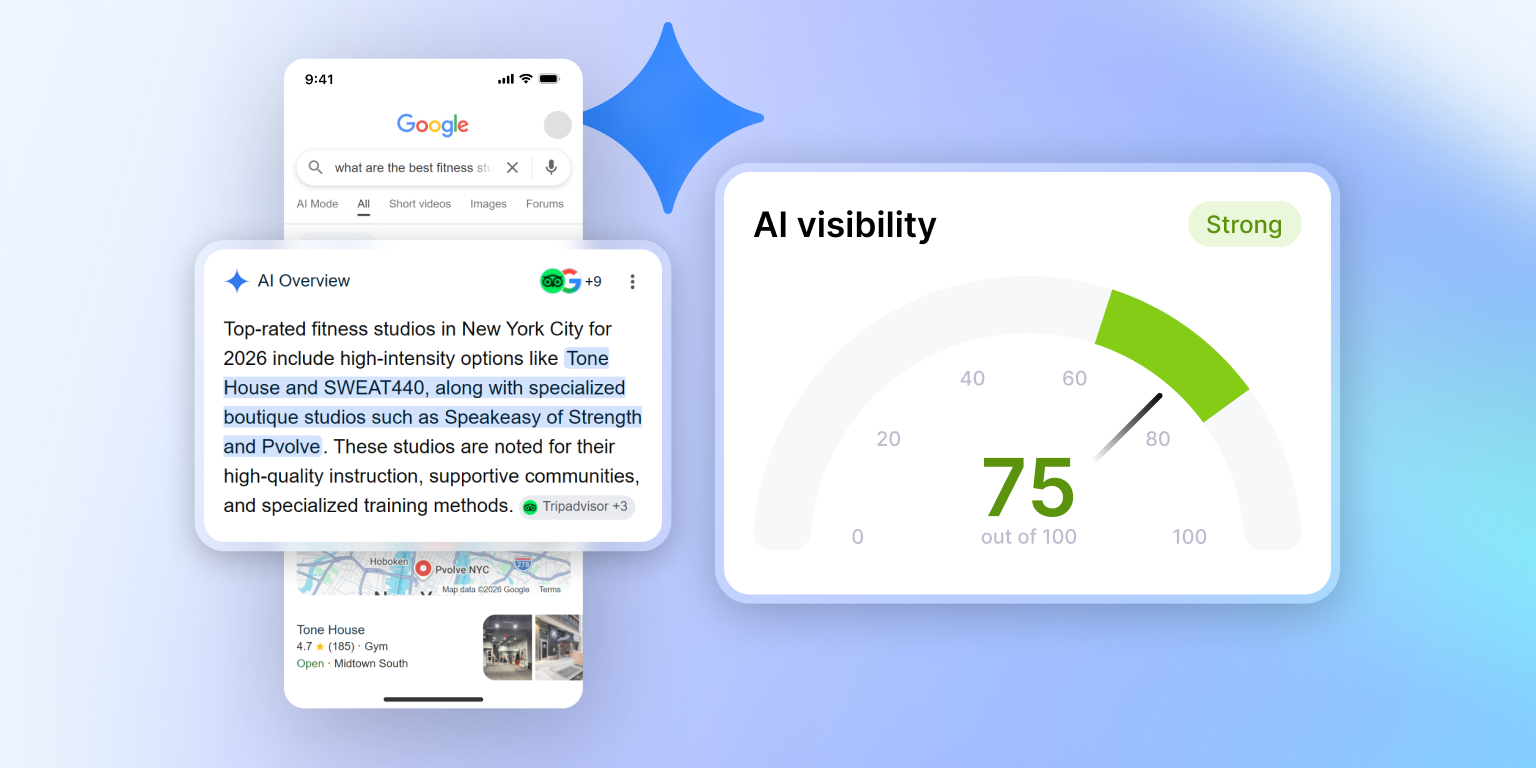
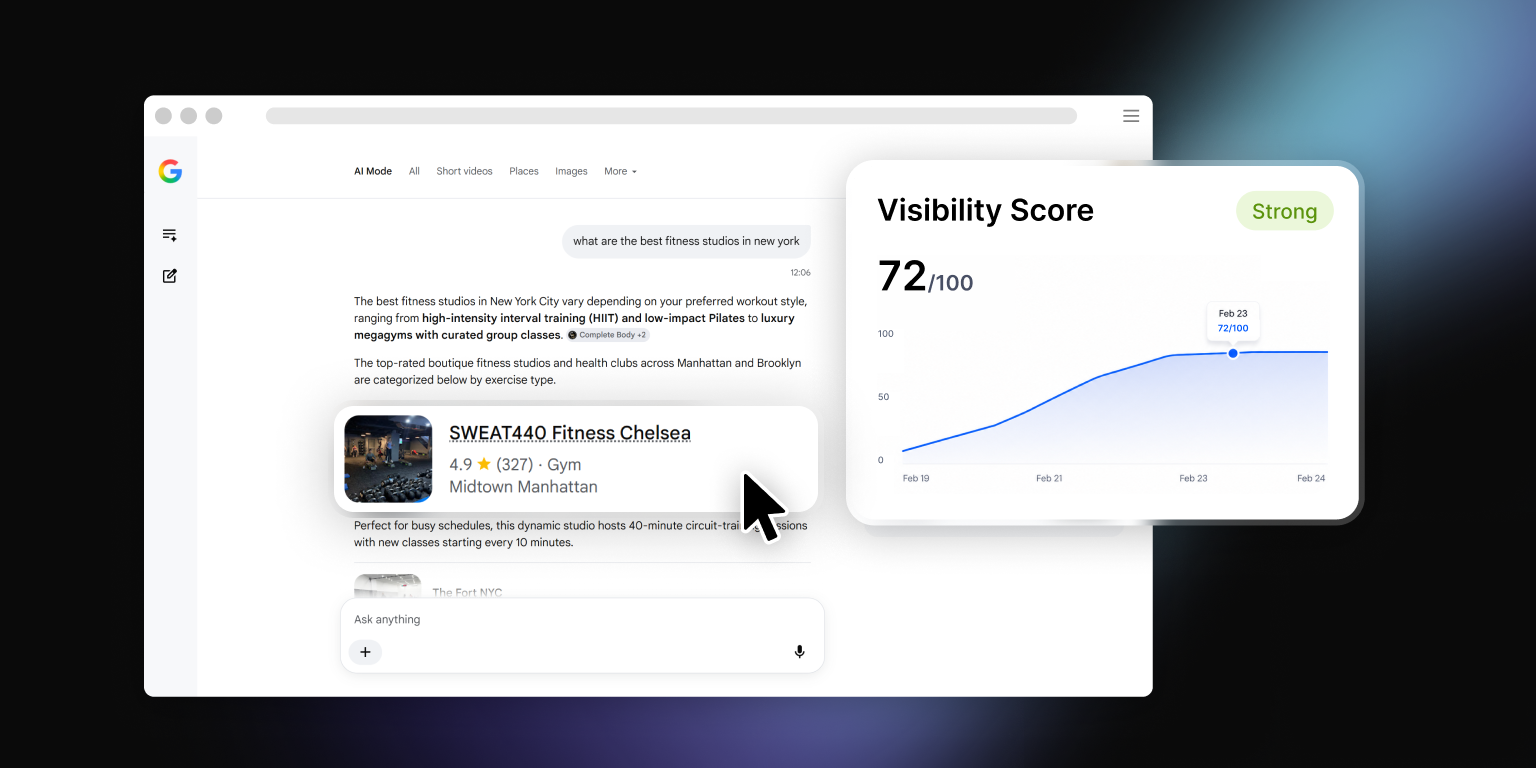
Google's AI Mode is now available in 200+ countries, citing an average of 12.6 sources per response — yet about 93% of sessions end without a click. The traffic that does come through converts far better, creating a new challenge for B2B marketers: visibility is shifting toward a system most teams can't track effectively.
This article breaks down how to track AI Mode brand visibility: how AI Mode works, how it selects sources, why it's harder to measure than other AI platforms, what tools are available, and which strategies actually deliver results.
What is AI Mode, and why you should track it
AI Mode is a user-activated, conversational interface within Google Search. Unlike AI Overviews, which appear automatically at the top of traditional search results, it requires clicking a dedicated "AI Mode" tab alongside filters like Images, Videos, and Shopping, and opens a full-page experience without traditional blue links.
Launched in March 2025, AI Mode now spans 200+ countries and serves roughly 75 million daily active users. Responses average 12.6 source citations and run approximately four times longer than AI Overviews. About 25% of users ask follow-up questions, turning single searches into multi-turn conversations.
The measurement challenge is straightforward: if your brand isn't visible in those citations, you're absent from a high-intent channel reaching tens of millions of daily users. Traditional web analytics won't show you whether AI Mode mentions your brand, cites your content, or recommends your competitors instead.
AI Mode vs. AI Overviews: Why the distinction matters for tracking
AI Overviews and AI Mode both run on Google's Gemini infrastructure, but they function very differently. AI Overviews are automatically triggered within standard search results when Google deems them useful, delivering short summaries (typically 2–5 sentences) that heavily rely on existing rankings: about 86% of their citations come from the organic top 10.
AI Mode, by contrast, is fully user-activated, and its sourcing behavior is far less tied to rankings: studies of 730,000 response pairs show just 13.7% citation overlap with AI Overviews for identical queries, even though both reach similar conclusions 86% of the time. AI Mode draws from a broader set of sources, with only 51% domain overlap — effectively expanding visibility beyond the traditional top 10.
| Dimension | AI Overviews | AI Mode |
|---|---|---|
| Trigger mechanism | Auto-generated by Google | User-activated via tab selection |
| Response length | 2–5 sentences | ~4× longer on average |
| Citation sources | ~86% from organic top 10 | ~51% domain overlap with organic top 10 |
| Citation overlap | — | Only ~13.7% overlap with AI Overviews for the same query |
| User interaction | Passive consumption | Conversational; ~25% ask follow-up questions |
Standalone Gemini (gemini.google.com) and AI Mode share the same Gemini model family and "Grounding with Google Search" infrastructure. The key difference is scope and entry point: Gemini is a general-purpose assistant (with tools such as file uploads, coding, image generation, and workspace integration), while AI Mode is embedded in Google Search as a dedicated conversational tab focused solely on search.
Although both can use real-time web grounding, they show different citation and source-selection patterns — meaning they often draw from different parts of the web despite relying on the same underlying retrieval system.
AI Mode has evolved quickly:
- Launch on Gemini 2.0 in March 2025
- Custom Gemini 2.5 upgrade by May
- Integrating Gemini 3 in November 2025
Paid users on Google AI Pro and Ultra can also access enhanced reasoning modes.
This matters for tracking because AI Mode and AI Overviews behave very differently, often surfacing entirely different sources for the same query. Treating them as a single system leads to distorted visibility and inaccurate performance measurement.
What the data reveals about AI Mode citation behavior
Multiple large-scale studies paint a detailed picture of how AI Mode selects sources.
Top domains dominate citations
Analysis of tens of millions of responses shows strong concentration: the top five domains account for 38.13% of all AI Mode citations, with 22.81% controlled by Google's own ecosystem.
Examples frequently cited:
- Wikipedia — 11.22%
- YouTube — 9.51%
- blog.google — 5.95%
- Reddit — 5.82%
- Google.com — 5.62%
Reddit's presence in AI Mode citations surged 450% in just three months (March–June 2025), reflecting both Google's partnership with Reddit and AI Mode's tendency to favor conversational, community-generated content.
Citation anatomy reveals extreme volatility
Research analyzing thousands of keywords found AI Mode shows a strong preference for non-traditional linking formats:
- 90.8% of citations appear as sidebar block links
- 8.9% are inline hyperlinks embedded directly within the response text
- 0.3% are formatted like traditional organic search results
The research also shows extreme instability: when the same query is run three times, only 9.2% of URLs repeat across all runs. Over 60% of domains and 80% of specific links change between responses — so single-snapshot measurements are unreliable.
Content format preferences
Content format plays a significant role. Listicles earn 21.9% of AI Mode citations, articles capture 16.7%, and product pages take 13.7% — together accounting for more than half of citations across large analyzed answer sets.
When researchers tested large query sets, they found that 77% of domains appeared in only one system or the other — AI Mode or AI Overviews — never both. The two systems draw from largely distinct citation universes.
Google's self-citation pattern accelerates
Longitudinal analysis tracked Google.com's share over time. By early 2026, Google's share had tripled versus mid-2025 — more than the combined share of the next six domains in some analyses. That trend reflects Google's increasing reliance on its own properties when generating AI Mode responses — meaning citation surface area outside Google's ecosystem is shrinking for brands competing for visibility.
Why tracking AI Mode is technically harder than tracking ChatGPT
Monitoring brand visibility in AI Mode presents unique challenges.
No API access
ChatGPT and Perplexity offer APIs for programmatic queries. Google AI Mode has no API. Most tracking solutions rely on browser automation — rendering full pages through headless browsers. Content loads dynamically with citations streamed after load, which is slower and more resource-intensive than API-based approaches.
Anti-scraping infrastructure
Google's anti-automation defenses are aggressive for AI Mode. Building reliable capture independently can cost thousands per month in proxies and maintenance — and page rendering changes frequently break scrapers.
Query fan-out creates blind spots
AI Mode splits user queries into many simultaneous sub-queries (and more in Deep Search), including dynamically generated queries that don't appear in classic keyword tools. No tracker fully exposes that retrieval surface — you see final answers, not the full candidate set.
Search Console doesn't isolate AI Mode
Google Search Console offers filters for AI Overviews in places, but AI Mode is generally lumped into broader web reporting — you can't isolate AI Mode impressions and clicks the same way you might want for strategy.
How to track brand visibility in AI Mode
Several platforms offer Google AI Mode tracking, though the market is still evolving.
What tracking tools can and can't do
Dedicated AI Mode tracking exists across price tiers — from accessible AI visibility tools to enterprise suites (SE Ranking, Semrush, Ahrefs, seoClarity, Scrunch AI, Profound, Otterly.AI, Peec AI, Promptmonitor, and others).
They all face the same structural constraints: no API access, anti-bot friction, and extreme citation volatility — but systematic capture at scale still beats one-off manual checks.
For tool comparisons and pricing frameworks, see Beamtrace's AI Visibility Tool Guide.
Manual tracking approach
A practical baseline:
- Build a library of 20–30 prompts mirroring real customer queries.
- Run prompts in controlled sessions (location matters).
- Record mentions, citations, and competitor presence consistently.
- Repeat weekly or bi-weekly.
Manual tracking breaks down quickly at scale — high variability means you need enough repetitions to separate signal from noise.
AI Mode traffic impact: what to measure beyond clicks
Between roughly 92–94% of AI Mode sessions may end without a click — far higher than typical AI Overview sessions — which reframes success metrics.
Users spend longer with AI Mode responses in behavioral studies versus shorter AI Overview snippets — suggesting deeper engagement even when clicks are rare.
Metrics that matter
| Metric type | Metric | Definition |
|---|---|---|
| Primary | Inclusion rate | Binary presence — does your brand appear at all? |
| Primary | Mention rate | % of tracked prompts where your brand is named |
| Primary | Citation rate | % of prompts where your URL is explicitly linked |
| Primary | Citation position | Where your link falls in the citation list |
| Primary | Share of AI voice | Your citation share vs competitors |
| Secondary | Sentiment | How AI frames your brand |
| Secondary | Source attribution | Which pages get cited most |
| Secondary | Co-citation analysis | Which competitors appear alongside you |
As practitioners sometimes summarize it: AI Mode visibility can behave like billboard SEO — presence matters even when clicks don't.
Optimizing for AI Mode citations
Optimization overlaps with AI Overviews work, but emphasis differs. Practitioner testing suggests most AI Overview optimizations help AI Mode — but not all — because sourcing patterns diverge.
Topical authority
Topical authority matters: isolated pages rarely earn citations without supporting clusters on the same topic.
Content structure and freshness
Long-form content tends to be cited more often than thin pages; strong introductions matter because models disproportionately cite early sections; freshness can materially improve citation likelihood in competitive categories.
Off-site presence as a multiplier
Earned mentions across multiple platforms correlate strongly with citation likelihood — third-party coverage often matters as much as owned pages.
For a broader optimization framework, see AI Visibility Optimization.
Conclusion
Google AI Mode is a structural shift, not an incremental AI Overview update. The systems cite different sources, serve different intents, and require different tracking approaches.
Three takeaways:
- Volatility is extreme — automated monitoring beats one-off checks.
- Measurement is immature — you'll rely on third-party capture methodologies more than first-party dashboards.
- Optimization rewards authority and depth — not just classic blue-link rankings.
Frequently asked questions
How do I track Google AI Mode rankings over time?
Use dedicated tracking tools with repeated sampling. Manual checks are unreliable because repeated runs diverge heavily.
Is AI Mode the same as AI Overviews?
No — trigger mechanics differ, and citation overlap for identical queries can be low even when conclusions match.
Can I track AI Mode in Google Search Console?
You generally can't isolate AI Mode the way teams want for attribution — treat third-party AI visibility tools as the practical measurement layer.
Does ranking #1 on Google guarantee AI Mode visibility?
No — AI Mode sourcing patterns are not equivalent to traditional organic rankings.
How long does AI Mode optimization take to show results?
Expect months, not days — especially when building topical authority clusters.
Key references
- Google AI Mode update — Google Search Blog
- Ahrefs — AI Overviews vs AI Mode — https://ahrefs.com/blog/ai-overviews-vs-ai-mode/
- SE Ranking — AI Mode research — https://seranking.com/blog/ai-mode-research/
- Semrush — AI Mode SEO impact — https://www.semrush.com/blog/google-ai-mode-seo-impact/