You've done everything right. Years of SEO work. First-page rankings. A backlink profile that would make competitors envious. Your Google Search Console shows steady traffic growth. Your keyword tracking tool confirms you're winning.
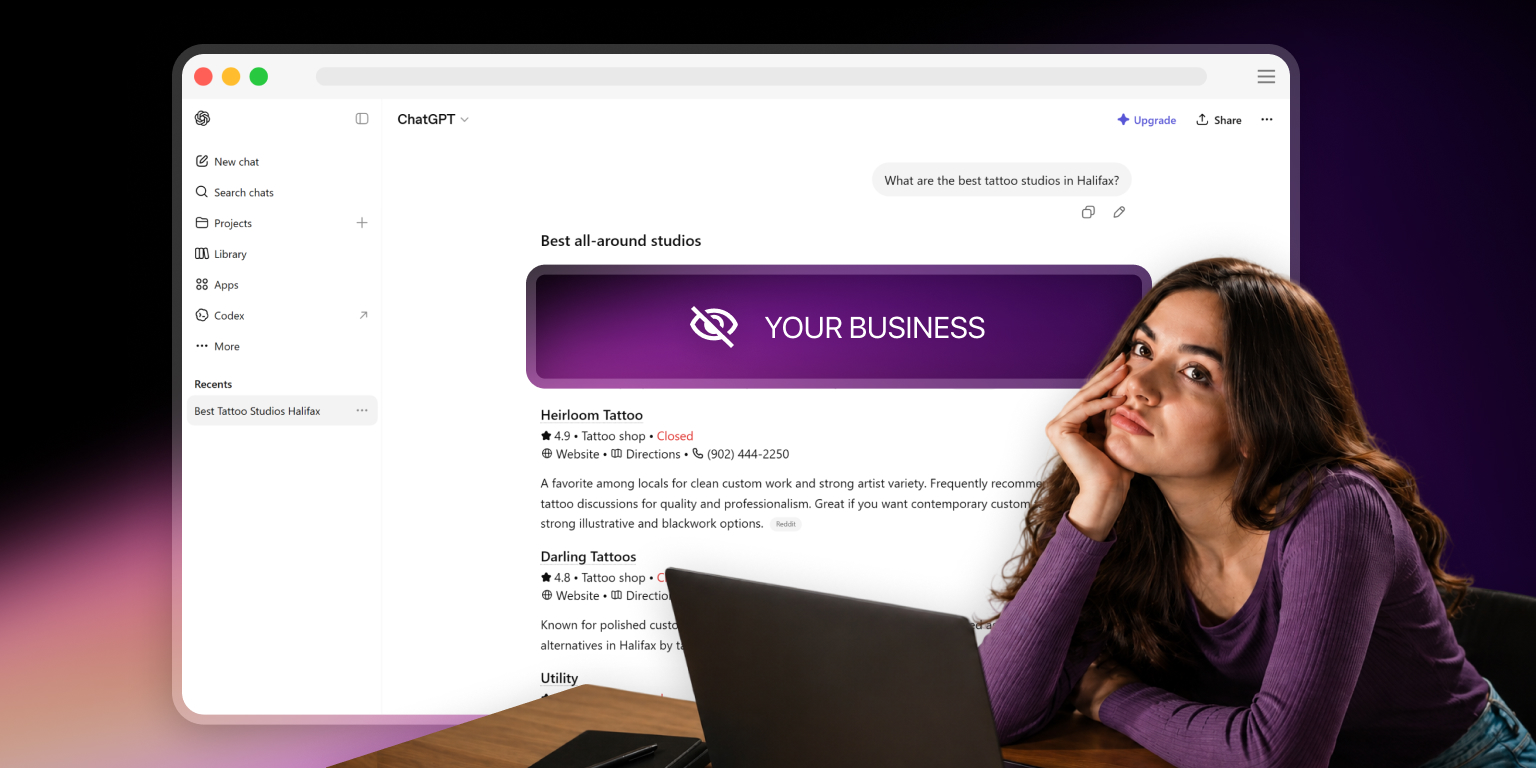
Then a potential customer mentions they asked ChatGPT for "the best [your category] tools for [their use case]" – and you weren't in the answer. They saw three competitors instead. One of them ranks #7 on Google. Another barely shows up in traditional search. Why?
This isn't a temporary glitch. It's not because ChatGPT's data is "out of date." It's because Google and ChatGPT are fundamentally different systems that evaluate authority using completely different architectures.
Understanding this gap isn't just an academic exercise. It's the difference between being visible in the fastest-growing discovery channel of the decade or being systematically bypassed as consumers shift to AI-first research.
The paradox that's breaking traditional SEO assumptions
A 2025 study by Chatoptic analyzed 15 brands across 5 categories and found something even more startling: the correlation between Google rank position and ChatGPT recommendation order was essentially zero (0.022–0.034). In statistical terms, knowing where you rank on Google tells you almost nothing about whether ChatGPT will mention you.
There's only 61-62% overlap between your Google rankings and ChatGPT's mentions of you. But wait – doesn't ChatGPT use web search? Doesn't it pull from the same internet Google indexes?
Yes. And that's exactly why this paradox is so confusing to experienced SEOs. Both systems access similar source material, yet reach radically different conclusions about which brands matter. The explanation lies in their fundamental architecture.
How Google and ChatGPT process information differently
To understand why your #1 Google ranking means nothing to ChatGPT, you need to know what each system is actually optimizing for.
Google: The link-ranking machine
Google Search operates as an index-based ranking system. According to Google's own documentation, it analyzes hundreds of billions of crawled pages and ranks results based on relevance and usefulness to a query. The core mechanisms include:
Link analysis systems and PageRank: Google evaluates backlinks to understand what pages are about and which might be most helpful. A page with 1,000 high-quality backlinks from authoritative domains signals "this content is trusted by the web."
On-page relevance evaluation: Systems like RankBrain, BERT, and neural matching interpret semantic meaning to match queries with relevant documents—even when exact keywords don't appear.
Site-wide trust signals: While Google evaluates pages individually, it also considers domain-level authority, creating a baseline trust score that influences how quickly new pages rank.
User engagement signals: Click-through rate, dwell time, and bounce rate refine which pages deserve top positions for specific queries.
The outcome? Google produces a ranked list of links (position #1, #2, #3) ordered by its confidence that each page will satisfy the user's query. Your #1 ranking is Google's verdict that, for a specific keyword, your page looks more relevant and trustworthy than alternatives.
ChatGPT: The answer synthesis engine
ChatGPT operates on a completely different paradigm. It's a generative language model that synthesizes answers rather than ranking links. The system has two knowledge layers:
1. Base model knowledge (training data)
ChatGPT's underlying GPT-4o model was trained on massive text corpora, including web pages, books, code, academic papers, and more. This creates "parametric knowledge": facts and patterns that the model absorbed during training and can recall without searching.
Current knowledge cutoffs:
- GPT-5.2: August 31, 2025
- GPT-4o: October 2023 (older versions)
Anything published after these dates doesn't exist in the base model's memory.
2. Real-time retrieval via ChatGPT Search
In October 2024, OpenAI launched ChatGPT Search – a fine-tuned version of GPT-4o that can query live web content via third-party search providers (primarily Bing) plus direct partnerships with publishers.
When you ask ChatGPT a question, it decides whether to:
- Answer purely from training data (no search triggered)
- Search the web for current information
- Combine both sources
According to Zapier's 2024 analysis of GPT-4's browsing behavior, when ChatGPT does search, it:
- Reformulates your question into precise, multi-keyword search queries
- Uses heavy recency filters (often restricting to very recent content)
- Prioritizes sources that mirror Google's E-E-A-T principles (government sites, reputable news, established brands)
- Chooses from roughly the top 20 results—not just the #1 position
The critical difference
Google is a link-ranking engine over its index. It says, "Here are the 10 most relevant pages – you choose."
ChatGPT is an answer synthesis engine. It says, "Here's what I think the answer is, based on what I know and what I found."
Even when ChatGPT uses search, it doesn't reproduce Google's ranking. It's sampling from a slice of results and deciding what to say, not who to list.
The data proves the gap is real
This isn't speculation. Multiple large-scale studies from 2025 confirm that Google rankings and AI mentions operate on separate logic.
Study 1: Only 12% of AI citations match Google's top 10
An Ahrefs analysis of ChatGPT, Gemini, Copilot, and Perplexity examined which URLs these AI systems cite. The finding: only 12% of links cited by AI assistants also appear in Google's top 10 results for the same query.
Think about what that means. If you're optimizing solely for Google rankings, you're competing for a position that matters to AI systems only 12% of the time.
Study 2: Google's AI Overviews show the opposite pattern
Interestingly, when Ahrefs analyzed Google AI Overviews (Google's own generative answer feature), they found 76.10% of cited pages do rank in Google's top 10.
This contrast is revealing: Google's AI features lean heavily on its organic ranking algorithm. But independent AI systems like ChatGPT do not.
Study 3: Position correlation is nearly zero
The Chatoptic study mentioned earlier tested whether Google ranking position predicts the order of ChatGPT recommendations. Correlation scores of 0.022–0.034 are statistically indistinguishable from random.
Translation: Ranking #1 on Google versus #7 makes no measurable difference in whether ChatGPT mentions you or where you appear in its answer.
What these patterns tell us
Combined, the research supports a conclusion that should fundamentally change how marketers think about visibility:
- Your Google ranking measures "Does Google think this page is relevant?"
- Your ChatGPT visibility measures "Does the AI model think this brand is authoritative?"
These are related questions, but they're not the same question. And increasingly, they produce different answers.
Try it on your brand
You know where you rank on Google. Now check ChatGPT.
Find out whether your Google visibility carries over to ChatGPT — without testing prompts one by one.
Add your website.
Enter your website URL.
We check ChatGPT.
Beamtrace runs your prompts and captures where you're mentioned.
See your mentions.
Frequency, context, and competitor comparison.
Why a #7 ranking can beat #1 in ChatGPT
If Google rank position doesn't predict ChatGPT mentions, what does?
Based on multiple 2025 LLM optimization studies, five factors drive ChatGPT recommendations, which differ from those that drive Google rankings:
Factor 1: Training data brand density
Because LLMs are trained on historical web snapshots, brands that appeared frequently in specific contexts during the training window have structural advantages.
If your competitors were mentioned repeatedly in:
- Editorial "best of" lists
- Industry roundups and comparisons
- YouTube video transcripts
- Q&A content on forums and Reddit
...during 2023-2025 (the primary training window for current models), they're embedded in ChatGPT's understanding of "who matters in this category."
If your brand wasn't part of those conversations during that window, ChatGPT has minimal training data about you—no matter how well you rank now.
Factor 2: Entity representation across platforms
Large-scale citation analyses reveal that AI systems heavily sample from a small set of high-signal platforms.
A 2025 study of Google AI Mode (analyzed by The Digital Bloom using Ahrefs data) found that Wikipedia, YouTube, Google properties, Reddit, and Amazon account for about 38% of all AI citations.
While this specific data is from Google's AI Mode, similar patterns appear across ChatGPT, Perplexity, and other generative engines. AI systems lean on:
- Wikipedia-style reference hubs
- Major review platforms (G2, Trustpilot, Yelp)
- Q&A communities (Reddit, Quora)
- Established publisher brands (news, industry media)
If your brand exists primarily on your own website plus a few backlinked blog posts, you're absent from the ecosystems AI systems sample most frequently.
Your #7-ranking competitor might have:
- A Wikipedia page
- 50+ reviews on G2 and Capterra
- Active Reddit discussions where users recommend them
- Coverage in 3-4 major industry publications
That cross-platform density signals authority to ChatGPT in a way your backlink profile does not.
Factor 3: Content structure and extractability
Research from Microsoft (summarized in generative engine optimization guides) found that content formatted for easy information extraction is significantly more likely to be included in AI answers.
ChatGPT doesn't need your content to be "keyword optimized." It needs clean, self-contained answer blocks. Compare these two product pages:
Page A (typical SEO page):
- Long marketing narrative about the company vision
- Feature descriptions woven into prose paragraphs
- Pricing information is scattered across multiple sections
- No clear "Who is this for?" statement until page 3
Page B (AI-extractable page):
- Clear one-sentence positioning: "[Product] is [category] for [audience]"
- FAQ section with schema markup answering "Is [Product] good for [use case]?"
- Comparison table: Page B vs Competitor X vs Competitor Y
- Structured pricing section with clear tiers
Page B is dramatically easier for ChatGPT to parse and cite, even if Page A ranks higher on Google.
A 2025 case study from Healthline demonstrated this perfectly. After reorganizing medical content to include clear symptom lists, structured treatment tables, and expert-validated definitions, they saw:
- 218% increase in AI citations across generative platforms
- 43% increase in traffic from generative search
The underlying content was largely the same. The structure changed—and AI visibility exploded.
Factor 4: Brand information consistency
AI models build internal knowledge graphs – maps connecting entities (brands, products) to attributes (features, industries, locations).
When your brand name, tagline, category description, and core benefits differ across platforms, the model's internal representation becomes fuzzy. And fuzzy entities get recommended less often.
If your competitor maintains identical information across:
- Their website
- Google Business Profile
- LinkedIn company page
- G2/Capterra profiles
- Industry directory listings
...ChatGPT builds a high-confidence entity profile. It "understands" exactly who they are and what they do.
If your descriptions vary, listed as a "Marketing Agency" on one site, "Creative Studio" on another, "Digital Services Provider" on a third, ChatGPT defaults to entities it understands with certainty.
Factor 5: Recency signals for time-sensitive queries
According to Zapier's analysis, the system uses aggressive recency filters for trend-related queries—often restricting results to content from the last week or month.
OpenAI's October 2024 announcement of ChatGPT Search explicitly positioned it as delivering "fast, timely answers with links to relevant web sources." If your content isn't clearly timestamped and regularly updated, AI systems may skip it in favor of fresher sources, even if your "evergreen" page still ranks #1 on Google.
At the same time, user behavior is shifting dramatically toward zero-click answers:
A 2025 Bain & Company study found that approximately 80% of search users rely on AI-written results for at least 40% of their searches, and about 60% of searches now end without clicking through to another site.
The implication: Even "winning" the AI answer doesn't guarantee traffic—but losing the AI answer means you're invisible to a rapidly growing segment of your market.
Real businesses where the paradox plays out
Case study: Gumlet's LLM SEO revenue transformation
Gumlet, a video hosting platform, provides the clearest example of AI visibility outperforming traditional rankings. A 2025 case study from Derivate X documented their results:
What they achieved
- Consistent ChatGPT visibility for queries like "best video hosting platforms" and "Vimeo alternatives"
- Users who discovered Gumlet via ChatGPT/Perplexity showed 2.3x higher conversion rates than traditional search visitors
- After LLM SEO optimization, ~20% of inbound revenue came from AI discovery channels
The feedback loop
- Branded search volume rose 62%
- 386 keywords improved rankings (including 127 first-page placements)
- AI visibility created momentum that strengthened Google SEO
The critical insight: Gumlet didn't necessarily outrank competitors on every Google query. But their entity clarity, structured content, and cross-platform presence made them ChatGPT's default recommendation.
Pattern analysis: Why traditional #1 rankings lost
Looking at competitors who rank well on Google but remain invisible in ChatGPT, common patterns emerge:
Missing Wikipedia presence: No Wikipedia page means missing from ChatGPT's most-trusted knowledge source (Wikipedia accounts for ~48% of ChatGPT's encyclopedic citations)
Weak review footprint: Fewer than 10 reviews across major platforms (G2, Capterra, Trustpilot) vs competitors with 50+
Inconsistent entity data: Company name appears differently across 5+ platforms
Prose-heavy content: No FAQ sections, comparison tables, or clearly extractable answer blocks
Infrequent updates: Last meaningful content update was 12+ months ago
Limited third-party mentions: Rarely cited in industry publications, "best of" lists, or community discussions
These brands invested heavily in traditional SEO – backlinks, keyword optimization, technical performance – but ignored the signals that drive AI entity recognition.
What this paradigm shift means for the future
This isn't a temporary anomaly that will resolve itself. It's the beginning of a permanent bifurcation in how digital discovery works.
Search is splitting into two channels
For the past 25 years, "search" meant Google (and maybe Bing). You optimized for one ranking algorithm and captured discovery across your market. That era is ending.
2025 consumer behavior data
- 80% of search users rely on AI summaries for at least 40% of searches (Bain)
- 59% of U.S. consumers use generative AI for shopping tasks (Omnisend)
- 57% specifically use AI for product research (Omnisend)
- 1 in 4 consumers say ChatGPT's recommendations are better than Google's (Omnisend)
Media industry adoption
- Pam Wasserstein (President, Vox Media): "ChatGPT search promises to better highlight and attribute information from trustworthy news sources, benefiting audiences while expanding the reach of publishers." (OpenAI)
- Louis Dreyfus (CEO, Le Monde): "We are convinced that AI search will be, in the near future and for next generations, a primary way to access information." (OpenAI)
Marketing professional usage
- 90% of marketers have used generative AI tools at work (AMA)
- 71% use them weekly or more
- 20% use them daily
The implications are stark: You now need dual visibility strategies—one for Google's ranking algorithm, one for AI answer synthesis.
SEO alone won't save you
Natasha Sommerfeld, partner at Bain & Company, put it bluntly in their 2025 AI search report:
"AI-generated search results are rewriting the rules, and SEO optimization is no longer enough. Brands must evolve or risk losing visibility into their customer journey, and control over their brand positioning, in a world where traditional clicks are disappearing."
Strong traditional SEO remains essential—you still need to be crawled, indexed, and trusted. But it's no longer sufficient. AI visibility additionally requires:
- Entity clarity across platforms
- Structured, extractable content
- Cross-platform brand presence
- Third-party validation and mentions
- Regular content freshness signals
The window for early advantage is closing
Right now, most of your competitors still assume Google rankings = total visibility. They're not tracking ChatGPT mentions. They're not optimizing for entity recognition. They're not building cross-platform brand density.
This won't last.
As more businesses realize that AI discovery is material to their pipelines, competition for ChatGPT visibility will intensify. The brands building entity authority now, through systematic third-party presence, structured content, and platform consistency, are establishing positions that will be increasingly difficult to displace.
The question isn't whether to adapt. It's whether you'll be early or late.
Frequently asked questions
Does ChatGPT use my Google rankings directly when deciding what to recommend?
No. ChatGPT doesn't read Google's ranking positions. Only about 12% of links cited by AI assistants also appear in Google's top 10 for the same query, and there's essentially zero correlation between where you rank on Google and where you appear in ChatGPT answers. ChatGPT may retrieve pages that rank well on Google, but it makes independent decisions about what to cite based on different signals.
Are consumers actually using ChatGPT to research products and make buying decisions?
Yes, and rapidly. About 60% of U.S. consumers now use AI tools for shopping and product research, with ChatGPT the most popular. Roughly 1 in 4 consumers say ChatGPT's recommendations are better than Google's for product research. Most significantly, about 60% of searches now end without any click-through—users get their answer directly from the AI and never visit a website. This is current behavior, not a prediction of the future.
What's the single most important thing I can do to improve ChatGPT visibility?
Build third-party brand presence. Get mentioned in industry publications, accumulate reviews on major platforms (G2, Trustpilot, Capterra), pursue Wikipedia eligibility, and participate authentically in community discussions. AI systems trust consensus—when they see your brand mentioned consistently across multiple independent sources, you become authoritative in ways your own website alone cannot achieve.
Is this Google vs ChatGPT gap permanent, or will the systems eventually align?
The gap is permanent by design. Google and ChatGPT serve different purposes: Google ranks options for users to choose from; ChatGPT synthesizes direct answers. Their core architectures—ranking algorithm versus generative language model—optimize for fundamentally different outcomes. As both systems evolve, they'll get better at their respective tasks, but the strategic reality remains: you need separate optimization approaches for two parallel discovery channels.
Final thoughts
The paradox "I rank #1 on Google, but ChatGPT doesn't know I exist" reveals something fundamental: authority is no longer singular.
Google's link-based authority and ChatGPT's entity-based authority are related but distinct. You can dominate one while being invisible in the other. This isn't a problem that can be solved by doing "more SEO." It's a strategic reorientation – understanding that search has bifurcated into two parallel discovery systems with fundamentally different logic.
The brands that recognize this early and build systematic AI visibility alongside traditional rankings will own the next era of digital discovery.
Ready to close your AI visibility gap? Start with a baseline audit: test your top 10 queries in ChatGPT and document where you appear (or don't). That single diagnostic will reveal more about your real visibility than any ranking report ever could.