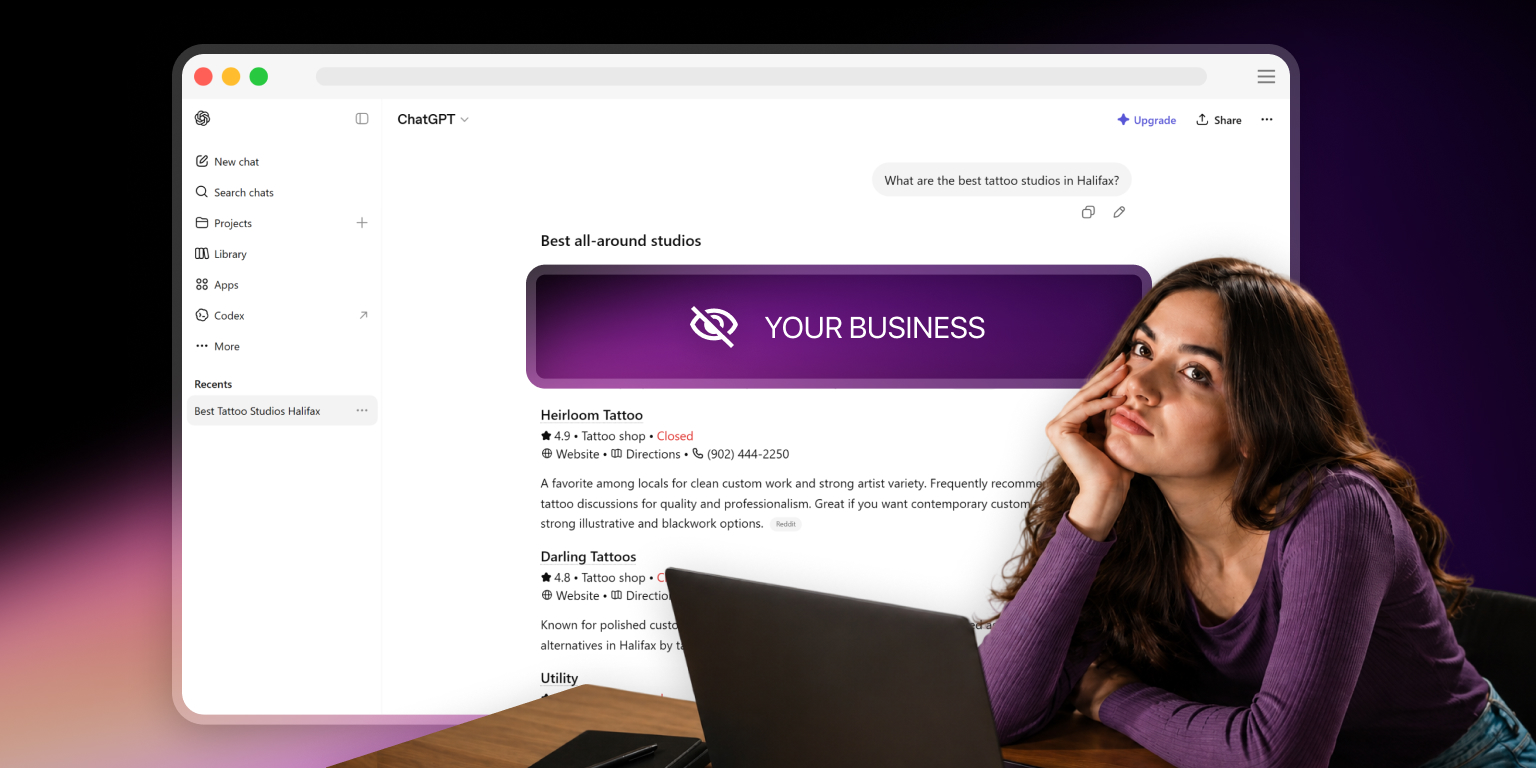
You rank #2 on Google for your target keywords. Your business has a solid reputation across multiple platforms. Yet when a potential customer asks ChatGPT for a recommendation in your category, your competitor's name comes up first — or you don't appear at all.
This isn't a glitch. Google's ranking algorithms and ChatGPT's recommendation engine operate on fundamentally different architectures, and the investments you made in keyword optimization and backlink profiles don't automatically translate to AI-powered discovery.
In this article, we'll walk through the five most common reasons ChatGPT doesn't recommend your business, how to diagnose which gaps are holding you back, and why your competitors might be showing up instead of you.
What you’ll learn:
- Page-one Google brands appear in ChatGPT only ~61–62% of the time.
- ChatGPT recommends brands primarily based on third-party consensus.
- Five common gaps determine whether AI mentions your brand.
- Visibility is earned through distributed web signals, and it can't be bought.
Google rankings don't transfer to ChatGPT
ChatGPT now processes 800 million weekly users, and nearly half of search-intent interactions bypass the traditional results page entirely. Yet there's only 61–62% overlap between your Google rankings and ChatGPT's mentions of you. That means nearly 4 out of 10 times, Google and ChatGPT completely disagree on whether your business deserves the spotlight.
You could be on page one, top three results, featured snippets — and ChatGPT might still act like you don't exist.
Why does this happen?
Google ranks websites using the link graph — backlinks, domain authority, and technical optimization. ChatGPT operates on a semantic graph: it recommends brands based on how well they fit the conceptual pattern of the user's request, drawing from training data, third-party consensus, and real-time web retrieval. Even with browsing enabled, search integration improves Google-ChatGPT alignment by only about 1%.
For a deep dive into how Google and ChatGPT process information differently at an architectural level, see our article on why Google rankings and ChatGPT visibility diverge.
Why ChatGPT doesn’t know your brand (5 common reasons)
If ChatGPT doesn't mention your company, one or more of these factors are at play. Use this as a diagnostic checklist.
1. Does your brand have enough third-party mentions?
Diagnostic test: Google your brand name: "YourBrand" -site:yourdomain.com
What to look for: How many third-party mentions appear in the first 3 pages
ChatGPT learns about you through mentions across the web, not from your own site. The model prefers third-party validation — it looks for mentions on Wikipedia, in news articles, on industry platforms, in expert roundups, and in user-generated content like reviews.
A competitor with 50 third-party mentions will likely outperform you with 100 mentions if all yours come from properties you own. ChatGPT evaluates brand authority by asking "How often does the internet independently mention this brand?" — not "How well does this brand market itself?"
Benchmark: Fewer than 10–15 third-party mentions in Google's first 3 pages = web presence gap.
2. Is your business info consistent across the web?
Diagnostic test: Check your NAP (Name, Address, Phone) across your website, Google Business Profile, Bing Places, top 3 industry directories, LinkedIn, and major review sites.
What to look for: Do any of these differ, even slightly?
When your business name, address, or phone number varies across platforms, AI systems struggle to verify you're a legitimate entity. According to Revved Digital’s research, consistent NAP directly affects inclusion in AI answers – an 85-point impact score within 65 most important factors that influence AI visibility.
What AI sees when your information is inconsistent: "Acme Software" on your website, "ACME Software Inc." on Google, "Acme (Software)" in directories, "Acme" on social. To you, obviously, the same company. To an AI trying to verify entity consistency, these may appear to be four different businesses.
Benchmark: More than 2 platforms with different NAP data = consistency gap.
3. Is your niche represented in ChatGPT's training data?
Diagnostic test: Ask ChatGPT: "What are the top 10 companies in [your exact industry niche]?"
What to look for: Does it return specific companies or vague categories? Does it include smaller specialists or only large enterprises?
Some industries are heavily represented in ChatGPT's training data. Others are sparse. If you operate in a specialized vertical with limited online discussion, Wikipedia coverage, or media attention, ChatGPT simply has less material to learn from. ChatGPT can't recommend what it hasn't synthesized.
Benchmark: ChatGPT can't name 5+ specific companies in your niche = training data gap.
4. Do your competitors have more high-authority mentions?
Diagnostic test: Compare search results:
- Your brand: "YourBrand" (review OR mentioned OR featured OR awarded)
- Competitor: "CompetitorBrand" (review OR mentioned OR featured OR awarded)
ChatGPT weighs brand mentions by source authority. One SEO analysis estimates the relative pull of different third-party signals as roughly:
| Signal Type | Weight |
|---|---|
| Authoritative list mentions (industry rankings, "best of" compilations, expert roundups) | 41% |
| Awards and official accreditations from established institutions | 18% |
| Online user reviews (customer validation) | 16% |
If your competitor has been featured in three "best in category" roundups, won an industry award, and has consistent reviews on trusted platforms, ChatGPT considers them more authoritative — regardless of your Google ranking. Entity recognition from training data also plays a major role, though it isn't cleanly quantifiable.
Benchmark: A competitor has 3× more mentions in high-authority sources = an authority gap.
5. Is your content structured so AI can actually extract it?
Diagnostic test: Open your homepage, key service pages, and top blog posts. For each, ask: Is there a clear H1 stating what you do? Do subheadings use question format? Is there a comparison table, FAQ section, or bulleted list? Can you extract a one-sentence answer to "What does this company do?" from the first paragraph?
Research shows content structure has a measurable effect on citation. In a controlled GEO experiment (Aggarwal et al., KDD 2024), adding sourced quotations was the single most effective edit — lifting a page's visibility by about 41% on a position-adjusted basis — with adding statistics (~31%) and citing sources (~27%) close behind. Separately, adding an FAQ section nearly doubles a page's chance of being cited by ChatGPT. Comparison tables and other scannable formats help too, by making it easier for a model to lift a clean snippet.
If your content is a wall of prose without structure, ChatGPT can't easily extract a citable snippet. A competitor with well-organized FAQ sections, comparison tables, and data-backed claims will get cited more often — even with shorter or less comprehensive content.
Benchmark: Zero FAQ sections, zero comparison tables, no question-based headings = structure gap.
Why ChatGPT cites your competitors (and not you)
If that competitor with the 2015-era website keeps showing up while you're invisible, it comes down to structural advantages:
They have a broader platform presence. Among ChatGPT's ten most-cited domains, Wikipedia accounts for nearly half (47.9%) — with Reddit (11.3%) and Forbes (6.8%) also ranking among the top sources. If your competitor appears across these "anchor" sources, they're effectively embedded in the AI's recommendation logic.
They've accumulated more user-generated content. Reviews, forum mentions, Reddit discussions where users genuinely recommend them — all count toward authority. ChatGPT treats user-generated mentions as credibility signals because they're harder to fake. Do not attempt to fabricate user-generated content on platforms like Reddit — moderators and AI systems detect it, and the reputation damage far outweighs any short-term gain.
Their brand messaging is clearer and more consistent. When a competitor's name, description, and core services are identical across the website, LinkedIn, and directory listings, ChatGPT builds a high-confidence entity profile. If your business is listed as a "Marketing Agency" on one site and a "Creative Studio" on another, the AI's confidence drops, and it defaults to brands it understands with certainty.
They built their presence earlier. ChatGPT strongly favors recent content: one analysis by Seer Interactive found ~89% of cited pages were published in 2023–2025 — so a competitor who invested in digital PR during that window carries lasting momentum.
How to diagnose your current ChatGPT visibility
Step 1: Manual visibility check
Open ChatGPT in incognito mode and test prompts tied to your business:
- "What are the best [product category] tools for [use case]?"
- "Who are the leading companies in [your niche]?"
- "Compare [your product] vs [competitor's product]."
Note: Does your brand appear? Is it mentioned by name? Does the AI accurately describe your services? What context surrounds the mention? Who appears instead of you?
Repeat the same prompts in Perplexity and check Google AI Overviews. Try different personas in your query ("As a small business owner..." vs. "As an enterprise marketing manager...") — context can significantly alter recommendations.
Limitation: ChatGPT's responses vary by phrasing and timing. For systematic tracking, learn how to track brand mentions in AI search.
Try it on your brand
Does ChatGPT mention your business?
Skip the manual runs. Beamtrace checks your key prompts on a schedule and tracks every mention for you.
Add your website.
Enter your website URL.
We check ChatGPT.
Beamtrace runs your prompts and captures where you're mentioned.
See your mentions.
Frequency, context, and who shows up instead of you.
Step 2: Gap identification
Use the diagnostic tests above to identify which specific gaps you have:
- Web presence gap: Fewer than 10–15 third-party mentions
- Consistency gap: NAP differs on 2+ platforms
- Training data gap: ChatGPT can't name 5+ companies in your niche
- Authority gap: Competitor has 3× more high-authority mentions
- Structure gap: Zero FAQ sections, comparison tables, or question-based headings
Step 3: Competitive benchmark
For your top 2–3 competitors, document: number of third-party mentions, platform presence (Wikipedia, major publications, Reddit), review count, NAP consistency score, and content structure score. This shows not just where you're weak, but where competitors are strong.
Step 4: Priority ranking
Rank your gaps by severity (which causes the most visibility loss), effort to fix (which can you close fastest), and competitive delta (where's the biggest difference vs. competitors). This creates your prioritized action plan.
Next steps
You now have a diagnostic and a direction. Here's the whole picture — the five gaps and the move that closes each:
| Why ChatGPT skips your business | How to spot it | How to close the gap |
|---|---|---|
| Weak third-party presence | <10–15 third-party mentions | Earn independent mentions: reviews, expert roundups, press, Wikipedia |
| Inconsistent NAP | NAP differs on 2+ platforms | Standardize your details everywhere ChatGPT can see them |
| Thin niche coverage | ChatGPT can't name 5+ specific companies in your niche | Build discussion and citations in your niche so the model has material to draw on |
| Competitors out-cited | A competitor has ~3× more mentions in high-authority sources | Get into "best of" lists, pursue accreditations, grow authoritative reviews |
| Unextractable content | Zero FAQ sections, comparison tables, or question-based headings | Add FAQs, comparison tables, question-based headings, and answer-first sections |
Every one of these gaps comes back to the same root: ChatGPT recommends the brands the independent web consistently validates, so the fix is always to give it more, clearer, better-structured evidence that you're one of them.
Frequently asked questions
How do I get ChatGPT to recommend my business?
Build third-party brand presence across platforms ChatGPT trusts, including Wikipedia, industry publications and “best of” lists, review sites (G2, Capterra, Trustpilot), and community platforms (Reddit, forums). Ensure consistent NAP across all directories. Structure your content with FAQ sections, comparison tables, and direct answers.
Does having a Wikipedia page help my ChatGPT visibility?
Yes. Wikipedia is the most trusted "truth anchor" for AI models, accounting for nearly half of ChatGPT's top-cited sources. A Wikipedia presence provides a high-confidence entity profile, often increasing recommendation frequency significantly compared to non-listed competitors.
Can I pay to be recommended by ChatGPT?
No. Unlike Google, ChatGPT has no sponsored placement in organic recommendations. Visibility must be earned through third-party mentions, NAP consistency, and structured, data-rich content. This discipline is known as Generative Engine Optimization (GEO).
Why did ChatGPT stop mentioning my business?
Usually something shifted: a competitor picked up new roundup or review coverage, your business info drifted out of sync across platforms, your content went stale relative to fresher sources, or a model update re-weighted who it considers authoritative in your category. Run the diagnostic tests above to see which gap opened up.
How long does it take to start showing up on ChatGPT?
It depends which gap you're closing. ChatGPT's real-time search layer can pick up fresh updates (content structure, third-party mentions) within days to weeks. The training-data layer is much slower — deep entity recognition compounds over time and only refreshes when a new model ships, so presence you build today mostly pays off in future model versions.