
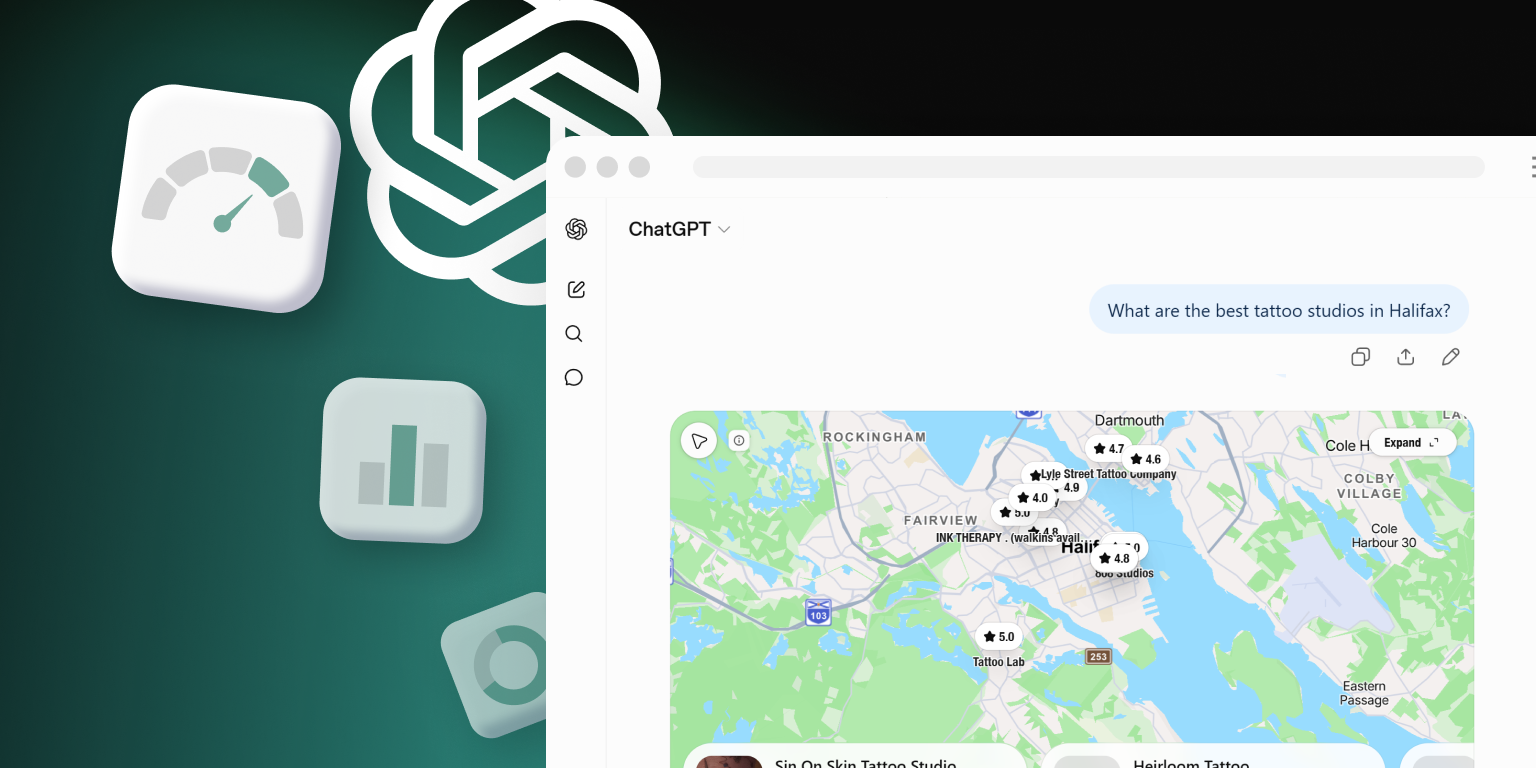
ChatGPT visibility sounds simple to measure: ask a question and check whether your brand appears.
The problem is that different tracking platforms can turn that same idea into very different metrics. One may calculate the percentage of monitored answers that mention your brand. Another may keep presence separate from position. Others emphasize competitive Share of Voice or let you segment visibility by audience, topic, or stage of the buying journey.
Before comparing visibility scores, compare how those scores are produced. A 40% visibility result in one platform may not represent exactly the same thing as 40% somewhere else.
That is the focus of this guide. Instead of comparing every GEO feature each platform offers, we looked at how six tools actually monitor brand presence in ChatGPT, what sits behind their headline metrics, how frequently answers are collected, and how much of the underlying evidence you can inspect.
Best tools for ChatGPT visibility monitoring at a glance
The six platforms below all support ChatGPT monitoring, but they do not measure visibility in exactly the same way.
| Tool | Visibility model | How ChatGPT data is collected | What stands out | Starting price |
|---|---|---|---|---|
| Beamtrace | Share of tracked prompt runs where the business appears | Customer-style prompts are sent to an AI assistant with web search enabled | Very transparent presence score connected to the exact prompts and answers behind it | $20/mo |
| Profound | Visibility Score based on how often the brand appears, alongside Share of Voice | Tracked prompts are run daily through consumer browser experiences | Browser-captured answers + real-user Prompt Volumes for choosing what to monitor | $82/mo |
| Scrunch | Brand Presence: how often the brand appears across monitored responses | Uses platform-specific methods including browser automation and official APIs | Deep segmentation by persona, funnel stage, topic, country, and branded/non-branded prompts | $250/mo |
| Peec AI | Percentage of AI responses mentioning the brand | Prompts are run daily and stored as individual chats | Explicit published formula + easy access to the responses behind the score | $80/mo |
| Otterly.AI | Brand Coverage for presence; Brand Visibility Index adds a separate position-based dimension | Tracked prompts are checked daily | Clearly separates “how often you appear” from “how prominently you appear” | $25/mo |
| AthenaHQ | Brand mentions and competitive Share of Voice across tracked prompts | Credit-based collection of AI responses | Visibility viewed heavily through competitive SoV, prompts, sources, and response analysis | Free entry plan |
Pricing and packaging change quickly, so current plan details should always be checked before purchasing.
What we compared
For this article, we did not ask which product has the longest list of GEO features.
We looked at the measurement system behind ChatGPT visibility.
Five questions mattered most:
- What counts as visibility? Is the metric simply based on whether the brand appears, or does the platform use position, competitors, Share of Voice, or another signal alongside it?
- What prompts are being measured? A visibility percentage only has meaning in relation to the questions behind it. We looked at how tools build, organize, or research their monitoring sets.
- How often are responses collected? ChatGPT can answer the same question differently on different runs, so recurring measurement matters.
- Can you verify the metric? We gave more weight to tools that let users move from an aggregate number back to the actual prompts and responses behind it.
- How does monitoring scale? Prompt limits, refresh frequency, projects, credits, and price all affect how useful a measurement model is in practice.
These differences matter when comparing the best AI tracking tools for ChatGPT visibility. Two platforms can both call something “visibility” while measuring slightly different aspects of brand presence.
How each tracker measures ChatGPT visibility
1. Beamtrace
Beamtrace publishes one of the clearest definitions of its visibility metric. Its AI Visibility Score is the share of tracked prompt runs where the AI answer mentions the business, expressed from 0 to 100. If a business appears in 8 of 20 tracked runs, its score is 40.
The measurement starts with the prompt set. Beamtrace researches the website to understand the business, category, location, and offering, then generates questions phrased more like customer recommendation requests than conventional SEO keywords. Users can add their own prompts and organize them by topic.
Each prompt is then sent to an AI assistant with web search enabled, and Beamtrace stores the answer that comes back. The first scan runs during setup; subsequent refreshes happen every three days on Starter, every two days on Growth, and daily on Premium.
How visibility is measured
Visibility = tracked prompt runs mentioning the business ÷ total tracked prompt runs.
That keeps the top-line metric intentionally narrow: it answers how consistently the business makes it into the monitored answers.
Beamtrace then keeps the surrounding diagnostics separate. If visibility changes, users can inspect which prompts moved and continue into rankings, competitors, reputation, sources, and Improvements rather than trying to make one visibility score explain everything.
What you can verify
- The tracked prompt.
- Whether the business appeared.
- The actual AI answer returned.
- Historical movement across repeated runs.
- The prompts responsible for changes in visibility.
- Competitor, reputation, source, and improvement context when deeper analysis is needed.
| Tracking setup | Best fit | Pricing |
|---|---|---|
| Automatically suggested customer-style prompts plus user-added questions; refreshed every 1–3 days depending on plan | SMBs and marketing teams that want an understandable visibility baseline with deeper analysis available when needed | From $20/mo |
The main limitation is scale: Beamtrace currently tracks one website per account, so large organizations managing many brands or properties may need a different account structure or a more enterprise-oriented platform.
2. Profound
Profound takes a more research-heavy approach to ChatGPT visibility.
Its Answer Engine Insights product describes Visibility Score as measuring how often a brand appears in AI answers, alongside Share of Voice and other performance signals. Every tracked prompt is run daily because the company explicitly accounts for answer variability between runs.
One important difference is the collection method. Profound says it captures answers directly from consumer browser experiences rather than using only API responses. That is intended to make the monitored output closer to what an ordinary ChatGPT user actually sees.
Where Profound becomes especially distinctive is prompt selection. Its Prompt Volumes product uses anonymized real-user queries licensed from double-opt-in consumer panels. Profound says it receives tens of millions of real prompts every month, while its current Prompt Tracking page describes a dataset containing more than 1.3 billion real user AI conversations.
That provides an additional question other trackers may not answer: Are the prompts we monitor similar to what people are actually asking ChatGPT?
How visibility is measured
Profound measures visibility by repeatedly running tracked prompts and analyzing how often a brand appears across the resulting AI responses. Prompts are checked daily, allowing teams to monitor changes in brand presence over time rather than relying on individual ChatGPT answers.
Visibility Score provides the top-level measure, while Visibility Rank and Share of Voice add competitive context. Profound also connects those results with citations, sentiment, and prompt-level trends to help explain changes in visibility.
What you can verify
- Daily ChatGPT responses for tracked prompts.
- Visibility Score and Visibility Rank.
- Share of Voice.
- Citation sources.
- Sentiment.
- Trends by prompt.
- Topics, regions, and audience segments.
- Real-user demand data for potential tracked prompts.
| Tracking setup | Best fit | Pricing |
|---|---|---|
| 50 ChatGPT prompts on Starter, run daily; custom, generated, or Prompt Volume-backed prompt selection | Larger teams that want ChatGPT tracking tied to evidence about real AI-query demand | $82/mo Starter, billed annually |
Profound Starter tracks ChatGPT only and includes 50 prompts. Growth expands the monitoring to three Answer Engines and 100 prompts at $399 per month billed annually.
The product makes most sense when prompt research and broader AEO workflows matter in addition to the visibility number itself.
3. Scrunch
Scrunch treats brand visibility as something that should be broken down, not just averaged.
Its Brand Presence metric measures how often the brand appears in AI responses. From there, users can segment results by persona, topic, platform, funnel stage, branded versus non-branded prompts, country, custom tags, and other dimensions.
That creates a different type of ChatGPT analysis.
Instead of only asking: How visible are we?
a team can investigate: How visible are we for enterprise buyers?
Or: What does visibility look like if we remove branded prompts?
Or: Are we appearing during consideration-stage questions but disappearing closer to purchase?
Scrunch Core currently includes 125 unique prompts, three personas, five competitors, and four AI platforms including ChatGPT.
How visibility is measured
Scrunch defines Brand Presence as how often the brand appears in collected AI responses. Competitive Presence adds a comparison against other brands, while Position, Sentiment, and Citations remain separate supporting signals.
Its data-collection approach is also worth noting. Scrunch does not use one universal method for every platform. It says collection is platform-specific and can include both browser automation and official platform APIs.
New prompts are collected daily for the first 14 days. After that, the default refresh cadence shifts to 72 hours, though prompt data can be refreshed manually.
What you can verify
- Brand Presence.
- Competitive Presence.
- Top/middle/bottom placement.
- Sentiment.
- Citations.
- Complete AI response.
- Persona and funnel-stage performance.
- Branded versus non-branded visibility.
- Historical changes.
| Tracking setup | Best fit | Pricing |
|---|---|---|
| Prompt tracking with extensive audience, intent, funnel, country, and topic segmentation | Mid-market and enterprise teams where one overall ChatGPT visibility percentage hides too much | $250/mo Core |
Core includes 125 unique prompts, one brand workspace, five user licenses, and four supported AI platforms. Enterprise expands the model set and tracking configuration.
Scrunch is therefore less compelling for a team that only needs one clean ChatGPT visibility trend, but much more interesting when visibility needs to be understood across different audiences and stages of the buying journey.
4. Peec AI
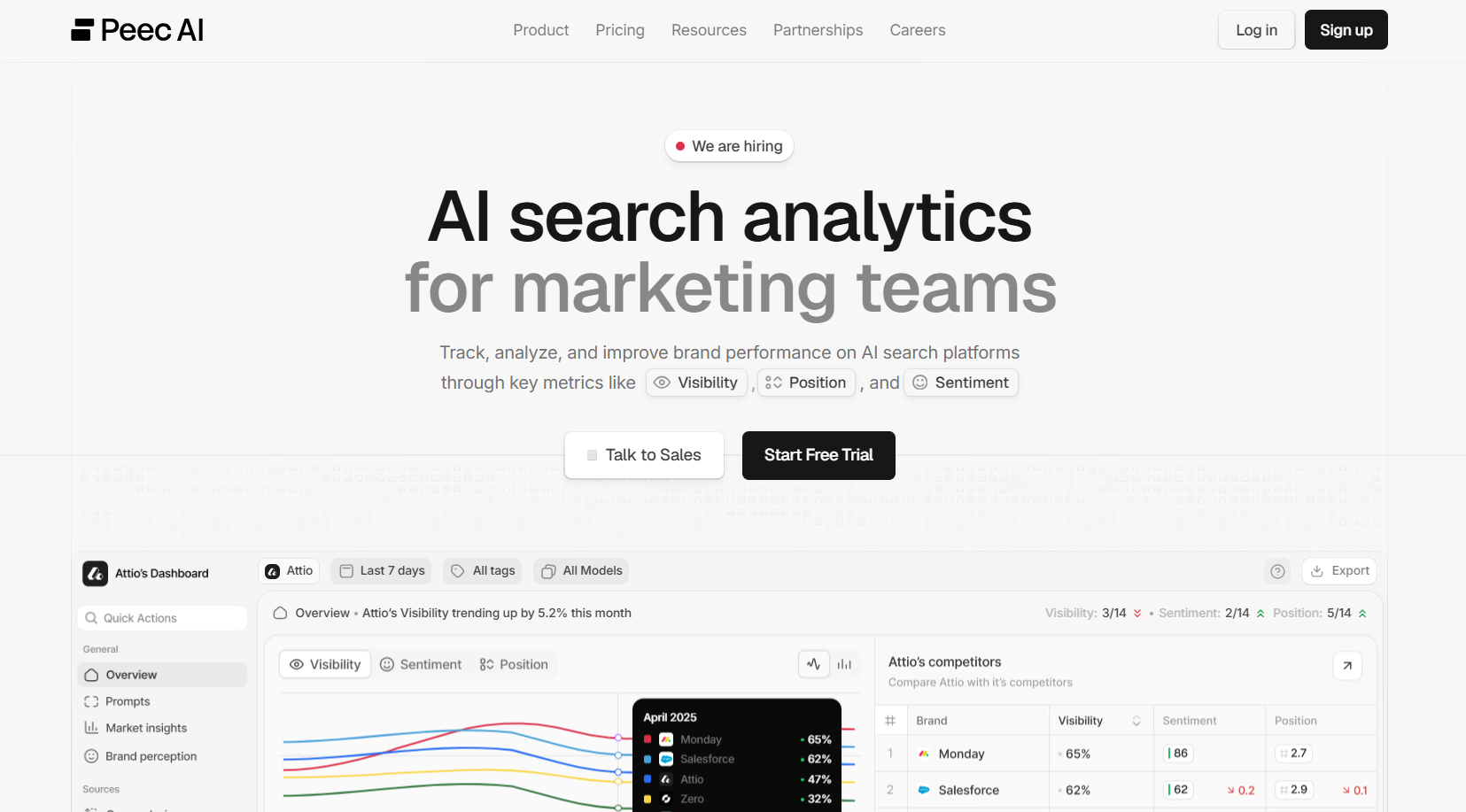
Peec AI is particularly explicit about what its Visibility Score represents.
Its formula is:
Visibility Score = responses mentioning your brand ÷ total responses × 100.
That makes interpretation straightforward.
If the brand appears in half of the ChatGPT responses included in the selected dataset, its visibility is 50%.
Peec deliberately keeps other performance dimensions separate. Position, Sentiment, and Share of Voice sit alongside Visibility rather than being blended into the same metric.
Prompts are run daily, and the individual responses form the basis for the platform's analytics. Peec's Recent Chats view lets users inspect up to 100 chats for a specific prompt, with ChatGPT-specific query fanouts also available.
How visibility is measured
Visibility = percentage of analyzed responses that mention the brand.
This is one of the easiest methodologies in the group to reproduce and understand from the published documentation.
What you can verify
- The original prompt.
- Actual AI response.
- Whether the brand appeared.
- Brand position.
- Sentiment.
- Other brands mentioned.
- Sources used.
- Recent ChatGPT query fanouts.
| Tracking setup | Best fit | Pricing |
|---|---|---|
| Daily monitoring; Starter includes 50 prompts and three selected models | Marketing teams that want a transparent percentage-based metric with detailed raw-response inspection | $80/mo Starter |
Starter includes 50 prompts, three selected models, daily tracking, unlimited users, and one project. Peec's higher plans increase prompt and project capacity, while Enterprise can use the wider model set.
For a ChatGPT-only team, that packaging may be broader than necessary because the self-serve plans are built around selecting three models.
5. Otterly.AI
Otterly is especially useful for showing why the word visibility can become ambiguous.
Its most direct presence metric is Brand Coverage: the percentage of monitored prompts in which the brand appears. Otterly publishes the formula as the number of prompts mentioning the brand divided by all prompts in the selected period.
Separately, Otterly offers its Brand Visibility Index.
This should not be interpreted as a simple one-number presence score. The index plots brands on two dimensions:
- Brand Coverage on the X-axis.
- Likelihood to Buy on the Y-axis, calculated from average position in AI answers.
That places brands into groups such as Leaders, Niche, Low Conversion, and Low Performance.
The distinction is useful because two companies can have identical Brand Coverage while appearing in very different positions when ChatGPT mentions them.
How visibility is measured
For pure presence:
Brand Coverage = prompts mentioning the brand ÷ total monitored prompts.
For the broader Brand Visibility Index, Otterly keeps coverage and position-derived commercial prominence as two separate axes rather than collapsing them into the same basic coverage percentage.
What you can verify
- Brand Coverage.
- Average Brand Position.
- Share of Voice.
- Brand Visibility Index position.
- Daily historical changes.
- Individual prompt-level results.
- Citations and broader brand-report context.
| Tracking setup | Best fit | Pricing |
|---|---|---|
| Daily tracking; Lite includes 15 prompts and ChatGPT plus three other AI search engines | Small teams that want to see both how often the brand appears and how prominently it tends to appear | $25/mo Lite |
Lite includes 15 prompts, ChatGPT, Google AI Overviews, Perplexity, Microsoft Copilot, daily tracking, and unlimited team members.
The low entry price is attractive, but 15 prompts can become restrictive if the monitoring set expands across many topics or buyer stages.
6. AthenaHQ

AthenaHQ takes a different approach again.
Its public material emphasizes brand mentions, citations, competitive Share of Voice, prompt analysis, and visibility across AI models rather than documenting a standalone proprietary ChatGPT Visibility Score formula comparable to Beamtrace or Peec.
Athena defines AI Share of Voice as the percentage of AI-generated answers that mention or cite the brand relative to competitor mentions across a relevant prompt set.
That makes its monitoring naturally more competitive.
A brand can appear frequently in ChatGPT but still have relatively weak Share of Voice if several competitors dominate the same monitored answers.
The product itself uses a credit system. Athena's current pricing page states that one credit equals one AI response. The free Essential tier includes 300 credits and supports ChatGPT alongside several other models, while Starter provides 3,600 credits per month.
How visibility is measured
AthenaHQ does not publicly document a separate ChatGPT visibility-score formula in the same way Beamtrace, Peec, or Otterly document presence calculations.
Its published measurement framework instead emphasizes:
Brand mentions + citations + relative competitive Share of Voice across tracked prompts.
That makes it more useful to think of Athena as measuring how much of the AI conversation the brand captures, rather than only asking whether it appeared.
What you can verify
- Prompt and response analysis.
- Brand mentions.
- Competitive Share of Voice.
- Citation sources.
- Competitor insights.
- Content recommendations.
- Visibility across individual supported models.
| Tracking setup | Best fit | Pricing |
|---|---|---|
| Credit-based AI response monitoring with ChatGPT included on the free tier | GEO teams that view ChatGPT visibility mainly through competitive Share of Voice and want analysis connected to optimization | Free Essential; $245/mo Starter |
Athena's free entry point is useful for testing, but the jump to the paid Starter plan is substantial if straightforward ChatGPT presence monitoring is the only requirement.
Why two ChatGPT visibility trackers can show different numbers
This is the most important thing to understand before comparing dashboards.
If one platform reports 28% visibility and another reports 44%, that does not automatically mean one of them is inaccurate.
1. They may be measuring different prompt sets
A tool dominated by branded prompts will naturally produce a different result from one focused on non-branded discovery questions.
The same applies to customer stage. Questions like:
What does Brand X offer?
and:
What are the best tools for solving Y?
measure very different kinds of visibility.
So when evaluating the best tools to track brand visibility in ChatGPT, inspect the prompt universe before comparing percentages.
2. “Visibility” does not have one universal formula
Beamtrace and Peec publish simple presence-based formulas.
Otterly calls that basic presence metric Brand Coverage, then adds its separate two-dimensional Brand Visibility Index.
AthenaHQ places heavier emphasis on competitive Share of Voice.
Profound publicly describes Visibility Score in terms of how often the brand appears, while also reporting Rank and Share of Voice around that visibility.
All of these approaches can be useful. They simply answer slightly different questions.
3. ChatGPT itself varies between runs
Running the same prompt again can produce a different answer, different ordering, or a different set of brands.
That is why recurring monitoring matters more than a single manual check. Profound explicitly runs tracked prompts daily because answer engines do not reliably return identical responses, while Beamtrace similarly recommends evaluating trends over multiple runs rather than reacting to small short-term movements.
4. Collection methods can differ
Profound says it captures results from consumer browser experiences rather than relying only on APIs.
Scrunch uses a platform-specific mix that can include both browser automation and official APIs.
That means the data-generation process itself can differ between products.
The important question is not necessarily whether one collection method is universally “better,” but whether you understand what experience the tool is measuring.
What to compare first
When evaluating the best tools for monitoring ChatGPT visibility, compare the prompt set, visibility definition, response-collection method, and refresh cadence before comparing the headline numbers.
Try it on your brand
How visible is your brand in ChatGPT?
See how often your business appears in relevant ChatGPT answers and track whether that visibility is changing over time.
Add your website.
Enter your website URL.
We check ChatGPT.
Beamtrace runs prompts and records where your business appears.
See your visibility.
Review your score, trend, underlying answers, and the gaps worth investigating.
Which ChatGPT measurement approach fits your team?
The best ChatGPT visibility tracker is ultimately the one whose measurement model matches the question your team actually wants answered.
“How often does ChatGPT include our brand?”
Beamtrace and Peec AI are particularly easy to interpret because both publish straightforward presence-based formulas.
Beamtrace is a strong fit when the visibility score is only the starting point with deeper analysis of competitors, rankings, citations, reputation, and improvement workflow. Peec provides a larger daily prompt allowance and more multi-model capacity out of the box.
“Are we monitoring the right questions?”
Profound stands out here because Prompt Volumes adds real-user query data to the prompt-selection process.
That becomes especially useful when choosing the monitoring set is itself a research problem rather than a simple configuration step.
“How does visibility change by audience or buying stage?”
Scrunch offers the most distinctive workflow for this question.
Persona, funnel-stage, topic, country, and branded/non-branded filters make it possible to see whether a healthy aggregate number is hiding weaker visibility for a specific segment.
“Do we appear often, and are we prominent when we do?”
Otterly.AI makes this distinction explicit by separating Brand Coverage from its position-based Visibility Index dimensions.
“How much of the ChatGPT conversation do we own versus competitors?”
AthenaHQ puts competitive Share of Voice at the center of its measurement approach.
There is no single correct model for every use case. The important thing is to understand what each metric represents and whether it matches what your team actually wants to monitor.
This comparison was prepared by the Beamtrace team, and Beamtrace is one of the products included. We aimed to make the listing as objective as possible by relying on each platform’s published methodology and highlighting both strengths and meaningful limitations.
We hope this gives you a balanced starting point for choosing the approach that best fits your workflow, goals, and budget.