
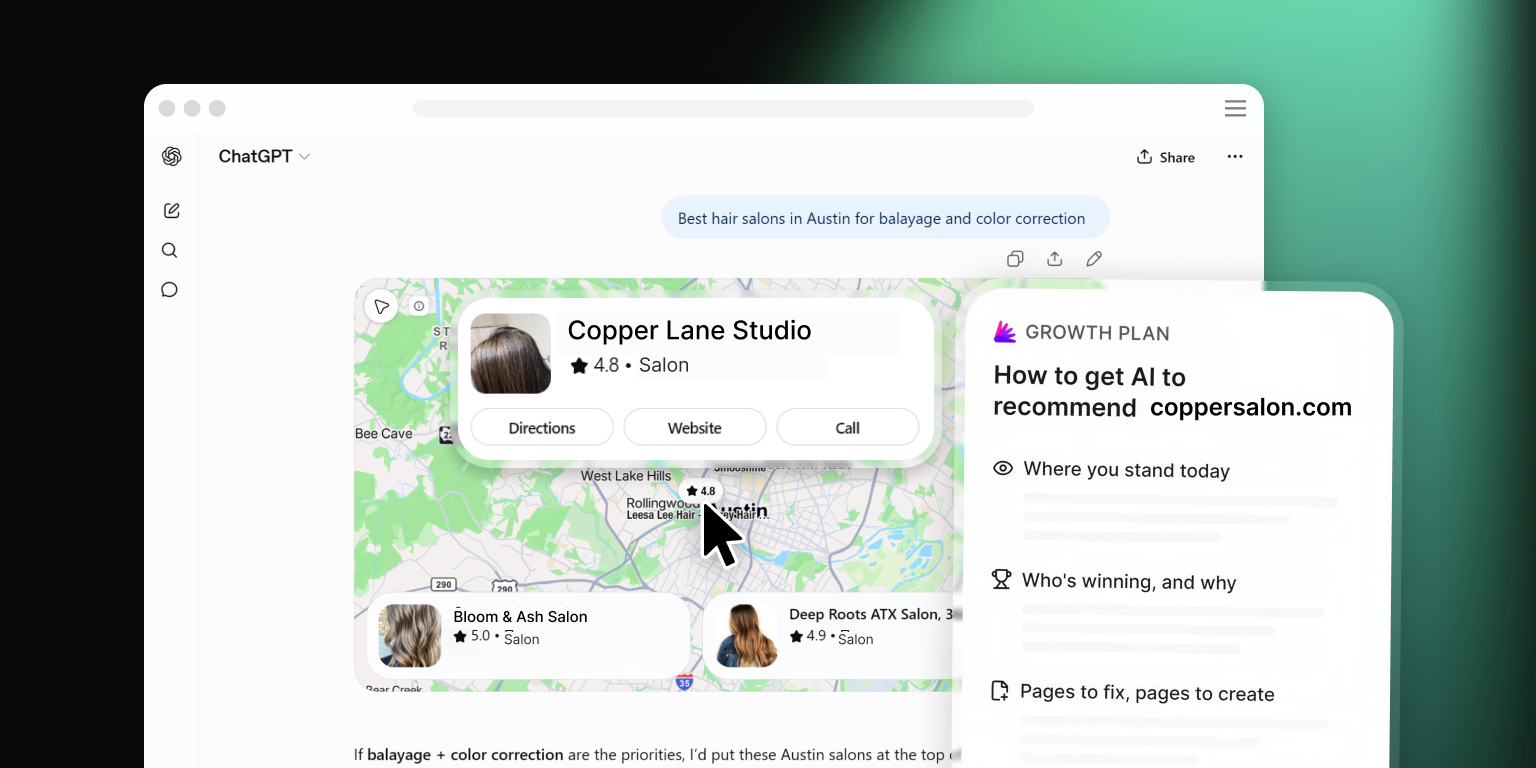
Most AI search tools can tell you that your brand is missing from ChatGPT. That is useful, but it is not optimization.
The harder question comes next: What should you actually change? Maybe important pages are inaccessible to OpenAI crawlers. Maybe your website does not clearly explain a product or service. Perhaps competitors cover a topic you barely mention, or third-party sources consistently reinforce their positioning instead of yours.
The tools in this comparison approach those problems very differently.
A useful ChatGPT optimization tool should shorten the distance between finding a visibility problem and making a change that could address it. Some stop at diagnosis. Others prioritize fixes, rewrite content, handle technical changes, or publish updates directly.
For this guide, we focused on that distance from gap to fix rather than comparing platforms by how many dashboards or AI models they support.
Best ChatGPT optimization tools at a glance
| Tool | Where optimization starts | What it helps change | How far the workflow goes | Starting price |
|---|---|---|---|---|
| Beamtrace | Website audit + current ChatGPT performance | Technical accessibility, content, positioning, structure, topic gaps, citations | Finding → prioritized Action → implementation guidance → measurement | $20/mo annually |
| HubSpot AEO | Visibility, prompts, competitors, and citation gaps | New or updated content, technical gaps, third-party opportunities | Gap → prioritized recommendation → execution through HubSpot tools → tracking | $45/mo annually |
| Writesonic | AI visibility + site/content audit | Technical issues, on-page content, external mentions, citations | Audit → prioritized actions → AI-assisted execution → measurement | $79/mo annually |
| Profound | Answer-engine data + page performance | Page structure, content, schema, answerability, content gaps | Benchmark → score → diagnose → optimize → CMS workflow | $99/mo annually |
| Scrunch | Page-level AI-agent diagnostics | Retrievability, citability, technical blockers, page content | Diagnose → prioritize → optimize page → optionally deliver AI-specific experience | $250/mo |
| AthenaHQ | Visibility, competitors, citations, and content gaps | On-page content, off-page authority, sources, competitive gaps | Insights → actions → optimization agent → continued measurement | Free; Starter: $245/mo annually |
| Semrush AI Visibility | Prompt, competitor, source, and AI-readiness research | Content opportunities, crawlability, SEO/AEO gaps | Research → prioritize → execute through wider SEO/content stack → measure | $99/mo per domain annually |
Pricing and packaging change quickly, so check current plan details before purchasing.
What counts as a ChatGPT optimization tool?
This sounds obvious, but the category has become unusually broad.
A ChatGPT visibility tracker primarily tells you what happened: your brand appeared, disappeared, moved, gained Share of Voice, or lost citations.
A ChatGPT optimization tool should help answer the next question: What should we change because of that information?
That change can happen in several places.
Technical optimization can involve crawler access, robots.txt, rendering, structured data, page accessibility, and other conditions affecting whether ChatGPT can retrieve or interpret your content.
Content optimization deals with how clearly pages explain products, services, entities, use cases, customer questions, and relevant topics.
Citation and authority optimization looks beyond your own site to understand which third-party sources influence ChatGPT and where your brand lacks supporting authority.
Competitive optimization starts with prompts where another brand consistently wins and works backward to identify the content, positioning, sources, or coverage behind the difference.
Some platforms address only one of these. Others try to connect several into a single workflow. That is the distinction we used when comparing the best answer engine optimization tools for ChatGPT.
How we evaluated the tools
Instead of counting features, we looked at five stages of the optimization process.
1. Diagnose
Can the platform identify a specific reason your current ChatGPT performance may be weak? A generic “visibility is low” message received little weight. Page-level problems, content gaps, inaccessible pages, competitor gaps, and missing sources are more useful.
2. Prioritize
A website can easily have dozens or hundreds of potential improvements. We favored tools that help distinguish high-impact work from changes that can wait.
3. Recommend
Does the platform tell you what to change, rather than simply identifying what is wrong? Specific page, content, technical, citation, or structural recommendations are more useful than generic GEO checklists.
4. Execute
Can the tool help produce the content, apply a fix, publish an update, create a ticket, or otherwise move the recommendation closer to completion? Not every team needs automation, but execution depth is an important difference between products in this category.
5. Measure
Once the change is live, can you connect it back to ChatGPT visibility, mentions, rankings, citations, or other monitored outcomes?
Optimization is difficult to manage if diagnosis and measurement live in completely separate systems. With those criteria in mind, here is how the seven platforms compare.
Best ChatGPT optimization tools comparison
1. Beamtrace
Beamtrace approaches optimization by starting with the business itself rather than generating a universal GEO checklist.
Its optimization workflow analyzes website content, technical setup, structure, and current AI visibility to identify issues that may be limiting how a business is understood or surfaced. Those findings become individual Actions, ranked so teams can work through higher-impact problems first.
For ChatGPT specifically, this can include technical considerations such as crawler access and website accessibility as well as content problems: unclear positioning, thin product or service information, missing customer questions, weak topic coverage, or poorly structured pages. The emphasis is on converting the audit into work.
What Beamtrace helps you change
Depending on what the audit finds, optimization workflow can surface opportunities around:
- Website and page accessibility.
- Technical and crawler-related issues.
- Titles, headings, and page structure.
- Homepage and landing-page positioning.
- Product and service descriptions.
- Topic and use-case coverage.
- FAQs and customer questions.
- Structured data and machine-readable business information.
- Wider visibility gaps that appear across monitored ChatGPT prompts.
Each recommendation becomes an Action rather than remaining inside an audit report. The action plan ranks issues by expected impact, explains the change, and lets users mark work complete and monitor subsequent visibility movement.
How far does it take the fix?
Audit → Identify issue → Prioritize Action→ Recommend → Help implement → Measure
That is the main reason Beamtrace fits this comparison better than a pure tracker. Visibility, rankings, competitors, citations, and reputation provide diagnostic context, while Optimization and Action Plan turn that information into changes to work through.
| Best for | Pricing | Main trade-off |
|---|---|---|
| Small businesses, startups, and lean marketing teams that want a focused ChatGPT optimization workflow rather than a large enterprise AEO stack | From $20/mo annually; 14-day trial, no card | Less suited to very large multi-site or enterprise content operations |
2. HubSpot AEO
HubSpot AEO is one of the clearest examples of why this category is moving beyond monitoring.
The standalone product tracks ChatGPT, Gemini, and Perplexity, but its workflow does not stop at visibility scores, prompts, competitor Share of Voice, and citations. HubSpot converts those inputs into prioritized recommendations.
Those recommendations can tell a team to create a new page, update existing content, fix a technical gap, publish a video, or pursue a third-party source. HubSpot also explains why the recommendation was generated rather than simply adding another task to a list.
What HubSpot AEO helps you change
The recommendations can surface opportunities around:
- Missing or weak content.
- Existing pages that need updating.
- Citation gaps.
- Third-party websites worth pursuing.
- Technical issues.
- Content formats missing from the current strategy.
- Prompts where competitors have stronger presence.
HubSpot's citation analysis is especially relevant to optimization because recommendations are generated partly from the patterns across sources appearing for tracked prompts.
How far does the workflow go?
For the standalone AEO product:
Monitor → identify gap → prioritize recommendation → create/update content → track impact
HubSpot AEO can generate blog posts from identified gaps, and it continues monitoring brand mentions, visibility, and citation patterns afterward. Marketing Hub Professional and Enterprise take execution further by connecting AEO recommendations with HubSpot's existing content and social tools.
| Best for | Pricing | Main trade-off |
|---|---|---|
| Marketing teams that want straightforward AEO recommendations, particularly those already working in HubSpot | $45/mo billed annually | Standalone AEO is lighter than enterprise optimization platforms; deeper execution benefits from the broader HubSpot ecosystem |
3. Writesonic
Writesonic approaches optimization through a much larger SEO and AI-search stack.
Its Action Center organizes optimization opportunities into three broad areas: technical issues, external mentions, and content visibility. Individual actions receive impact and effort signals so teams can prioritize work rather than treating every GEO recommendation equally.
This gives Writesonic unusually broad optimization coverage. One recommendation might involve repairing a technical barrier. Another could suggest creating content around a citation opportunity or pursuing an external mention from a community or publication.
What Writesonic helps you change
Its current optimization workflows cover areas such as:
- AI crawler accessibility.
- Broken or non-indexable pages.
- Site-audit issues.
- Missing content topics.
- Content inspired by sources already winning AI citations.
- On-page optimization.
- External mention opportunities.
- Community and third-party authority.
- AI-focused content creation.
Writesonic also combines these workflows with a site audit and its SEO/content agents, so some changes can move directly into AI-assisted execution.
How far does the workflow go?
Audit → prioritize → guide/generate fix → execute → measure
There is an important packaging caveat: the full Action Center is not included in the lower plans. Writesonic's public pricing shows Starter at $79 per month annually, while broader Action Center functionality is reserved for higher/Enterprise access. Lower plans still include content creation and site-audit capabilities.
| Best for | Pricing | Main trade-off |
|---|---|---|
| Growth and SEO teams that want AI visibility, content, site audits, and GEO execution inside one larger platform | From $79/mo annually; full Action Center requires higher-tier/Enterprise access | Powerful breadth creates more complexity, and the most complete optimization workflow is not available at the entry price |
Try it on your website
What's holding your brand back in ChatGPT?
Find technical and content issues that may be limiting your performance and get a prioritized plan showing what to fix first.
Add your website.
Enter your domain and establish your current ChatGPT baseline.
We analyze the gaps.
Beamtrace reviews your website and current AI performance to identify potential issues.
Get prioritized Actions.
See what to change, why it matters, and which improvements deserve attention first.
4. Profound
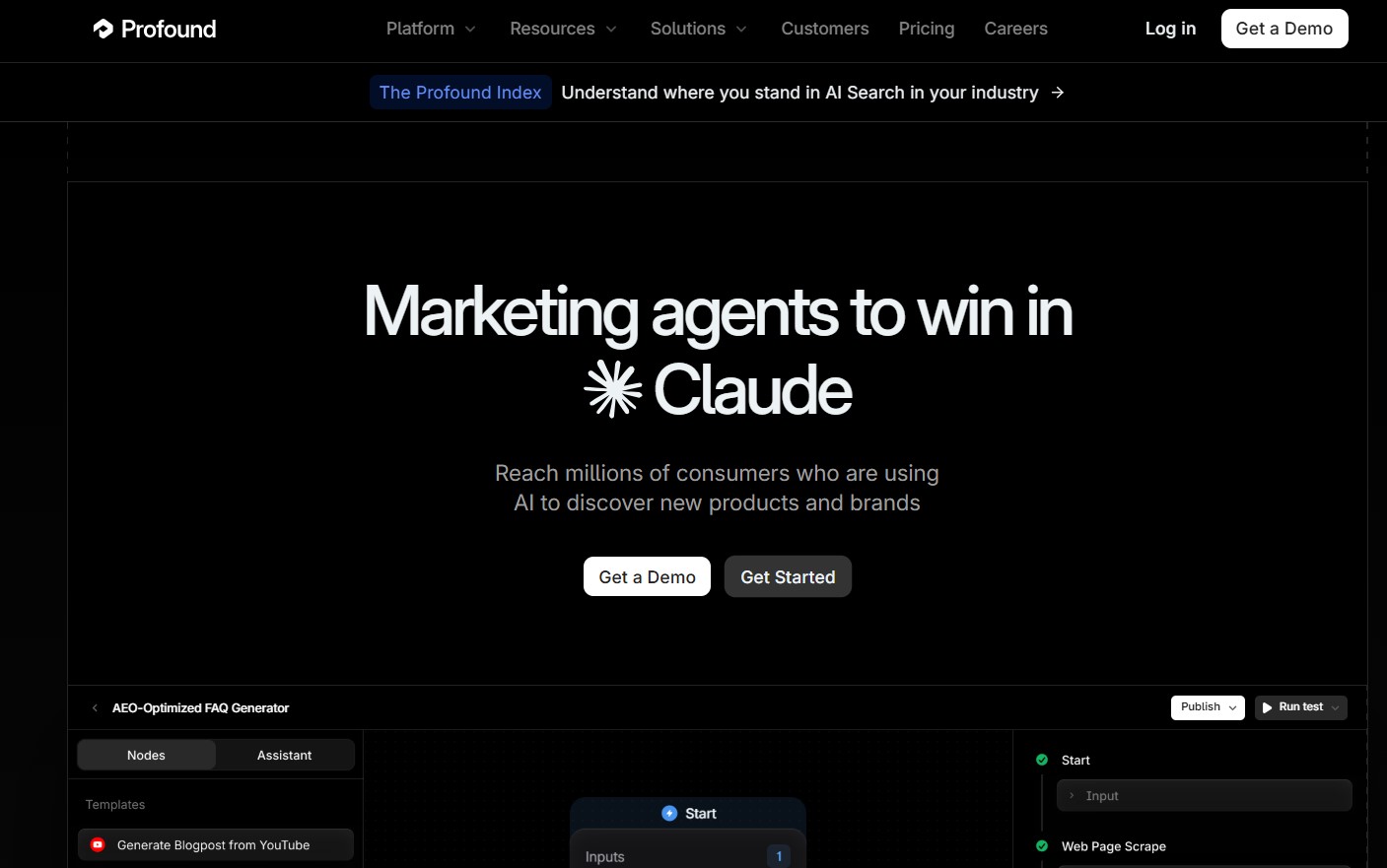
Profound is often discussed as an AI visibility platform, but its 2026 product has moved significantly further into optimization.
Its Content Optimization system benchmarks a page against content already being cited by answer engines, scores its AEO readiness, diagnoses structural and technical gaps, and produces specific recommendations. Profound describes the workflow directly as Benchmark → Score → Diagnose → Prioritize → Fix.
That makes Profound a much stronger fit for this comparison than a monitoring-only tool.
What Profound helps you change
Its AEO Content Scorecard can evaluate:
- Page structure.
- Relevance and answerability.
- Content clarity.
- Schema and technical improvements.
- Weak or missing sections.
- Content needing a refresh.
- Differences from highly cited competitors.
The recommendations can then feed into Profound Agents, which can rewrite or generate content, validate the result against the scorecard, and connect the workflow to a CMS.
Profound can also ground optimization in live Answer Engine Insights, meaning page recommendations can incorporate actual citation and AI-search performance rather than operating as an isolated content score.
How far does the workflow go?
Benchmark → diagnose → prioritize → generate/refresh → publish → repeat
Agents are designed to automate the AEO cycle from visibility data through optimized content and CMS publishing. Recurring workflows can also revisit content later as performance changes.
| Best for | Pricing | Main trade-off |
|---|---|---|
| Enterprise and advanced content teams that want optimization grounded in large-scale answer-engine intelligence | $99/mo annually Starter; $399/mo annually Growth | The strongest value appears when teams use Profound's wider AEO data and Agents ecosystem, making it heavier than necessary for a small website |
5. Scrunch
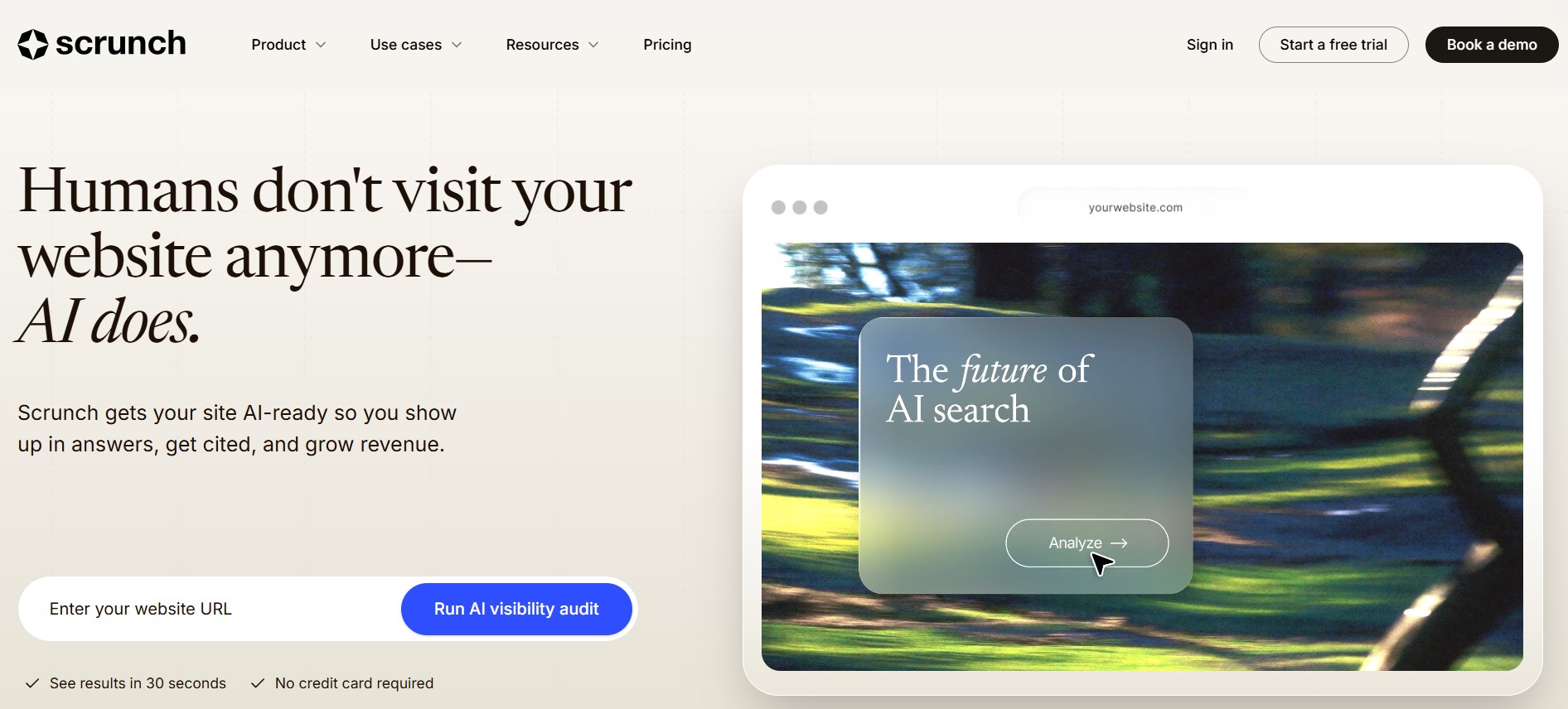
Scrunch approaches the problem through the eyes of the AI agent consuming the website.
Its Site Diagnostics product maps individual pages, measures agent traffic and citations, identifies blockers, and recommends which pages should be improved first. Scrunch frames the central problem as retrievability and citability rather than simply content quality.
That makes it particularly relevant for technically complex websites where the issue is not just what the copy says, but whether AI agents can efficiently retrieve and interpret it.
What Scrunch helps you change
Site Diagnostics can identify and prioritize:
- Pages with weak AI accessibility.
- Technical blockers.
- Poor retrievability.
- Weak citability.
- Page-level content gaps.
- Pages receiving agent traffic but failing to earn citations.
- Opportunities to add specific sections or comparisons.
For example, Scrunch can recommend adding a comparative-analysis section to an individual page based on the site's current AI-search performance.
Its Enterprise Agent Experience Platform goes further by allowing organizations to deploy an optimized content experience specifically for AI agents rather than relying entirely on the human-facing version of the site.
How far does the workflow go?
Map page → diagnose blocker → recommend fix → optimize/deliver → track citations and presence
The Core plan already includes five site audits per month, one page optimization per month, basic content generation, and AI-search monitoring.
| Best for | Pricing | Main trade-off |
|---|---|---|
| Larger and technically complex sites where AI-agent access, page retrievability, and citability are major concerns | $250/mo Core | More technical and enterprise-oriented than most SMBs need; AXP is Enterprise-only |
6. AthenaHQ
AthenaHQ combines monitoring with a fairly explicit execution layer.
Its current Starter plan includes on-page and off-page actions, a content optimization agent, and self-learning content improvement, alongside source and competitor analysis. Even its free Essential tier includes content recommendations and the Athena AI agent.
That gives Athena a useful place in this comparison because it treats optimization as broader than rewriting owned content.
What AthenaHQ helps you change
Its workflow can connect AI-search findings to:
- On-page content improvements.
- Off-page actions.
- Content gaps.
- Citation opportunities.
- Competitor weaknesses.
- Source strategy.
- New or updated content.
- Repeated optimization through its content agent.
Athena's source and competitor data helps inform those recommendations, so teams can work from the reasons another brand is appearing rather than applying generic GEO advice.
How far does the workflow go?
Track → identify opportunity → recommend action → optimize content/on-page/off-page → continue learning
Athena therefore sits somewhere between a monitoring suite and an agent-led optimization system.
| Best for | Pricing | Main trade-off |
|---|---|---|
| GEO teams that want visibility, sources, competitors, on-page actions, and off-page optimization in one environment | Free Essential; Starter about $245/mo annually | Paid entry becomes expensive quickly compared with SMB-oriented tools, and the platform is designed around broader multi-engine GEO rather than ChatGPT alone |
7. Semrush AI Visibility
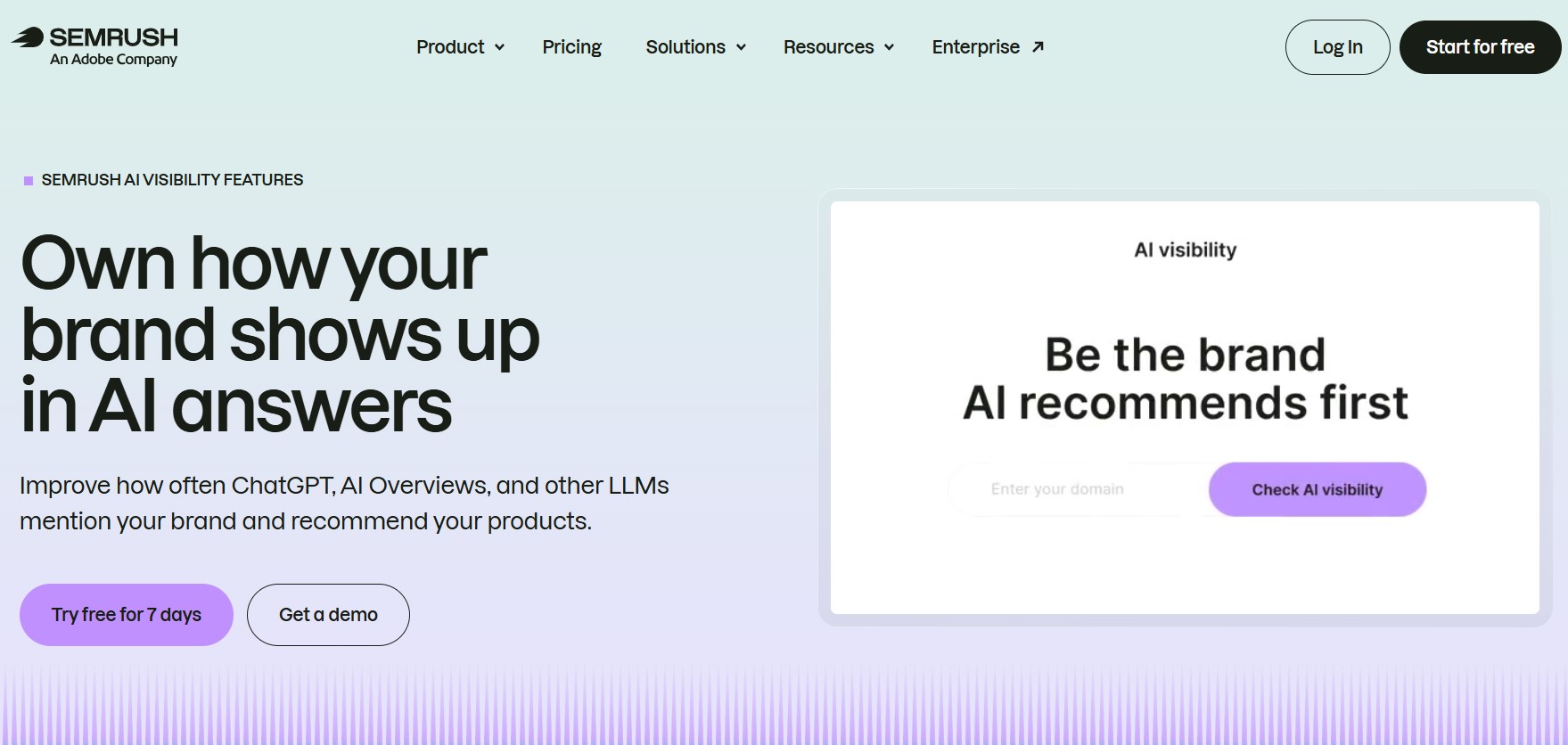
Semrush is the least execution-focused platform in this group, but it still belongs because its diagnosis can feed directly into an established SEO workflow.
The standalone AI Visibility Base plan includes AI competitor analysis, Prompt Research, 25 custom daily prompts, and an AI-ready Site Audit. These tools help teams identify where the site, topics, competitors, and prompt coverage create optimization opportunities.
The real advantage appears when that AI-search data is combined with the rest of the Semrush ecosystem.
What Semrush helps you change
The AI Visibility workflow can help expose:
- Weak or missing prompts.
- Competitor advantages.
- Topics where the brand lacks coverage.
- Sources influencing AI answers.
- AI-readiness issues.
- Technical crawlability problems.
- Content opportunities that overlap with SEO.
Teams already using Semrush can then continue into site auditing, keyword research, competitor research, backlinks, and content workflows rather than treating ChatGPT optimization as a completely separate marketing program.
How far does the workflow go?
Research → diagnose → prioritize → move into SEO/content tools → measure
This is less of an automatic “fix it for me” model than Profound, AthenaHQ, or Writesonic. Its strength is connecting new AI-search problems with an established body of SEO data.
| Best for | Pricing | Main trade-off |
|---|---|---|
| SEO teams that want ChatGPT/AEO optimization to become part of their existing search workflow | $99/mo per domain billed annually | The standalone AI Visibility Toolkit is stronger at identifying opportunities than implementing them |
For teams comparing the best AI tools for Google and ChatGPT optimization, that overlap can be more valuable than a completely separate GEO stack.
ChatGPT Optimization Tips from the Beamtrace Team
ChatGPT optimization works best when you diagnose the bottleneck first. Instead of changing dozens of pages at once, identify which layer is most likely limiting your visibility and start there.
🛠️ 1. Start with technical access
Check: crawler restrictions, robots.txt, rendering, site architecture, structured data.
If ChatGPT cannot reliably access or process important pages, improving the copy on those pages may have limited effect. This is why the best optimization tools for ranking in ChatGPT should help you identify technical barriers as well as content opportunities.
🧩 2. Make your offer easy to understand
Check: products and services, target audiences, use cases, pricing, FAQs, comparisons, locations, and supporting evidence.
The goal is simple: ChatGPT should be able to understand what you offer, who it is for, and when your business is relevant.
Beamtrace helps identify missing or unclear information, while Profound and Writesonic provide heavier content-production workflows. HubSpot can also turn visibility and citation gaps into content recommendations.
For teams comparing the best ChatGPT SEO tools for content optimization, this distinction matters: some platforms mainly identify what is missing, while others can also help rewrite, generate, or publish the content needed to address the gap.
🆚 3. Let competitor gaps set your priorities
If competitors consistently appear for commercially important questions while your brand does not, investigate why they are winning those prompts.
Look at the topics they cover, pages supporting their visibility, questions they answer more completely, and sources mentioning them.
Rather than optimizing everything, focus on the gaps connected with real customer intent.
🔗 4. Look beyond your own website
Sometimes another landing-page rewrite is not the answer.
Reviews, industry publications, comparison websites, directories, communities, and other independent sources can all contribute to how ChatGPT understands and presents a business.
If competitors are repeatedly supported by sources where your brand is absent, building stronger third-party authority may deserve higher priority.
🎯 5. Prioritize impact, not the number of fixes
A longer optimization checklist is not automatically a better one.
Start with issues that affect important prompts and have a realistic chance of changing how ChatGPT understands, retrieves, compares, or recommends your brand.
High impact + low effort → fix first
High impact + high effort → plan next
Low impact → deprioritize
Practical tip: The best GEO tools for ChatGPT optimization are not necessarily the platforms that can generate the most content. First identify whether your bottleneck is technical access, content clarity, topic coverage, citations, or authority, then choose a tool that can actually address that type of gap.
Which ChatGPT optimization tool should you choose?
The right platform depends on where your optimization bottleneck sits – diagnosis, prioritization, content execution, technical access, authority, or integration with an existing SEO workflow.
| Your main optimization need | Strong fit |
|---|---|
| Audit your website and get prioritized technical + content actions | Beamtrace |
| Turn visibility, citation, and competitor gaps into marketing recommendations | HubSpot AEO |
| Run a broad SEO + GEO optimization and content execution workflow | Writesonic |
| Scale content optimization with AI-search data and automated workflows | Profound |
| Diagnose AI-agent and page-level technical problems | Scrunch |
| Connect visibility, competitors, sources, and on/off-page optimization | AthenaHQ |
| Combine ChatGPT optimization opportunities with established SEO research | Semrush |
There is no single optimization workflow that is best for every business. The most useful question is therefore not simply “Which platform has the most GEO features?” It is “How much of the work between finding our problem and fixing it does this platform actually remove?”
This comparison was prepared by the Beamtrace team, and Beamtrace is one of the products included. We aimed to keep the listing as objective as possible by relying on current public product information, evaluating each platform around the same optimization loop, and calling out both strengths and meaningful limitations.
We hope it gives you a useful starting point for choosing the best ChatGPT optimization tools for businesses based on the work your team actually needs to get done.