
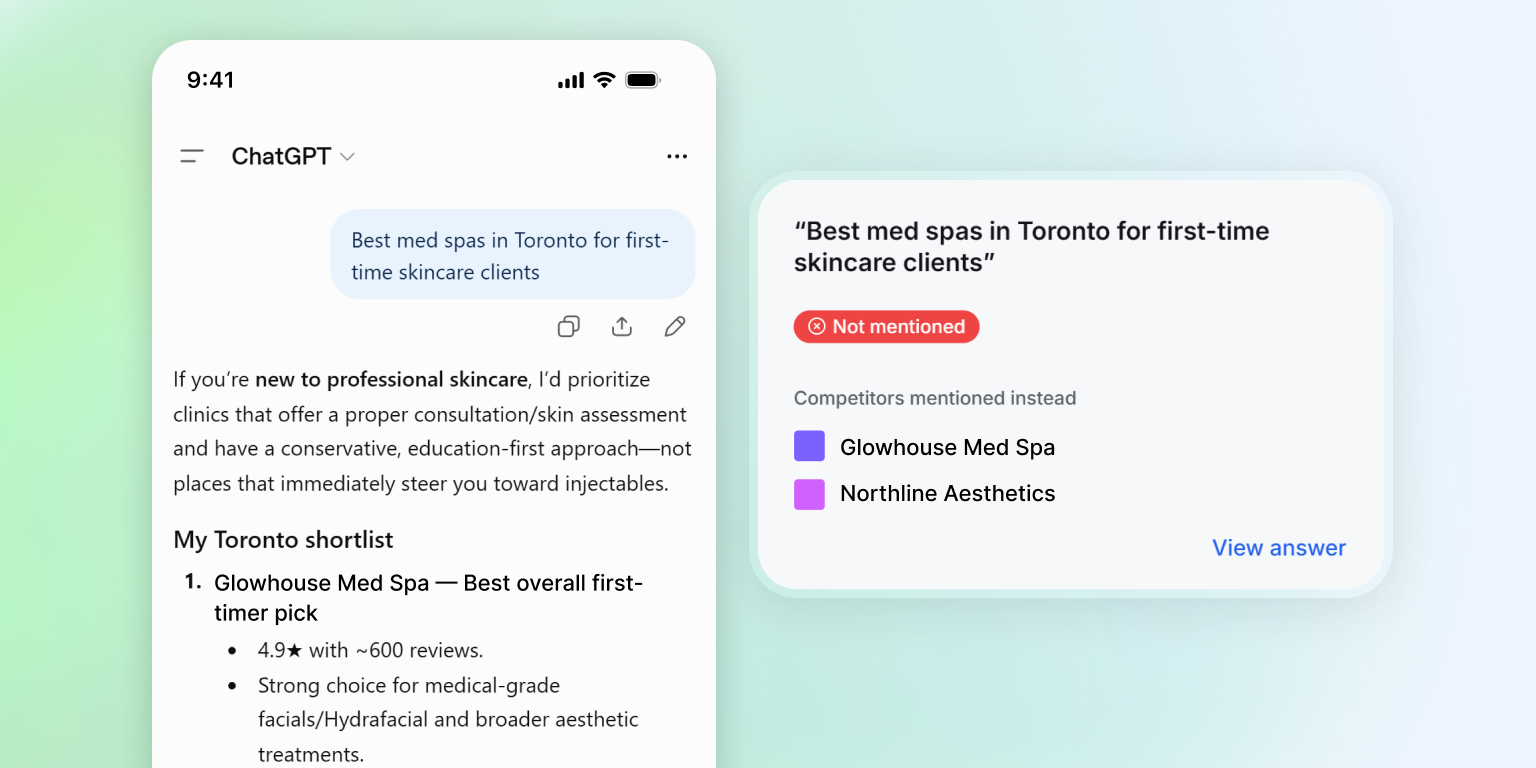
A brand mention in ChatGPT can mean very different things. Your company might be named because the user asked about it directly. It might appear naturally in a shortlist of recommended products. ChatGPT could compare it with a competitor, cite your website while discussing another company, or mention your brand negatively.
A simple “mentioned / not mentioned” count does not tell those stories apart.
The best mention trackers do more than count how many ChatGPT answers contain your brand. They preserve enough context to show why you appeared, what ChatGPT said, who appeared with you, and which sources shaped the answer.
That is the focus of this comparison. Rather than ranking another group of AI visibility platforms by overall feature count, we looked specifically at the best tools for monitoring ChatGPT mentions and what happens after each tool detects one.
Best tools to track ChatGPT brand mentions at a glance
| Tool | What you can see around a mention | What stands out | Starting price |
|---|---|---|---|
| Beamtrace | Exact prompt, full answer, position, sentiment, competitors, and citation sources | Connects each mention with the wider competitive, citation, reputation, and optimization picture | $20/mo annually |
| Siftly | Mention rate, answer position, sentiment, citations, competitors, and full response | Separates ChatGPT Search from conversational answers and accounts for response variability | $63/mo annually |
| LLM Pulse | Full answer, highlighted mentions, entities, citations, sentiment, competitors, and metadata | Strong response-level data plus mention alerts and workflow automation | $50/mo annually |
| Profound | Brand presence, Share of Voice, sentiment, citations, positioning, themes, and daily answers | Enterprise-level monitoring combined with real-user prompt research | $82/mo annually |
| Knowatoa | Company, product and executive mentions, sentiment, accuracy, sources, competitors, and full answers | Can monitor brand variations, products, people, and misinformation—not only the company name | $59/mo |
| MentionedOn | Recommendations, competitors, visibility changes, sources, and local customer questions | Monitoring designed specifically around local businesses and location-based recommendations | $83/mo annually |
Pricing and packaging change quickly, so current plan details should always be checked before purchasing.
Mention tracking vs. visibility tracking
This distinction is easy to miss because many platforms surface both metrics in the same dashboard.
Visibility tracking aggregates many ChatGPT responses into a metric: for example, the percentage of monitored answers where your brand appears.
Mention tracking goes one level deeper. It deals with the individual occurrences that produced that metric:
- Which prompt triggered the mention?
- Did ChatGPT introduce your brand naturally?
- Was it recommended or simply referenced?
- Where did it appear relative to competitors?
- Was the description positive, neutral, or critical?
- Which sources were attached to the answer?
- Has ChatGPT started mentioning the brand in a new context?
A visibility score may tell you that your presence increased from 25% to 35%. A useful mention tracker should help explain what actually changed inside those additional answers.
That is why we evaluated these products differently from our broader visibility-tool comparisons.
How we evaluated ChatGPT mention trackers
When evaluating the best tools to monitor brand mentions in ChatGPT, we focused on five practical questions.
1. Can you inspect the actual mention?
A dashboard total is useful, but the underlying answer matters more when something unusual happens. We looked for tools that preserve the prompt and response rather than showing only an aggregate score.
2. Does the tool capture context?
“Brand X is a good option” and “Brand X is expensive compared with the alternatives” both count as mentions.
Position, sentiment, recommendation context, competitors, and surrounding text help distinguish them.
3. Does it handle changing ChatGPT answers?
ChatGPT does not necessarily return the same brands each time a prompt is run. Strong monitoring needs recurring checks, historical data, or repeated sampling rather than treating one generated response as permanent.
4. Can it track more than the company name?
Products, executives, alternate spellings, and newly discovered competitors can all matter. Some platforms treat brand entities more broadly than others.
5. Can the mention trigger action?
Alerts, exports, integrations, source analysis, or optimization workflows can make the difference between discovering a mention and actually doing something with it.
With those criteria in mind, here is how the six platforms differ.
Best Tools for Monitoring ChatGPT Mentions
1. Beamtrace
Beamtrace's ChatGPT Brand Mentions Tracker is built around individual responses rather than treating mentions only as an aggregate number.
When ChatGPT mentions the tracked business, Beamtrace lets users see the exact prompt that triggered it and the complete answer around the mention. The surrounding analysis adds the brand's position, sentiment, competitors appearing in the same answer, and the sources ChatGPT used.
This becomes particularly useful when a mention changes.
For example, a team can see that ChatGPT has started naming the brand more frequently, then determine whether those new appearances come from category-discovery questions, competitive comparisons, or another topic. From there, the same data connects into competitor analysis, citations, reputation, rankings, Strategy, and the Action plan rather than leaving the mention as an isolated event.
What happens when Beamtrace finds a mention
- The exact tracked prompt is preserved.
- The complete ChatGPT answer can be reviewed.
- The brand's position in the answer is recorded.
- Sentiment provides context around how the brand was described.
- Competitors appearing in the same answer can be compared.
- Citation sources show which pages were associated with the response.
- Historical data shows whether mention frequency is increasing or decreasing.
Beamtrace also deliberately separates the initial presence metric from the surrounding analysis. Its Visibility Score is calculated from the share of tracked prompt runs where AI mentions the business, while the individual prompt and answer views provide the detail behind that aggregate result.
| Best for | Pricing |
|---|---|
| SMBs and marketing teams that want mention monitoring connected with competitors, citations, reputation, and concrete next steps | From $20/mo annually; 14-day trial, no card |
Starter currently includes 10 prompts, with Growth at 30 and Premium at 60. Beamtrace tracks one website per account today, which makes it less suitable for large multi-brand portfolios than some enterprise platforms.
2. Siftly
Siftly takes a notably different approach to the problem of unstable ChatGPT answers.
Instead of treating a prompt as a single observation, Siftly says it samples tracked ChatGPT prompts multiple times and calculates a mention rate. It also distinguishes between conversational ChatGPT and ChatGPT Search rather than combining both experiences into one dataset.
That makes it particularly relevant when the question is not simply:
Did ChatGPT mention us?
but:
How reliably does ChatGPT mention us when this question is asked repeatedly?
Siftly also reports mention rate per model with confidence intervals, while preserving answer position, competitors, sentiment, citations, and the individual response. Alerts can be configured when mention rates cross selected thresholds.
What happens when Siftly finds a mention
- Mention frequency is measured across repeated samples.
- Conversational ChatGPT and ChatGPT Search can be analyzed separately.
- The full response is available for prompt-level inspection.
- Answer position and Share of Voice add competitive context.
- Sentiment shows how ChatGPT framed the brand.
- Citation URLs are logged for linked ChatGPT Search answers.
- Threshold-based alerts can flag a meaningful change in mention rate.
Siftly's monitoring model makes it one of the more technically interesting options in this list. For teams that care about variance between ChatGPT runs, repeated sampling may be more informative than one answer per scheduled interval.
| Best for | Pricing |
|---|---|
| Teams that want mention-rate measurement designed around ChatGPT's response variability | Starter is $63/mo annually |
The trade-off is that Siftly is broader than a pure monitoring product. Content generation, outreach, social distribution, and other GEO execution features are part of its paid packages, which may be more platform than a team needs if the goal is only ChatGPT mention tracking.
3. LLM Pulse
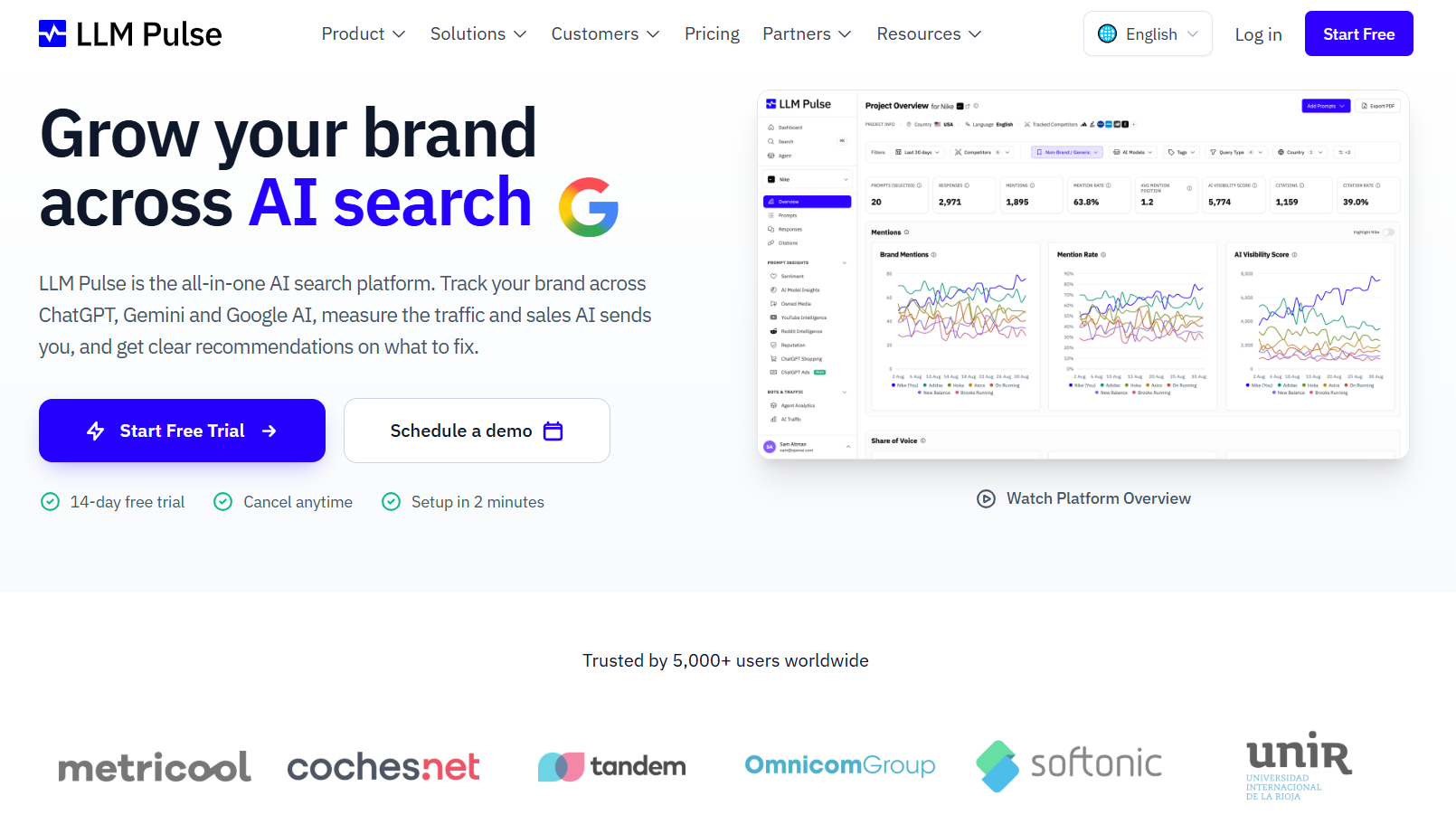
LLM Pulse treats each prompt execution as a structured data record.
The platform says it runs prompts directly through consumer AI platforms rather than simulating results through model APIs. For every execution, it can capture the complete response, whether the brand was mentioned, every cited URL and its position, sentiment, timestamp, and model metadata.
Its published visibility formula is also straightforward:
Visibility = mentions ÷ total prompt executions.
For this article, however, the more interesting part is what LLM Pulse does below that score.
The Responses Explorer highlights both tracked brands and competitors directly inside the original answer. Its ChatGPT Entities feature goes further by extracting other brands, products, organizations, marketplaces, and publications even if they were never configured as competitors beforehand.
What happens when LLM Pulse finds a mention
- The complete ChatGPT response is stored.
- Brand and competitor mentions are highlighted in the answer.
- Mention position can be analyzed by prompt and model.
- Citations are attached to the same response.
- Sentiment is scored on a five-level scale.
- Previously untracked brands and products can be extracted as entities.
- Mention events can be sent into external workflows through integrations.
The automation layer is a particularly distinctive feature. LLM Pulse's Zapier integration can trigger workflows when a brand mention, competitor mention, citation, or negative-sentiment event occurs, allowing mention data to flow into Slack, Sheets, HubSpot, Notion, email, and other systems.
| Best for | Pricing |
|---|---|
| Data-oriented marketing teams, agencies, and teams that want mention events connected to reporting or automation | Weekly Starter: $50/mo annually |
LLM Pulse offers substantially more infrastructure than a basic brand-monitoring dashboard, which is an advantage for advanced workflows but can add complexity for teams that simply want a quick mention report.
Try it on your brand
Does ChatGPT mention your brand when it matters?
See where your business appears in relevant ChatGPT answers, what is being said, who appears beside you, and which sources influence the response.
Add your website.
Enter your website URL.
We check ChatGPT.
Prompts are monitored for mentions of your brand and competitors.
See every mention in context.
Review the prompt, full response, position, sentiment, competitors, and sources behind it.
4. Profound
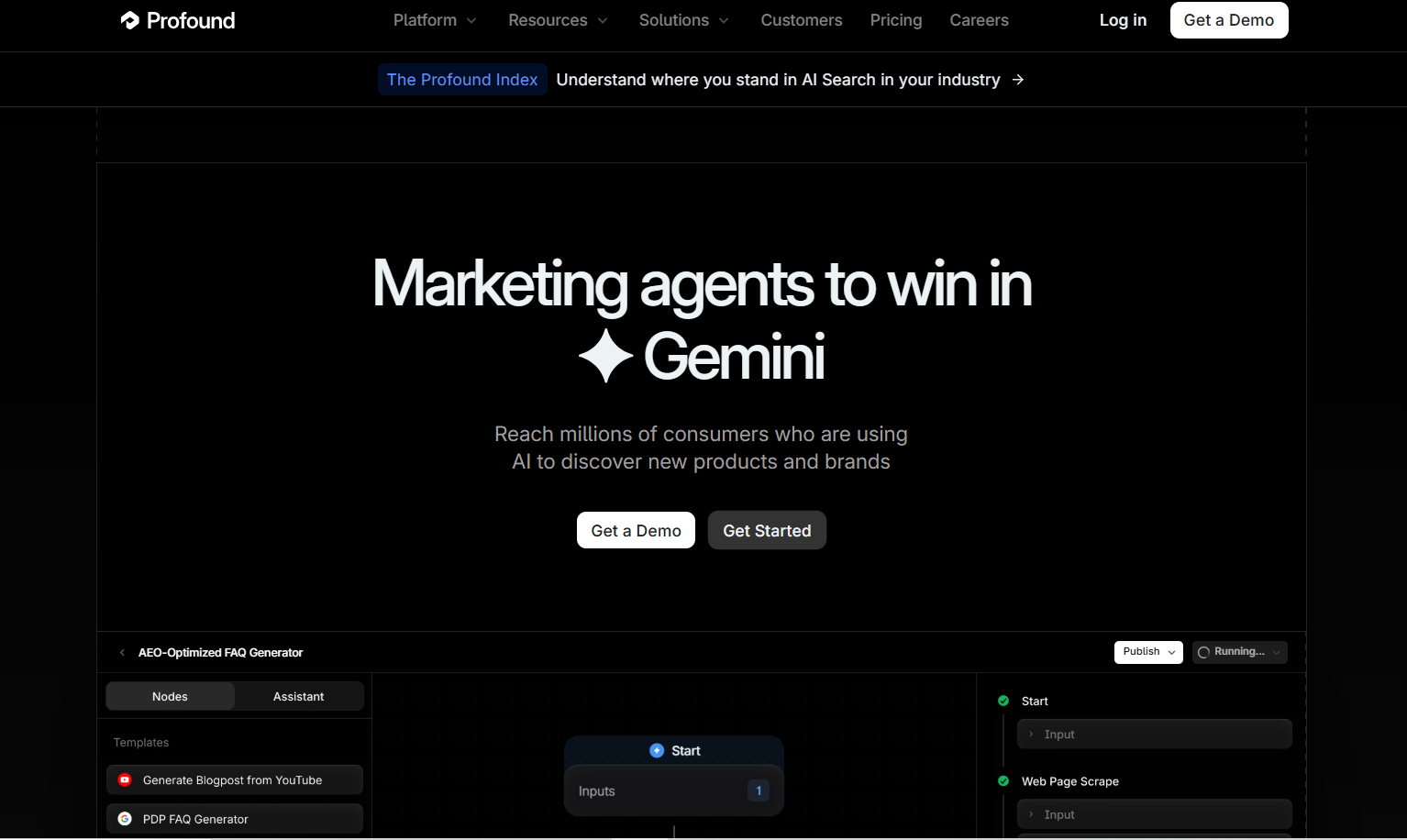
Profound's Answer Engine Insights begins with daily structured prompts sent to ChatGPT and other supported answer engines.
The resulting dataset records whether the brand appears, then connects that presence with Share of Voice, positioning, sentiment, citations, topics, and historical trends. Profound's Visibility Score is calculated from the number of responses that include the brand relative to the relevant response set, while Share of Voice measures brand mentions against mentions of other brands.
For mention monitoring specifically, Profound's main advantage is scale and context.
It captures AI responses directly from consumer browser experiences and runs tracked prompts daily. That gives enterprise teams a recurring dataset rather than a series of manual snapshots.
Profound also offers dedicated Sentiment analysis, which identifies themes and attributes associated with a brand and connects them back to the sources shaping those narratives.
What happens when Profound detects brand presence
- Brand presence is incorporated into the Visibility Score.
- Share of Voice compares mention frequency against competitors.
- Daily tracking shows changes over time.
- Sentiment analyzes how the brand is described.
- Themes reveal recurring narratives around the brand.
- Citation analysis links those narratives with underlying sources.
- Topic, tag, region, and platform filters provide additional segmentation.
Profound's other differentiator is Prompt Volumes. Its real-user query dataset can help teams determine whether the questions they monitor resemble what people actually ask AI assistants, rather than building the entire monitoring set from assumed buyer prompts.
| Best for | Pricing |
|---|---|
| Enterprise and larger marketing teams that need mention analysis tied to prompt research, segmentation, and broader AEO intelligence | $82/mo billed annually |
The Starter plan is currently ChatGPT-only and includes 50 prompts and 1,500 analyzed responses per month. Growth costs $399 per month billed annually and expands coverage to three answer engines and 100 prompts.
For a smaller company that only needs a mention count plus answer context, Profound's wider research and enterprise capabilities may be unnecessary.
5. Knowatoa
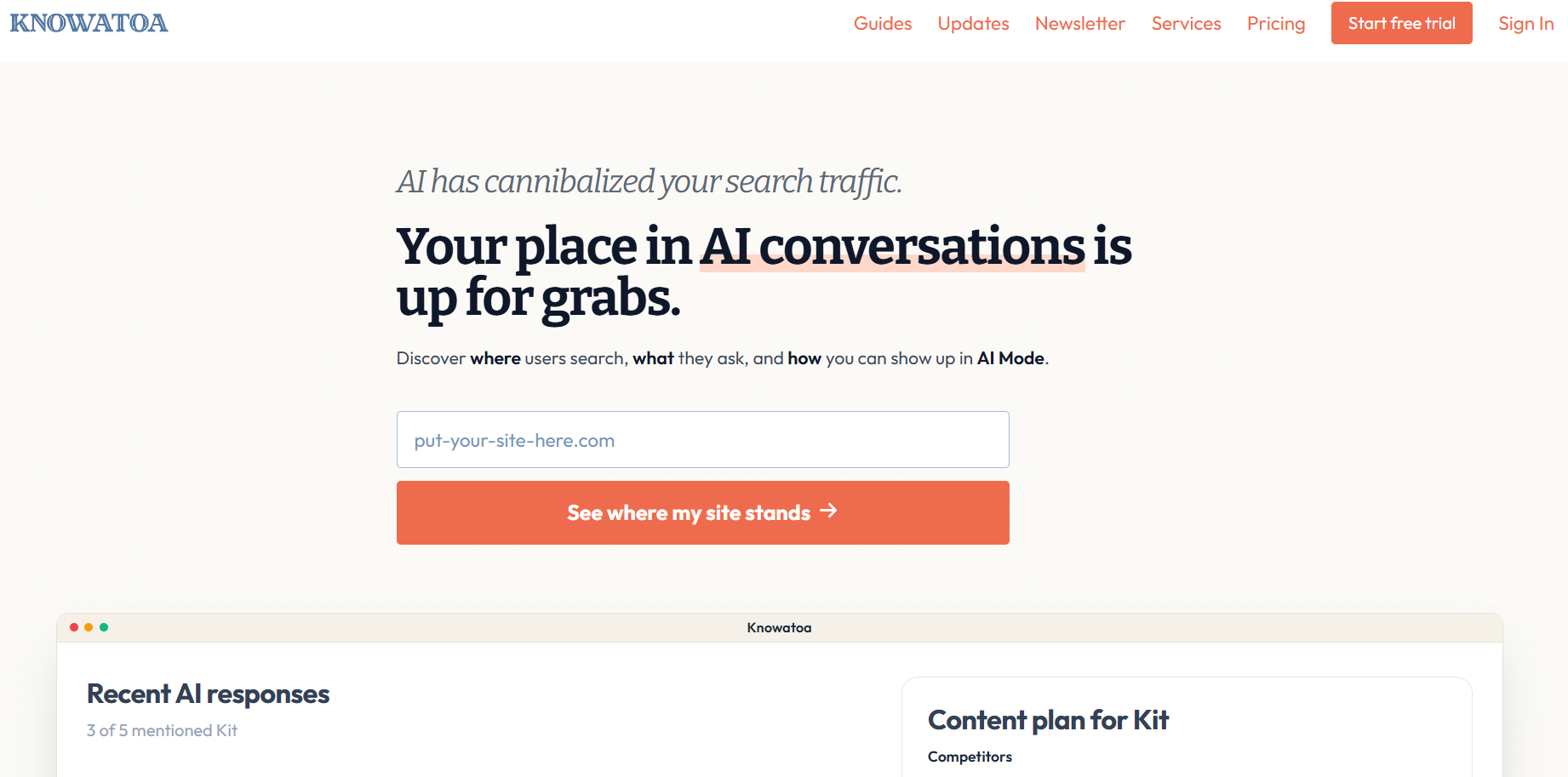
Most trackers begin with one primary brand entity.
Knowatoa is interesting because its Brand Monitoring feature explicitly supports company names, products, executives, variations, and common misspellings. All of those terms can be associated with the same brand and monitored inside AI responses.
That changes what “brand mention tracking” can mean.
A SaaS company might monitor the corporate brand, individual product names, a founder or CEO, and an older product name that ChatGPT still uses. A consumer business might want to catch common misspellings that still refer to the same entity.
Knowatoa then adds context and sentiment around those appearances, along with competitor comparisons, source data, historical trends, and alerts when mention patterns change.
What happens when Knowatoa finds a mention
- Company names can be tracked alongside products and key people.
- Variations and common misspellings can be associated with the same brand.
- The actual AI response can be inspected.
- Sentiment shows whether the mention is positive, neutral, or negative.
- Competitors can be compared at the question level.
- Citation sources are connected to individual questions.
- Accuracy tracking can flag outdated or potentially incorrect brand claims.
The accuracy layer is especially relevant for brand and communications teams. A mention can be frequent and positive while still containing outdated pricing, a product feature that no longer exists, or another factual error. Knowatoa lets teams categorize those problems and track whether corrections improve future responses.
| Best for | Pricing |
|---|---|
| Brands that want to monitor products, executives, naming variations, and misinformation alongside their main company name | From $59/mo; annual billing available |
Starter includes ChatGPT, Google AI Overviews, and AI Mode. Growth expands coverage to seven AI services and costs $199 per month. Knowatoa states that annual pricing is available, but its public pricing page does not currently display a discounted annual equivalent.
Knowatoa is therefore a useful alternative when the monitoring subject itself is more complicated than one brand name.
6. MentionedOn
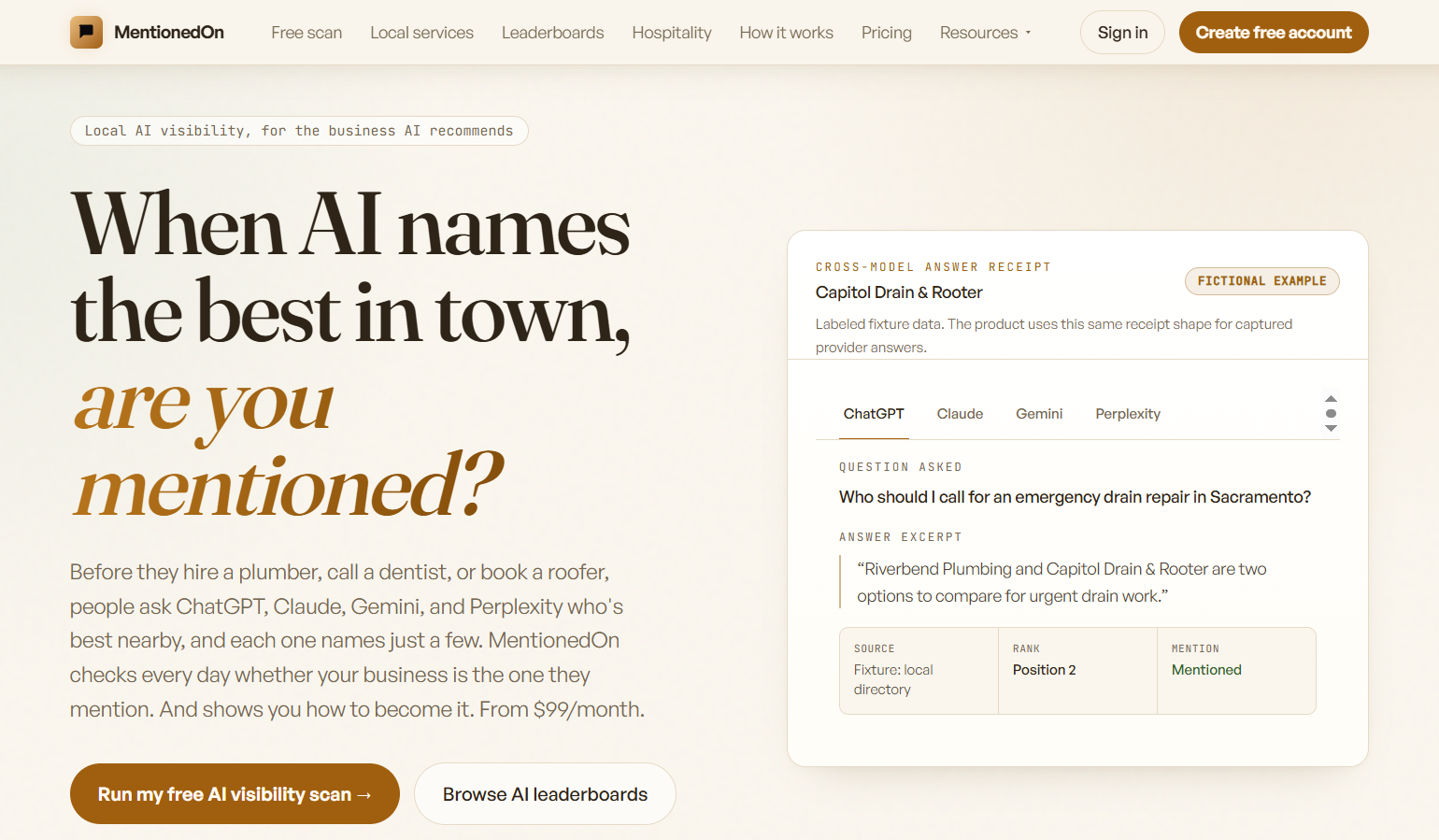
MentionedOn takes the most specialized approach in this comparison.
Rather than positioning itself primarily around SaaS, enterprise brands, or broad GEO teams, it is designed around local businesses and the customer questions that lead to local recommendations.
Its Local plan tracks 100 customer questions. The top 25 are checked every day on ChatGPT and Gemini, while all 100 are rechecked weekly across ChatGPT, Claude, Gemini, and Perplexity. The product also tracks up to 15 competitors that AI recommends instead.
That model is useful for businesses where the important ChatGPT mention is often something like:
Who are the best roofers near me?
rather than a generic national category query.
What happens when MentionedOn tracks your local questions
- High-priority local customer questions are checked daily.
- The wider question set is rechecked weekly.
- Competitors recommended instead of the business are identified.
- Visibility changes feed into a prioritized to-do list.
- Users receive an email when performance slips and a weekly summary.
- Manual rechecks are available after changes are made.
MentionedOn's own local-business dataset illustrates why that use case deserves separate treatment: across the markets it studied, recommendations were distributed among multiple local businesses rather than being dominated by one permanent winner.
| Best for | Pricing |
|---|---|
| Local businesses, service companies, and multi-location operators monitoring recommendation-style prompts | $83/mo annually |
The Local plan is $99 month-to-month, while annual billing provides two months free, giving an effective monthly cost of $83.
For SaaS companies or global brands, its local-first workflow will be less relevant. For a restaurant, contractor, clinic, or other location-dependent business, that specialization can be an advantage.
Not every ChatGPT mention is equally valuable
Whichever tool you choose, raw mention count should not be the end of the analysis.
We recommend separating at least four types of appearances.
1. Prompted mentions
The brand already appears in the user's question:
Is Acme a good project management tool?
ChatGPT is very likely to discuss Acme because the prompt explicitly asks about it.
These mentions are useful for reputation and accuracy monitoring but tell you relatively little about whether ChatGPT would discover the brand independently.
2. Unprompted discovery mentions
The prompt contains no brand name:
What are the best project management tools for remote agencies?
If ChatGPT introduces Acme here, that is a much stronger discovery signal.
These responses are particularly useful when the goal is to understand whether the brand enters buyer consideration without being prompted first.
3. Recommendation mentions
Simply appearing in an answer is not the same as being recommended.
Compare:
Other tools in this category include Acme.
with:
For remote agencies, Acme is one of the strongest options because…
Both are mentions, but the second carries far more commercial weight.
Position and sentiment can help distinguish these cases, but reading the actual response remains important.
4. Citation-linked mentions
ChatGPT Search may mention the brand and attach sources explaining why it was included.
These answers connect the mention itself with the pages influencing it. That creates a different optimization path: instead of only trying to increase the number of mentions, teams can investigate which owned or third-party sources repeatedly support them.
Practical rule
The best way to monitor ChatGPT brand mentions is to keep presence, recommendation context, sentiment, and citations as related but separate signals. Combining them into one number can hide what actually changed.
Which ChatGPT mention tracker should you choose?
Different tools are stronger at different parts of mention monitoring. The best fit depends on what you want to understand or do after ChatGPT mentions your brand.
| Priority | Strong fit |
|---|---|
| Understand the context behind each mention | Beamtrace |
| Measure how consistently mentions repeat | Siftly |
| Send mention data into other workflows | LLM Pulse |
| Enterprise-scale monitoring and research | Profound |
| Track products, executives, and brand variations | Knowatoa |
| Monitor local ChatGPT recommendations | MentionedOn |
The right choice depends on what you need beyond the mention itself: response context, repeatability, automation, deeper research, entity tracking, or local recommendations.
This comparison was prepared by the Beamtrace team. Since Beamtrace is included, we aimed to keep the listing as objective as possible by relying on public product information and highlighting both strengths and meaningful limitations.
We hope it gives you a balanced starting point for choosing the best tool to track ChatGPT brand mentions for your own workflow.