
A citation count tells you how often AI linked to a source. It does not tell you whether that source was your website, a competitor's page, a third-party article that mentions you, or a publication shaping the answer without giving your brand much credit.
That is where citation analysis becomes useful. The right tools help you move from “we were cited 38 times” to understanding which pages AI relies on, where those citations appear, who else benefits from the same sources, and which parts of the citation landscape your brand is missing.
AI citation analysis is less about counting links and more about understanding which sources shape AI answers and how your brand fits into that source network.
For this comparison, we focused specifically on citation and source intelligence. Rankings, mentions, sentiment, prompt monitoring, and competitor analysis can add useful context, but they are not the main criteria here. The best AI visibility tool for citation analysis should make the sources behind AI answers easier to understand, compare, and investigate.
Best AI citation analysis tools at a glance
| Tool | Citation lens | What it reveals particularly well | Best for | Starting price |
|---|---|---|---|---|
| Beamtrace | Exact cited pages + full-answer context | Which pages are cited, how often, where citation gaps appear, and how sources relate to wider visibility | SMBs and marketing teams | $20/mo |
| Scrunch | Citation ownership + Influence Scores | Whether citations belong to your brand, competitors, or third parties, down to domain and URL level | Teams needing deep source segmentation | $250/mo |
| Profound | Citation Decay + large-scale source patterns | Which URLs are gaining or losing citation influence and how source mixes shift across industries and AI engines | Enterprise teams | $99/mo |
| Semrush AI Visibility | Cited Sources + Source Opportunities + AI Volume | Which high-demand sources support competitors or topics where your own brand is missing | SEO and content teams | $165/mo per domain |
| Ahrefs Brand Radar | Cited Pages across a massive search-backed index | Market-wide citation discovery, top cited domains, and pages found by AI but not ultimately cited | SEO and research teams | From $199/mo per AI index |
| Peec AI | Retrieval Rate vs Citation Rate | Whether AI merely uses a source in retrieval or explicitly attributes information to it in the answer | Mid-market teams and agencies | $80/mo |
| Otterly.AI | Citation trends + Top Winners & Losers | Which URLs are gaining, declining, or repeatedly appearing across tracked AI answers | Small and mid-sized teams | $29/mo |
Pricing changes quickly in this category, so check current plan details before making a final decision.
How we evaluated these tools
We compared each platform specifically as an AI citation analysis tool, rather than judging it by its total number of GEO, SEO, content, or visibility features.
The strongest citation tools should do more than produce a list of links. We focused on four areas:
- Citation depth. Can the tool identify cited domains and individual URLs, show how frequently they appear, and connect them back to the AI answers or prompts where they were used?
- Source intelligence. We looked at whether the platform distinguishes your own pages from competitor and third-party sources, identifies citation gaps, and provides enough context to understand why a source matters.
- Patterns and changes. A single cited URL is only a snapshot. We gave more weight to products that help reveal recurring sources, historical changes, source categories, citation trends, or other patterns across a larger dataset.
- Tracking scope and value. We considered AI-engine coverage, prompt limits, historical data, reporting capabilities, and pricing relative to the citation analysis available on each plan.
We also considered who each product is designed for. A huge citation dataset can be valuable for enterprise research, while a smaller team may get more practical value from being able to open an exact cited page, see the answer around it, and quickly identify the gaps worth investigating.
Features, platform coverage, and pricing were checked against publicly available product information.
How the top AI citation analysis tools compare
1. Beamtrace
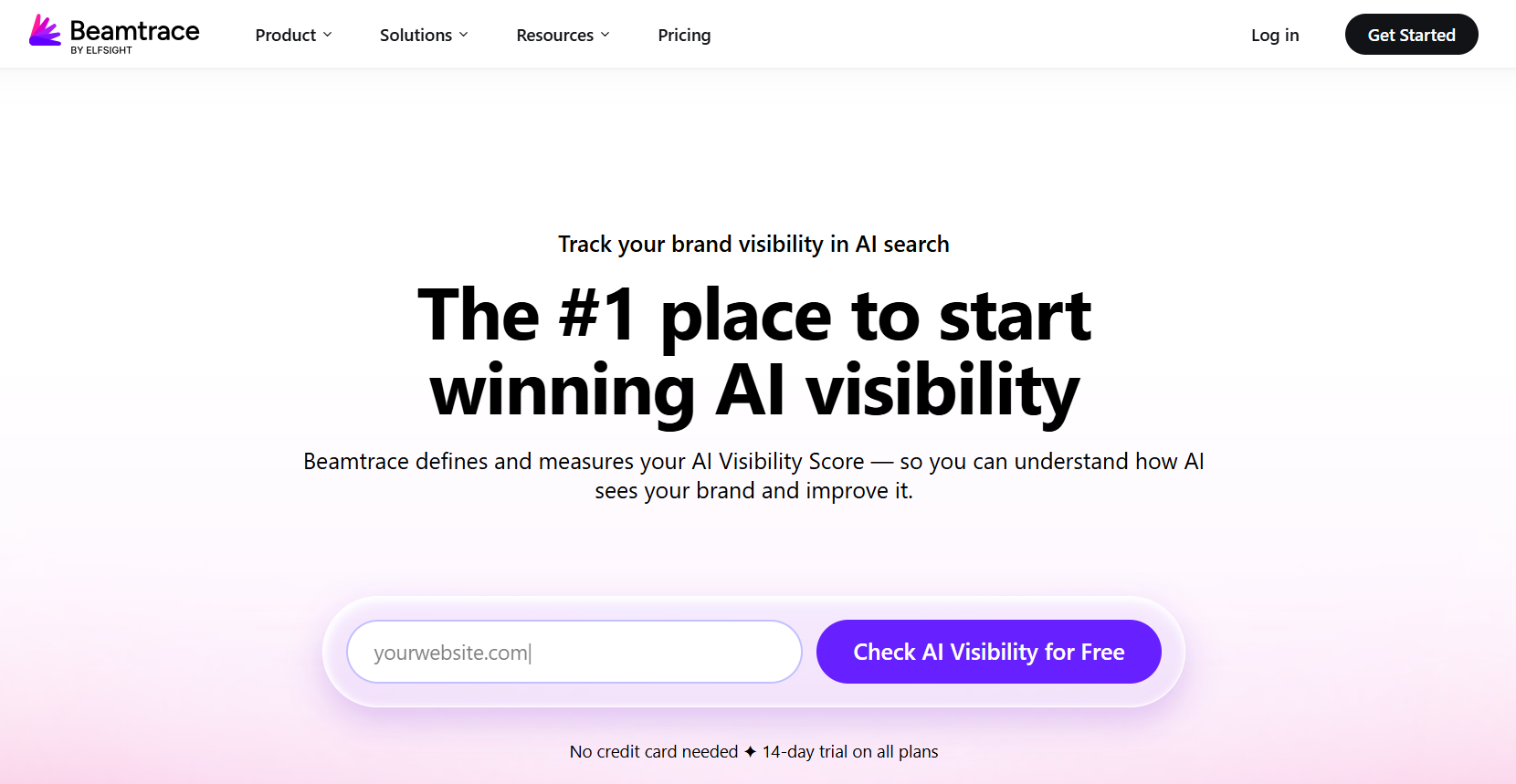
Beamtrace approaches citations as one part of the explanation behind AI visibility rather than treating them as an isolated link count.
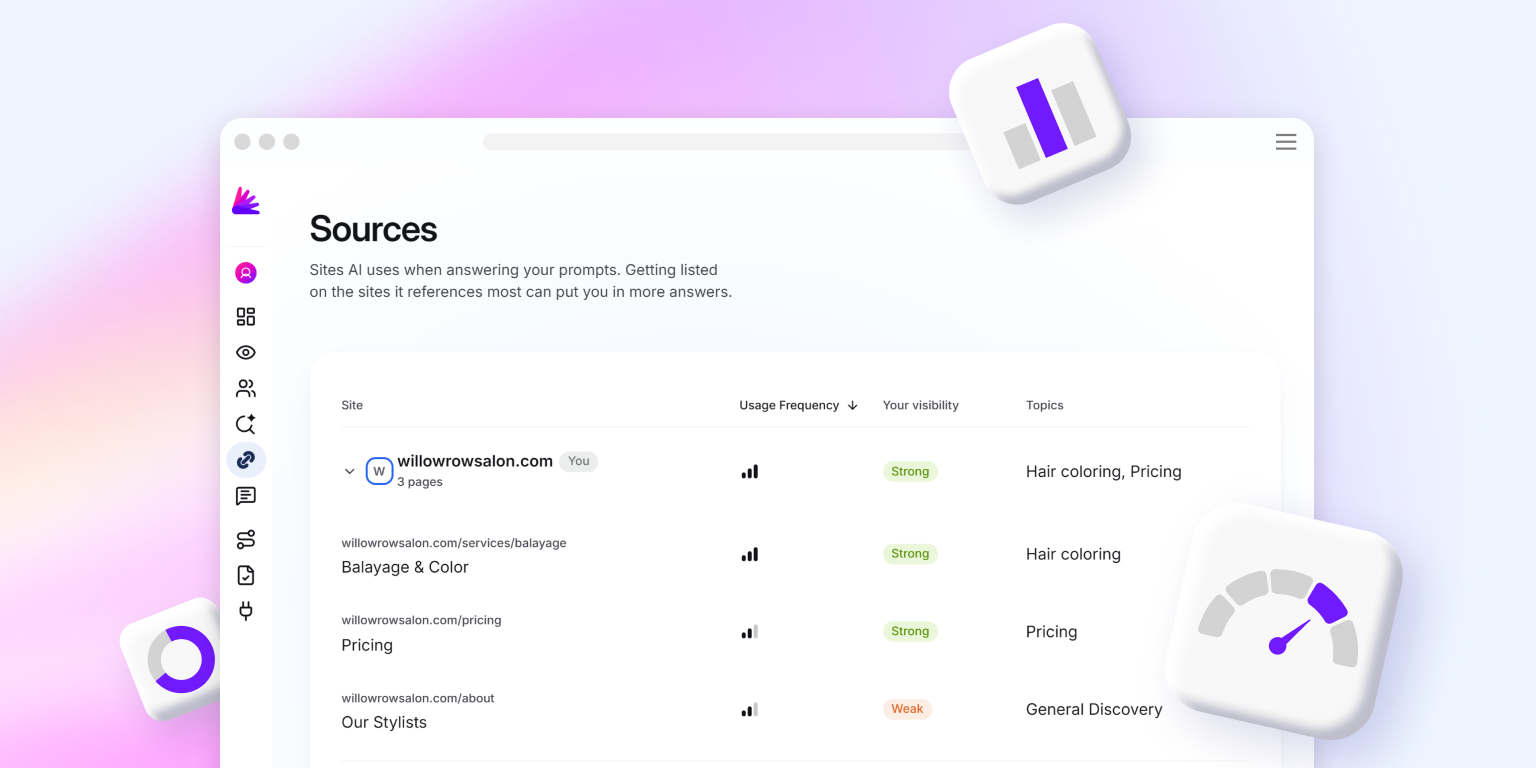
Its Citation Analysis feature identifies the specific pages, articles, and references AI uses when generating answers around your business or category. You can track how often your own content is cited, open the AI-generated answer around the citation, and see whether the source is being used in a way that is relevant to your positioning. Beamtrace also surfaces competitor citations and citation gaps.
That context becomes more useful when a citation raises another question. From the same Beamtrace ecosystem, you can move into prompt and rank performance, competitor analysis, overall visibility, or optimization actions. In other words, the citation itself can be the starting point rather than the end of the investigation.
For example, discovering that AI repeatedly cites a third-party comparison article is useful on its own. But it becomes more actionable when you can also see whether your brand appears in those answers, where it ranks, which competitors benefit, and whether the pattern corresponds with a wider visibility gap.
Main features
- Exact cited domains and URLs behind AI-generated answers.
- Citation Frequency to see how often your own content is used.
- Full-answer context around individual citations.
- Competitor citation analysis to see which sources support other brands.
- Citation gaps showing where relevant sources or content are missing.
- Connected rank, prompt, competitor, visibility, and optimization workflows for deeper investigation.
| 👍 Best for | 💰 Pricing plans |
|---|---|
| SMBs, startups, local businesses, and marketing teams that want citation tracking without separating source analysis from the rest of their AI visibility workflow. | 14-day trial with no credit card. Paid plans start from $20/month. |
Beamtrace is lighter than enterprise platforms designed around extremely large datasets, advanced BI integrations, and multi-brand account structures. Its strength is the connection between an individual source and the broader question of what that citation means for your visibility.
2. Scrunch
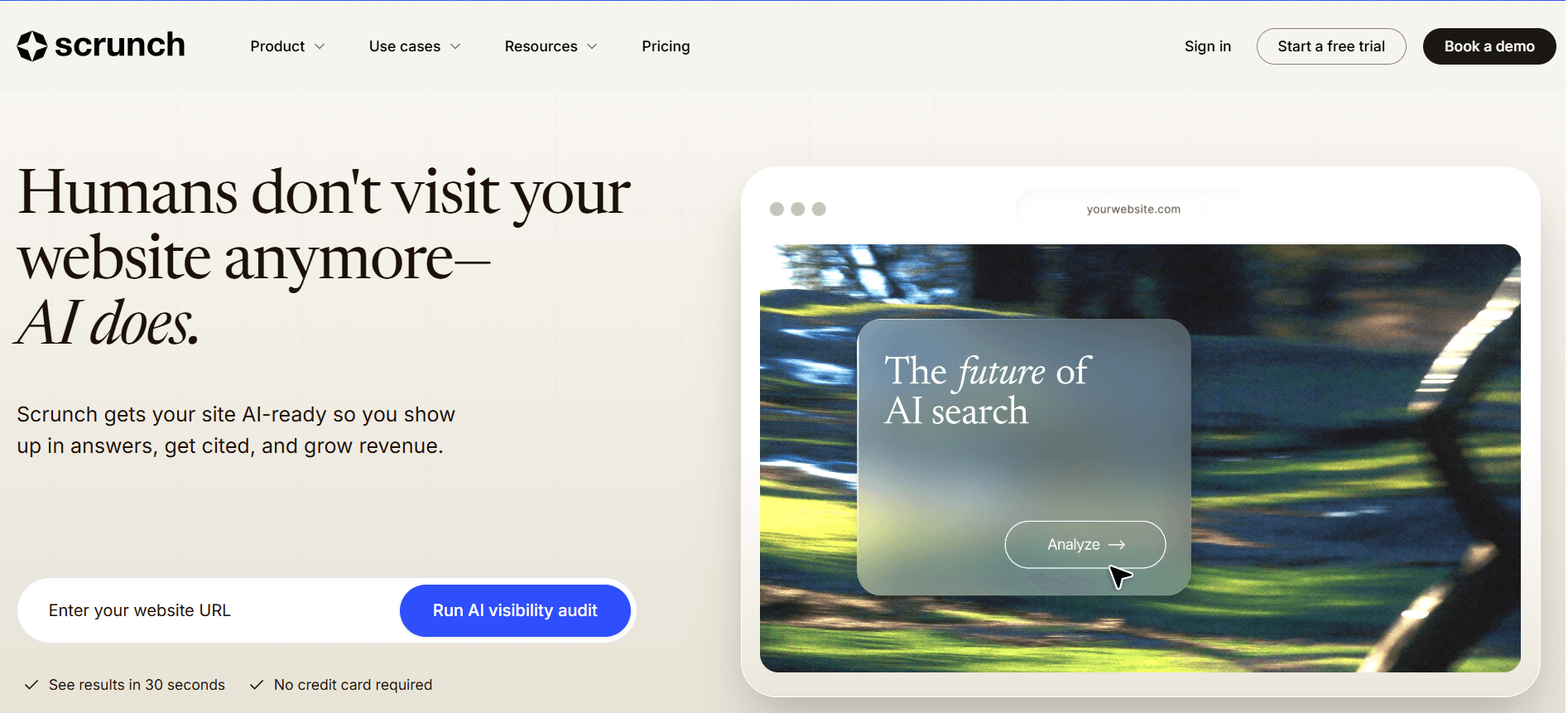
Scrunch has one of the most purpose-built citation workflows in this comparison.
Its dedicated Citations tab separates sources by owner: your own brand, competitors, and third parties. Users can then drill from domain level into individual URLs, see which prompts cited each page, track citation consistency, and view week-over-week changes. Scrunch also applies Influence Scores to citations and supports filtering by topic, persona, AI platform, funnel stage, branded vs. non-branded prompts, country, and other dimensions.
That makes it particularly useful when citation analysis needs to answer more than “which sites appear most often?” You can instead examine which types of sources dominate a particular stage of the buyer journey or whether third-party pages are having more influence than brand-owned content.
Main features
- Citations by Owner: brand, competitor, and third-party sources.
- Domain- and URL-level citation analysis.
- Influence Scores for individual citations.
- Prompt-level connection between cited pages and AI responses.
- Historical citation trends and consistency.
- Deep filtering by topic, persona, platform, funnel stage, country, and more.
| 👍 Best for | 💰 Pricing plans |
|---|---|
| Larger marketing teams that need to segment citation data across audiences, funnel stages, topics, and source ownership rather than only monitor total citations. | Core: $250/month with 125 prompts and four supported LLMs. Enterprise: custom pricing with expanded coverage and advanced features. |
The main trade-off is entry cost. Scrunch provides much deeper citation segmentation than many lightweight trackers, but smaller teams may not need enough of that depth to justify starting at $250 per month.
3. Profound
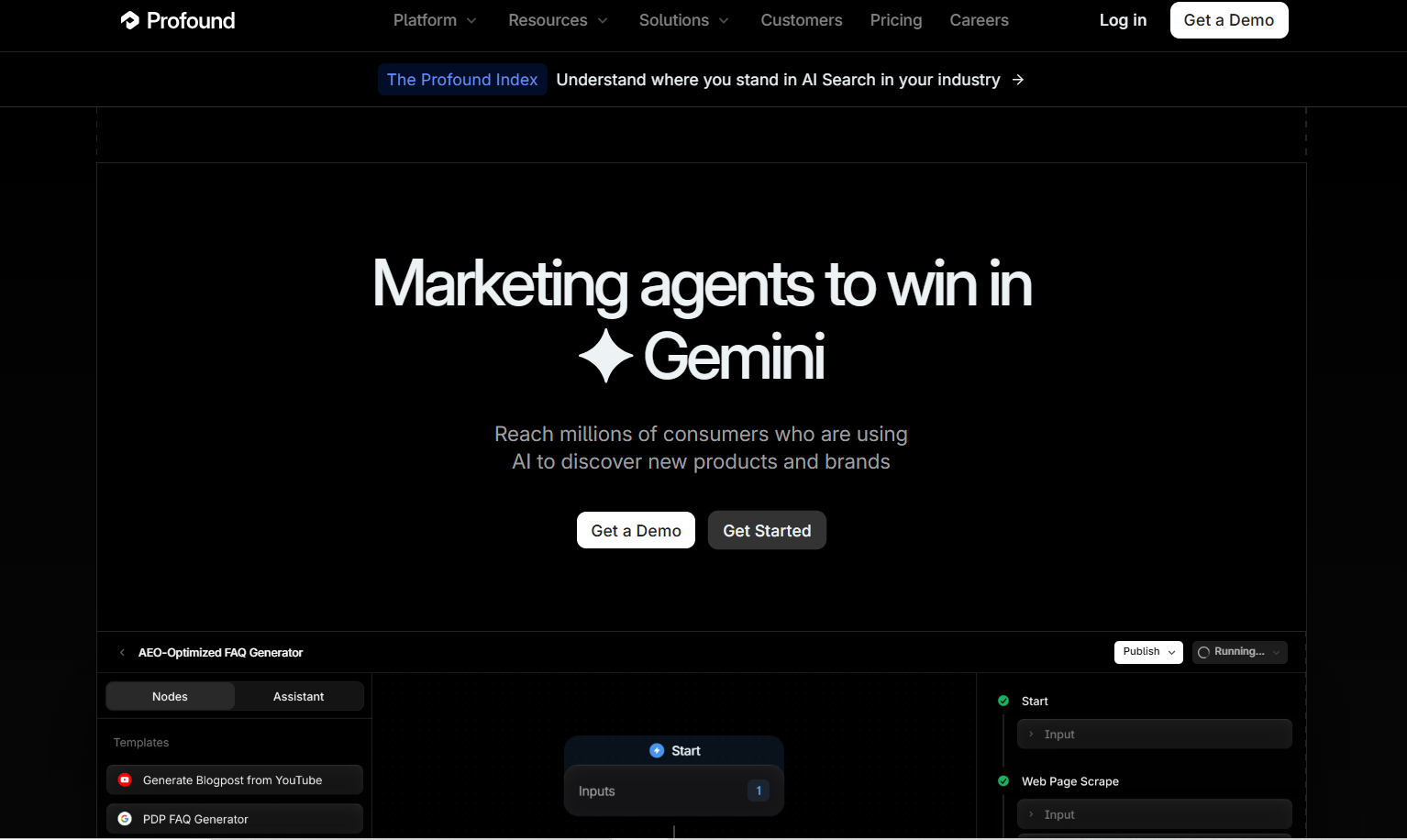
Profound stands out less for showing individual citation URLs — many tools do that — and more for the scale at which it analyzes how sources behave.
A particularly distinctive feature is Citation Decay. Instead of treating every cited page as equally current, Profound plots a citation curve for each URL to show when its influence begins to decline. This gives teams a way to identify content that may be losing its place in AI answers rather than refreshing pages on an arbitrary schedule.
Profound also works with exceptionally large citation datasets. Its 2026 research has analyzed billions of citations across multiple models, countries, and industries, including differences between brand-owned, earned-media, and social sources. Its broader Profound Index is now based on more than 1.9 billion real user conversations.
Main features
- Citation tracking across Answer Engines.
- Citation Decay curves showing when individual URLs lose influence.
- Source analysis across brand, earned-media, social, and other citation types.
- Large-scale cross-platform and industry citation datasets.
- Historical analysis of changing source behavior.
- Wider Answer Engine Insights for connecting citations with visibility and competitive performance.
| 👍 Best for | 💰 Pricing plans |
|---|---|
| Enterprise teams that need category-level citation intelligence, cross-market analysis, and source trends at a much larger scale. | Starter: $99/month billed yearly. Growth: $399/month. Enterprise: custom. Broader Answer Engine coverage requires higher tiers. |
For a small brand tracking its own cited pages, Profound can be significantly more platform than necessary. Its advantage becomes clearer when the question expands from “Who cites us?” to “How is the citation landscape of an entire market changing?”
4. Semrush AI Visibility Toolkit
Semrush's strongest citation workflow comes from combining AI source data with its existing search and content datasets.
The Visibility Overview separates Cited Sources, Source Opportunities, and Cited Pages. Source Opportunities specifically identify external sites that appear in AI answers mentioning competitors but not your brand. Users can also sort opportunities using Visibility, mentions, and AI Volume, which adds an estimate of demand behind the topics involved.
Prompt Tracking adds another source report showing every domain and URL cited for the prompts you monitor, split into categories such as your domain, competitor domains, social platforms, knowledge bases, and other sites.
This is where Semrush differs from a standalone citation tracker: source gaps can be evaluated alongside keyword, SEO, content, backlink, and demand data already inside the platform.
Main features
- Cited Sources showing external domains AI relies on.
- Cited Pages identifying your own pages appearing as AI sources.
- Source Opportunities where competitors are supported by sources that do not mention you.
- AI Volume for prioritizing citation opportunities by estimated demand.
- Source categorization across brand, competitor, social, knowledge-base, and other domains.
- Connection with Semrush's wider SEO and content datasets.
| 👍 Best for | 💰 Pricing plans |
|---|---|
| SEO and content teams that want citation analysis connected to search demand, competitive research, and existing SEO workflows. | AI Visibility Base starts at $165/month per domain, billed annually, and includes 25 custom prompts. |
Semrush is less focused than a dedicated citation platform, but the surrounding data can be more valuable than additional citation-specific metrics if your team already works heavily in SEO.
5. Ahrefs Brand Radar
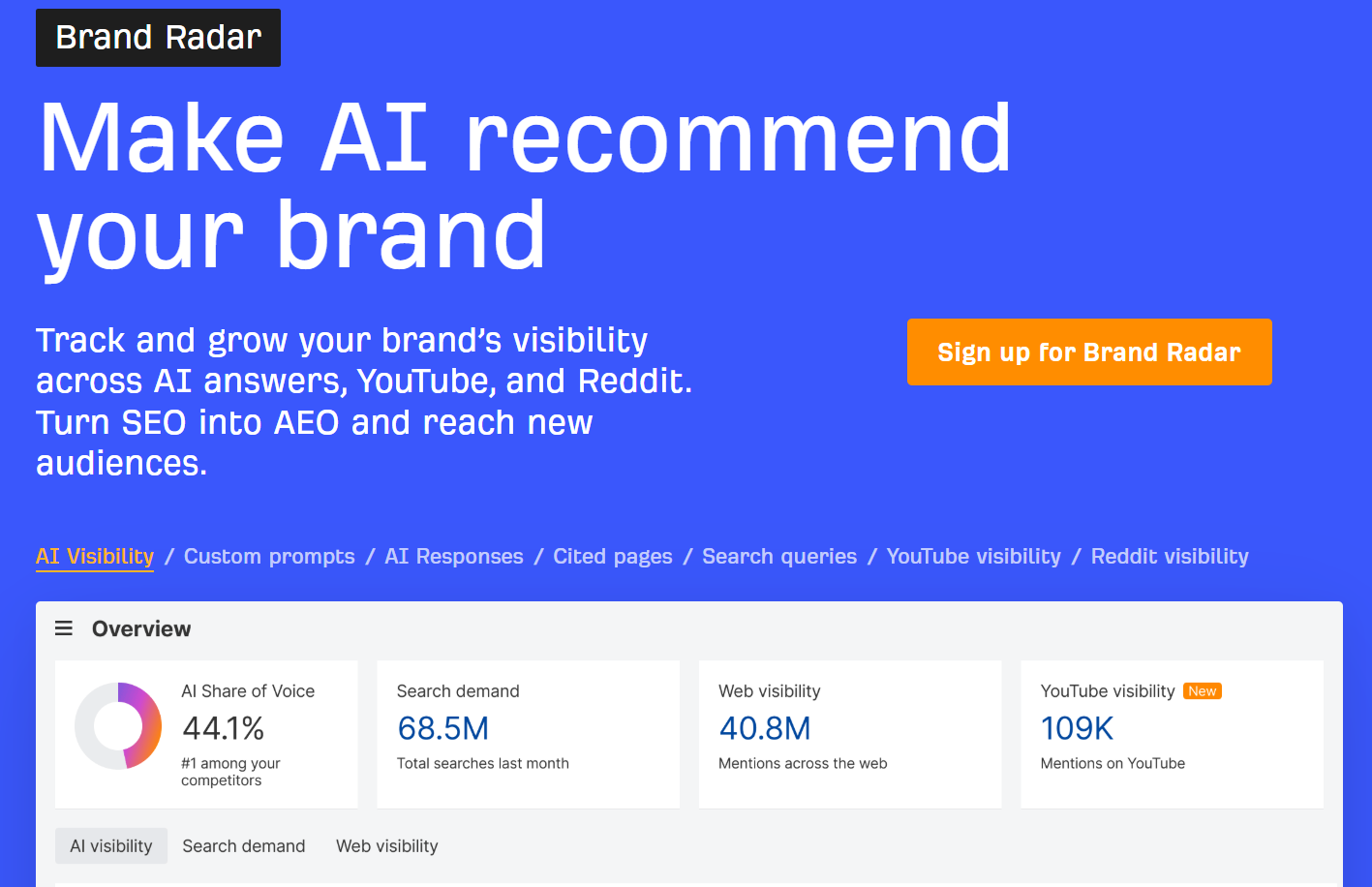
Ahrefs takes citation analysis beyond the prompt set you manually decide to track.
Brand Radar's AI Visibility Index currently covers hundreds of millions of search-backed prompts. Within that dataset, the Cited Pages report can surface top cited domains and URLs for a brand, competitor, or entire topic. Users can also look for third-party pages where competitors get cited but their own brand does not.
A particularly interesting addition is Ahrefs' citation funnel. The Cited Pages data now distinguishes pages that AI found during retrieval from pages it actually cited in the final answer. That creates a useful intermediate state: content can be discoverable to an AI system but still fail to earn explicit attribution.
That combination makes Ahrefs strong for broad discovery. Instead of asking only “Which pages were cited for my 50 prompts?”, you can explore what sources repeatedly influence a much larger market.
Main features
- Cited Pages and source discovery across a massive search-backed AI index.
- Top cited domains and URLs by brand or topic.
- Competitor citation-gap discovery.
- Found vs. cited data showing pages retrieved but not ultimately referenced.
- Historical AI-response data.
- Custom Prompts for more focused ongoing citation tracking.
| 👍 Best for | 💰 Pricing plans |
|---|---|
| SEO, digital PR, and market-research teams that want to discover citation patterns beyond a manually defined prompt list. | AI Visibility Index access starts at $199/month per platform or $699/month for all platforms. Custom Prompt packages start at $50/month. |
Ahrefs can be expensive if all you want is a small recurring citation report. Its value grows when citation discovery across a large market is the actual research problem.
6. Peec AI
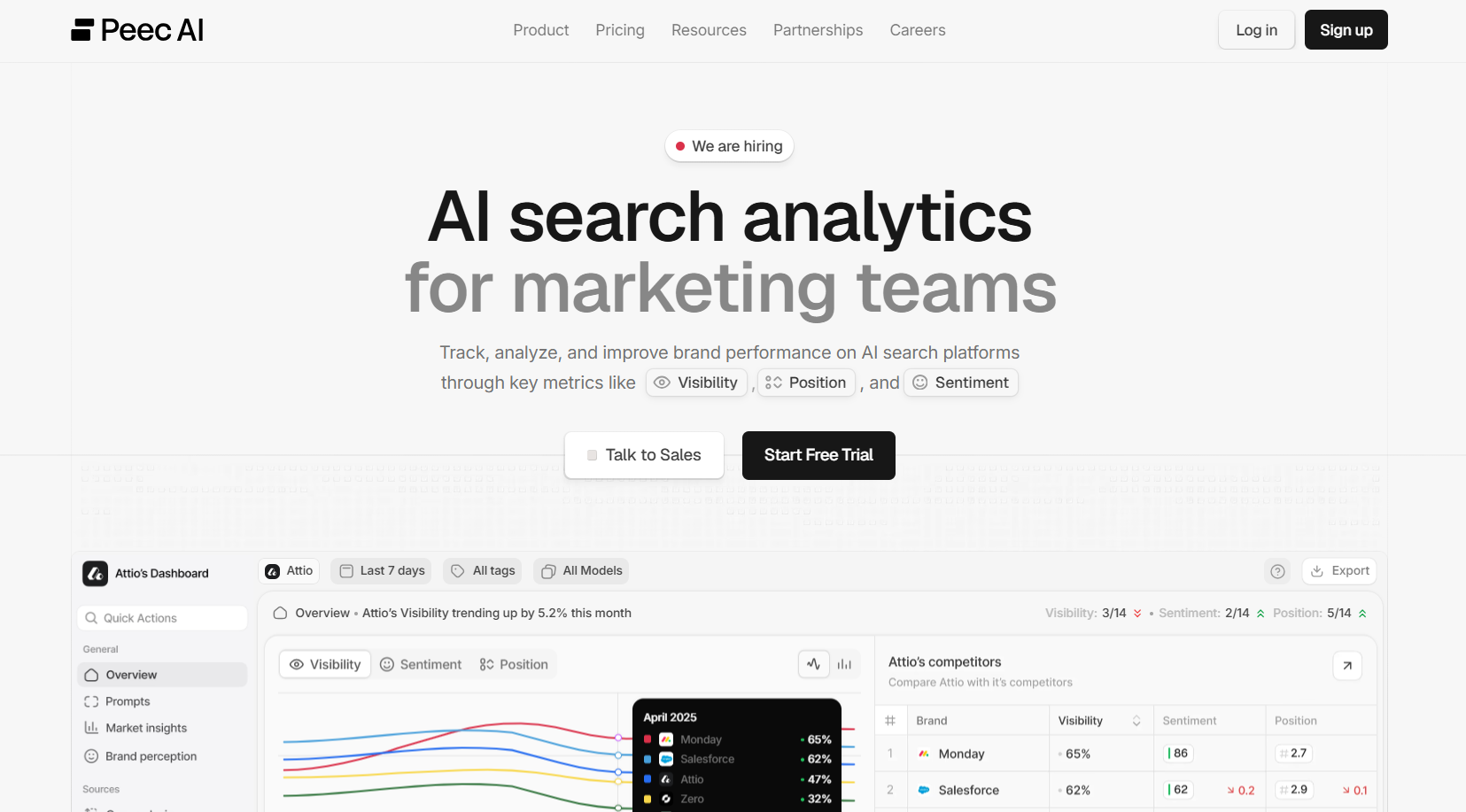
Peec provides one of the clearest distinctions in this category: being used as a source is not necessarily the same as being cited.
For domains, Peec tracks how often a source is retrieved by an AI system and separately calculates Citation Rate — how often that domain is explicitly referenced in the response when it was used. The same analysis is available at URL level.
This distinction can reveal an important gap. Your content may be contributing information behind the scenes without receiving explicit attribution, or your brand may be mentioned even though your own website is rarely used as a source.
Peec explicitly separates brand visibility from source visibility, making that relationship easier to analyze.
Main features
- Domain and URL retrieval tracking.
- Retrieval Rate showing how often a source enters the AI sourcing process.
- Citation Rate measuring explicit attribution when the source is used.
- Source visibility separated from brand visibility.
- URL-level details and retrieved page content.
- Daily tracking across selected AI models.
| 👍 Best for | 💰 Pricing plans |
|---|---|
| Mid-market marketing and SEO teams that want to understand the difference between being discovered by an AI system and actually earning a citation. | Starter: $80/mo. Pro: $205/mo. Advanced: $420/mo. Standard plans let you choose three models. |
Peec's standard plans limit model selection, so teams prioritizing the widest possible engine coverage may need Enterprise or another platform.
7. Otterly.AI
Otterly's citation reporting has become considerably more detailed in 2026.
Its Citations report now includes Top Winners and Top Losers, highlighting URLs with the largest citation increases or decreases compared with the previous period. A Citations Over Time chart gives the broader trend, while Citation Details connects an individual URL with its citation metrics, prompts, brand mentions, and competitors mentioned on the cited page.
The full cited-URL table can also be filtered by domain category, engine, country, and other dimensions, and users can star important citations to create a shortlist for later investigation.
This makes Otterly particularly useful when citation analysis is less about mapping the whole market and more about watching which specific sources are becoming more or less influential over time.
Main features
- Top Winners and Top Losers for citation changes.
- Citations Over Time trend analysis.
- Full cited-URL table with domain categories.
- Prompt-level details for each cited URL.
- Brand and competitor mentions on cited pages.
- Citation exports and saved/starred source lists.
| 👍 Best for | 💰 Pricing plans |
|---|---|
| Small and mid-sized teams that want detailed citation-change monitoring without starting with an enterprise platform. | Lite: $29/mo. Standard: $189/mo. Premium: $489/mo. Link Citations Analysis is listed among the more advanced plan capabilities. |
Otterly has a low entry price, but tracking capacity and additional engines can increase the effective cost as the project grows.
A few citation analysis tips from the Beamtrace team
Citation data becomes more useful when you stop treating every source as equally important. Here are four things we recommend checking before deciding what a citation pattern actually means.
- Separate your own citations from third-party influence
A citation to your website and a citation to a review, directory, article, or Reddit thread mentioning your brand are different signals.
Break citations into brand-owned, competitor-owned, and independent third-party sources first. That makes it much easier to understand whether AI is learning about you directly or relying mostly on what others say. - Read the answer around the citation
A citation count can look positive while the surrounding answer tells a different story.
Check whether the source supports a recommendation, provides a neutral fact, introduces a competitor, or is simply one reference among many. Citation context often matters more than the raw number. - Do not confuse retrieval with attribution
AI systems can retrieve or use a page without explicitly linking to it in the final answer.
If your tool exposes both signals, compare them. A page that is frequently found but rarely cited may present a different problem from a page that never enters the sourcing process at all. - Look for recurring source patterns, not individual URLs
One citation can disappear on the next run. More useful signals emerge when the same domain, content type, or source category repeatedly appears across related questions.
Look for patterns such as review sites dominating commercial prompts, documentation winning technical questions, or particular publishers appearing across several AI platforms. Those patterns tell you much more about the citation landscape than a single successful link.
The goal is not to maximize citation count at any cost. It is to understand which sources consistently shape the answers that matter to your audience and where your brand is missing from that picture.
Try it on your brand
Which sources are shaping your AI visibility?
See which pages AI cites around your business, how often they appear, and where your brand or content is missing from the source landscape.
Add your website.
Enter your website URL.
We analyze AI sources.
Beamtrace records the pages and references used in relevant AI answers.
See the citation picture.
Review cited pages, frequency, answer context, competitor sources, and citation gaps.
Which AI citation analysis tool should you choose?
The best AI citation analysis tool depends largely on what you want to learn from the sources behind AI answers.
| Your priority | Strong fit | Why |
|---|---|---|
| Connect citations with wider visibility diagnostics | Beamtrace | Exact pages and answer context sit alongside rankings, competitors, visibility, and optimization |
| Deeply segment citations by owner, audience, and funnel stage | Scrunch | Dedicated citation ownership, Influence Scores, and extensive filtering |
| Analyze citation behavior at enterprise and market scale | Profound | Citation Decay plus very large cross-industry citation datasets |
| Turn source gaps into SEO and outreach research | Semrush | Source Opportunities combined with AI Volume and wider SEO data |
| Discover the citation landscape beyond your tracked prompts | Ahrefs Brand Radar | Large search-backed index and found-vs-cited source analysis |
| Distinguish source retrieval from explicit attribution | Peec AI | Separate Retrieval Rate and Citation Rate metrics |
| Monitor URLs gaining and losing citation influence | Otterly.AI | Top Winners/Losers and citation-change reporting |
There is no single citation metric that makes one platform universally better. Scrunch and Profound provide considerably more depth for larger programs, while Ahrefs and Semrush benefit from the scale of their wider search datasets. Peec offers an unusually useful distinction between retrieval and attribution, and Otterly makes changes at individual URL level easy to follow.
Beamtrace takes a broader connected-workflow approach: citation analysis can start with an exact source or gap and then continue into the visibility, prompt, ranking, competitor, or optimization data around it. That is useful for teams that do not want citation analysis to live as a separate research process.
This comparison was prepared by the Beamtrace team to make current AI citation-analysis platforms easier to evaluate side by side. Since Beamtrace is included, we aimed to apply the same citation-focused criteria to every product and highlight both meaningful strengths and limitations. We hope the overview provides a useful starting point for choosing the approach that fits your own research needs and budget.