
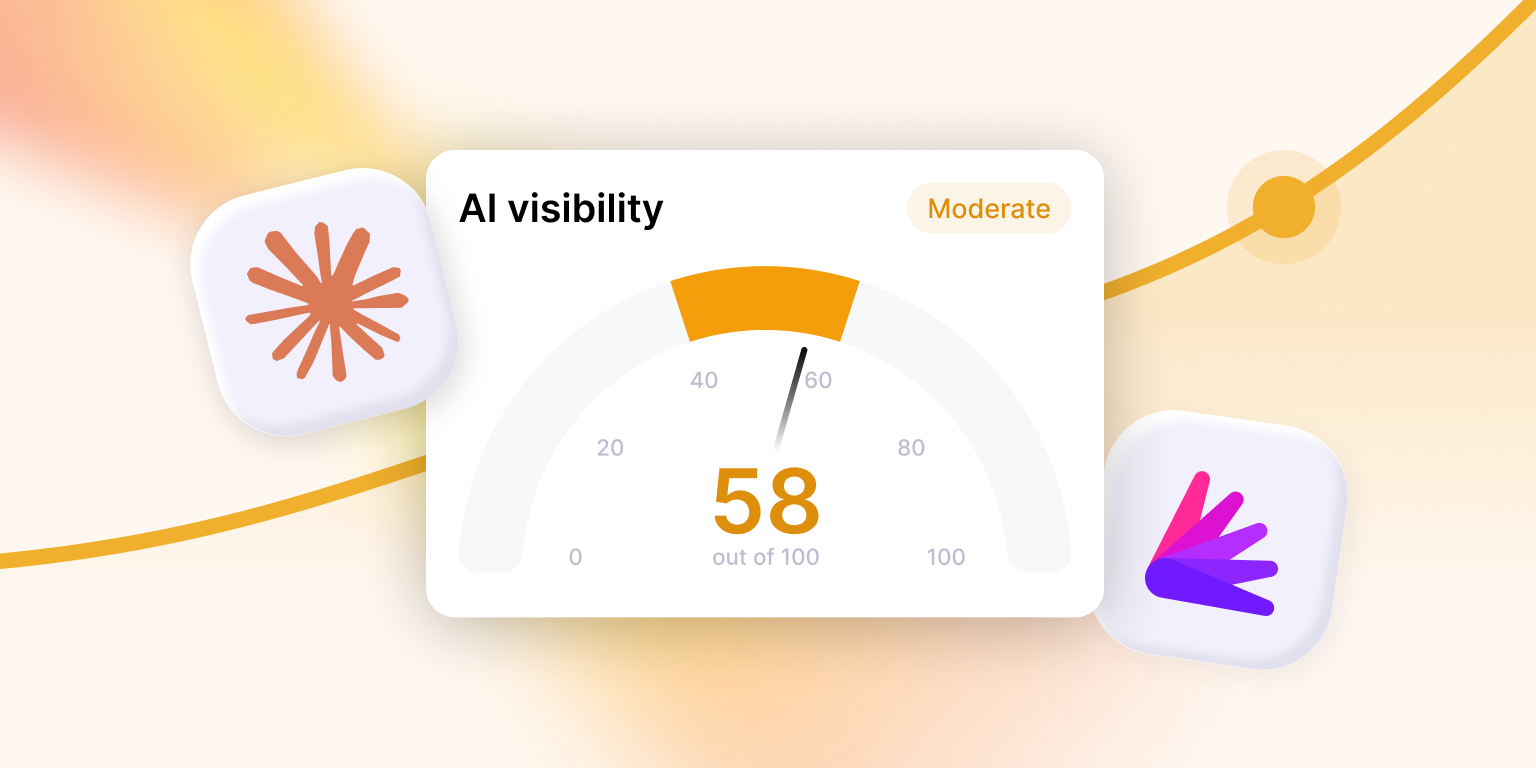
Claude's market position creates a strategic opportunity. Anthropic captured 40% of the enterprise LLM API market, meaning business decision-makers increasingly rely on Claude for research and vendor evaluation. Yet Claude drives only ~2.9% of AI referral traffic, far behind ChatGPT. If you gain visibility now while competition is sparse, you're positioned ahead of the curve as Claude's consumer adoption catches up — but only if you understand how Claude actually differs from other large language models.
This guide breaks down how to gain visibility in Claude: how its search system works, why the model’s ~86.7% alignment with Brave Search matters, and what its Constitutional AI filtering means for visibility, with a practical framework for improving Claude citations.
Why Claude is different: architecture and implications
On March 19, 2025, Anthropic added Brave Search to its official list of subprocessors, confirming that Claude uses Brave’s index rather than Google's or Bing's. This is significant because ~86.7% of Claude’s citations align with Brave’s organic rankings, meaning Brave SEO directly influences Claude visibility. Unlike ChatGPT, which only shows ~26.7% alignment with Bing due to heavy re-ranking, Claude largely trusts Brave's algorithm.
What does that mean for your business? Ranking in Brave Search strongly increases your chances of being cited in Claude, while poor Brave visibility likely means no inclusion at all. This makes Claude optimization more dependent on traditional search rankings, but within a narrower ecosystem. It also differs from ChatGPT and Perplexity, which apply more aggressive re-ranking on top of their search sources.
Claude also shows only ~20% overlap with ChatGPT citations, reflecting its more selective sourcing. Guided by Constitutional AI, it tends to favor balanced, clearly attributed, non-promotional content and typically cites fewer sources (3–4 vs. ChatGPT’s broader sets). In practice, it means that ChatGPT rewards breadth, Perplexity rewards citation coverage, and Claude rewards trust and source quality.
The dual-pathway framework: training data vs. web search
Claude doesn't pull from a single content source. Instead, it operates on two distinct pathways, each requiring different optimization tactics.
Training data pathway
Claude's base knowledge comes from snapshots of web content, documentation, and other sources collected during training. The current models have these knowledge cutoffs:
- Claude Opus 4.6: August 2025
- Claude Sonnet 4.6: January 2026
- Claude Haiku 4.5: July 2025
If your content was indexed and included in these training snapshots, Claude can reference it without ever triggering a web search. This pathway is closed, i.e., you can't update training data retroactively. Your only opportunity is to ensure your content is well-structured, authoritative, and discoverable when Anthropic trains its next model.
Web search pathway
Claude uses a server-side web search tool that it selectively invokes based on the user’s query. It isn’t always active — the model analyzes each prompt and determines whether fresh web data would improve the response. Time-sensitive queries, such as current prices and recent events, typically trigger search; evergreen questions rely on training data, and local queries use contextual location signals to fetch relevant results.
The technical documentation confirms that users can explicitly force search by phrasing prompts ("search the web for..."), and developers using Claude's API can control search behavior through parameters such as max_uses, allowed_domains, and blocked_domains.
However, search invocation is not 100% consistent — a known limitation where some queries that would benefit from fresh data don't automatically trigger a search.
Here's how query types map to pathways:
| Query type → | Claude’s source → | Optimization target |
|---|---|---|
| Time-sensitive queries | Web search | Brave Search rankings + recency signals |
| Evergreen/definitional | Training data | Historical authority + documentation quality |
| Local queries | Web search | Brave local SEO + structured data |
| Product recommendations | Mixed, depends on context | Both pathways |
You're not optimizing for one system. You're optimizing for two, and the tactics differ significantly between them.
How Claude's web search actually works
When Claude decides to trigger a web search, here's the technical flow it follows, according to Anthropic's API documentation:
- Claude analyzes the user’s prompt and decides whether fresh web information would improve the response.
- If search is needed, Claude reformulates the natural-language question into a structured, search-optimized query (e.g., turning “best CRM software for small teams” into a format Brave Search can interpret more effectively).
- The query is sent to Brave Search, which returns the top ~10 organic results.
- Claude reviews these results and filters them based on relevance, recency, and overall quality using its own evaluation criteria.
- Claude synthesizes the final answer and adds inline citations directly within the text, rather than using separate footnote-style references.
The latest web search tool version (web_search_20260209) supports dynamic filtering, where Claude can write and execute code to post-process search results before loading them into its context window. This reduces irrelevant content and token consumption, allowing Claude to focus on the most useful sources.
If Claude's confidence in the answer is low, it can loop, i.e., reformulate the query, run another search, and refine the response. This agentic behavior means Claude sometimes makes *multiple *search attempts for a single user question, particularly for complex or ambiguous queries.
From Anthropic's web search API announcement:
"Claude can progressively search for information, refining its queries based on what it learns — similar to how a researcher might conduct multiple searches while investigating a topic."
This progressive querying matters because Claude isn't locked into a single keyword formulation. If your content comprehensively addresses a concept, you have multiple opportunities to appear as Claude refines its search approach.
The three-bot framework: ClaudeBot, Claude-User, Claude-SearchBot
Anthropic operates three distinct web crawlers, each serving a different purpose in Claude's content pipeline. Understanding these bots and configuring your robots.txt appropriately gives you precise control over how Claude accesses your content.
ClaudeBot
ClaudeBot (user-agent: ClaudeBot) is the training data crawler. It discovers and indexes web content for inclusion in future model training datasets. If you want your content to appear in Claude's base knowledge for the next model release, you need to grant ClaudeBot access. Blocking it means your content won't be part of training data snapshots, though it can still be found via web search.
Claude-User
Claude-User (user-agent: Claude-User) handles web search requests from the consumer-facing claude.ai interface. When someone uses Claude's web search feature in the standard chat interface, this is the bot that fetches content. Blocking Claude-User prevents your content from appearing in search results for claude.ai users but doesn't affect API-based implementations.
Claude-SearchBot
Claude-SearchBot (user-agent: Claude-SearchBot) handles web search for developers using Claude's API with the web_search tool enabled. Enterprise and developer implementations rely on this bot. If you block Claude-SearchBot, your content won't appear in Claude search results for applications built on the API.
The official crawler documentation notes that ClaudeBot respects standard crawl-delay directives and follows robots.txt rules. Most sites should allow all three bots unless you have specific reasons to limit Claude's access to proprietary content or paid subscription areas.
Try it on your brand
How visible is your brand in AI search right now?
Get a clear picture of your current AI presence before you start working on the signals that can improve it.
Add your website.
Enter your website URL.
We check your visibility.
Beamtrace runs your prompts and captures where you're mentioned.
See your mentions.
Positions, context, competitors, and visibility gaps to prioritize.
What makes content Claude-worthy: confirmed optimization strategies
Research into Claude's citation patterns reveals consistent factors, though Anthropic hasn't published official documentation on citation criteria. What follows is based on third-party analysis and observable Claude-specific behavior.
Brand authority
Brand authority emerges as the strongest predictor. Research analyzing AI citation patterns found that brand authority (measured by brand search volume) shows a 0.334 correlation coefficient with AI citations — stronger than any technical signal. This suggests Claude (or Brave's algorithm feeding Claude) uses brand recognition as a proxy for trustworthiness.
Content structure and clarity
Content structure matters beyond generic "use headings" advice. Claude rewards a clear hierarchical organization where main points are introduced early and supporting details follow logically. The Stanford "Lost in the Middle" study found that LLMs systematically underweight information in the middle of long contexts: attention follows a U-shape, with greater weight at the beginning and end. Front-load key information rather than burying your main point in the third paragraph.
Claude also shows the "most aggressive content filtering" among LLMs tested in searchVIU's experiment. The model extracted 0/8 test prices from pages where pricing information existed in schema markup or JavaScript but not in clean text. This means critical information must appear in an accessible text format — Claude won't parse complex markup or scripts to extract data.
Constitutional AI filtering
Constitutional AI filtering creates a measurable preference for balanced, well-attributed content. Observable patterns show that content that presents multiple perspectives, acknowledges limitations, and clearly attributes claims performs better than content that makes absolute statements without qualification.
This doesn't mean hedging every sentence — it means avoiding promotional language, inflammatory framing, and unsupported superlatives.
Selective citation
Claude's selective citation behavior ("fewer but higher-quality sources") means depth beats keyword density. Content thoroughly addressing one aspect of a topic outperforms superficial coverage of ten aspects. The Aggarwal et al. paper on Generative Engine Optimization found that keyword stuffing performs worse in GEO contexts than in traditional SEO — a pattern that directly applies to Claude's preferences.
Natural language structure consistently beats SEO-optimized phrasing. Write for human comprehension first, search engines second. Claude's Constitutional AI training emphasizes clear communication, which means content written in straightforward prose without awkward keyword insertion performs better than heavily optimized text that sacrifices readability.
Brave Search optimization: the critical lever
The 86.7% alignment between Claude's citations and Brave's organic rankings means Brave Search optimization isn't supplementary — it's foundational. If you don't appear in Brave's top results for relevant queries, Claude won't find you regardless of content quality.
Brave's ranking philosophy differs from Google's in ways that create specific opportunities. Brave prioritizes:
- Privacy-first content w/o aggressive tracking or dark patterns
- Recently updated content
- Diverse perspectives over algorithmic echo chambers)
- Open content over paywalls and authentication
Brave's index contains approximately 40 billion pages, compared to Google's hundreds of billions — a smaller, curated ecosystem with less competition for visibility but narrower niche coverage. Brave doesn't incorporate direct brand preference signals like Google's E-E-A-T, though indirect brand signals (ranking for your own brand name) still matter based on the patterns we noted earlier.
The tactical implication: check your Brave Search rankings separately, even if you rank well in Google. Brave's smaller index and different ranking philosophy mean Google positions don't automatically transfer. Run the same queries in Brave and identify gaps where you appear on Google page one but are absent from Brave's results — those are your Claude optimization priorities.
Content characteristics that improve AI citations generally
While Claude-specific optimization studies are limited, broader research on AI citation patterns reveals tactics likely to transfer given Claude's similar retrieval architecture.
Entity density and specificity
Analysis of AI-cited content reveals entity density of approximately 20.6% (proper nouns, brand names, tools, people) compared to 5-8% in standard English text. Higher entity density correlates with higher citation likelihood across platforms.
The Information Density Formula proposed by iPullRank captures this pattern: Information Density = (Unique Entities + Factual Claims) / Total Word Count. Higher density correlates with higher citation-worthiness.
Named entities outperform generic descriptions consistently. "Amazon EKS" gets cited more than "a major cloud provider's container orchestration platform." Specific product names, company names, and proper nouns improve citation rates.
Content formats and structure
Comparison tables with data show strong performance: 32.5% of AI citations involve comparison tables. Tables showing side-by-side feature comparisons, pricing tiers, or specification differences perform 2.5 times better for citations than the same information presented in prose.
Self-Contained Content Units (SCUs), i.e., content blocks that retain their full meaning when taken out of context, exhibit higher citation rates. The optimal chunk size is 50-150 words per discrete topic section, allowing AI systems to extract and cite specific information without needing surrounding paragraphs for context.
Step-by-step processes with specific parameters outperform vague instructions. Procedural content with concrete details ("bake at 375°F for 22 minutes") gets cited more than generic guidance ("bake until done").
Data and verification
Numerical data with context performs better than qualitative descriptions. "40% increase in conversion rates" gets cited more than "significant improvement." AI models reference quantifiable claims more frequently.
Original or proprietary data — content that provides unique information LLMs can't find elsewhere, such as original research, survey results, or proprietary benchmarks — is cited more frequently because it fills information gaps.
External validation and freshness
Traditional link-building may be less effective for AI visibility than brand-building through press mentions and multi-platform presence. Analysis of Herman Miller’s AI visibility found that 273 pages of press mentions (Yahoo, CBS, The Independent, etc.) containing "ergonomic" in one year contributed to consistent brand recommendations — external validation mattered more than owned content optimization.
URLs cited in AI results are 25.7% fresher on average than those in traditional search results. Research shows 65% of AI citations come from content published in the past year. However, recency alone doesn't guarantee citations — a newly published article from an established expert carries more weight than fresh content from an unknown source.
GEO tactics backed by research
The most rigorous evidence for generative engine optimization comes from the Aggarwal et al. study, which found GEO tactics can boost visibility in AI responses by up to 40%. The strongest gains came from Statistics Addition (+22%) and Quotation Addition (+37%), highlighting the impact of adding concrete data and expert-backed statements.
Statistics Addition involves adding specific, cited data points, while Quotation Addition uses expert or authoritative quotes to increase credibility. Both align with Claude’s preference for well-attributed, evidence-backed content, especially when key information is front-loaded.
The study was conducted on Perplexity, not Claude, but the principles likely transfer due to similar citation mechanisms. It also confirmed that keyword stuffing underperforms in generative systems — consistent with Claude’s behavior.
Limited evidence: what we know from early adopters
Documented Claude optimization case studies are still scarce because Claude’s consumer web search only launched in March 2025, leaving too little time for longitudinal analysis.
Even so, the patterns observed suggest Claude visibility is achievable and likely follows predictable patterns: strong Brave Search rankings combined with trust signals that pass Constitutional AI filtering. However, results may vary significantly by context (e.g., local services vs. SaaS or e-commerce).
Supporting academic research offers proxy insight. Wu et al. (Nature Communications, 2025) found that 50–90% of LLM outputs are not fully supported by cited sources, with even GPT-4o showing ~30% unsupported statements despite web search. This reinforces Claude’s more selective, conservative citation behavior, but also implies a higher bar for being cited compared to more permissive systems.
Structured data and technical signals: what works (and what doesn't)
Schema markup
Schema markup has a mixed impact on Claude. Some evidence suggests it helps with content understanding, but testing indicates no direct citation preference when rankings are equal. Its value is likely indirect — improving Brave Search rankings, which then influences Claude visibility.
LLMs.txt standard
The llms.txt standard remains unproven. Anthropic hasn’t confirmed support, and no studies show a clear impact on Claude citations, so it should be treated as experimental.
Author expertise
Author bios and expertise signals may help via Brave’s ranking algorithm, but there’s no evidence Claude evaluates them directly. Any benefit is indirect, coming from improved search visibility rather than a standalone influence on citations.
Monitoring and measurement
Claude’s selective citation behavior and non-deterministic outputs make manual tracking unreliable beyond small sample sizes. The same query can surface different sources as Claude reformulates its search, so meaningful visibility tracking requires systematic monitoring across many prompts.
Several tracking tools now support this. Profound tracks brand mentions across AI platforms, including Claude, Panto AI focuses on citation tracking and competitive analysis, and Beamtrace is building Claude support (currently live for ChatGPT). For passive insight, GPTBot Blocker shows which AI bots access your site.
Unlike SEO, Claude has no Search Console equivalent, and Anthropic provides no APIs for citations or impressions. As a result, tracking relies on repeated prompt testing and citation analysis, constrained by cost and response variability.
Final thoughts
Claude’s ~2.9% AI referral traffic share versus its ~40% enterprise API market share highlights a clear gap between consumer adoption and enterprise influence. As consumer usage grows, this gap is likely to narrow — and early visibility may give current brands a compounding advantage.
Claude’s selectivity is both the barrier and the benefit. It relies heavily on Brave Search rankings, applies Constitutional AI filtering for trust and balance, and returns fewer citations per response. While this makes visibility harder to achieve, it also produces more focused, higher-signal recommendations.
This is fundamentally a trust-driven system, not a volume game. To increase visibility in Claude, focus on:
- Strong Brave SEO
- Clear and structured content
- Minimal promotional tone
- Front-loaded key information
The technical lift is simpler than ChatGPT’s re-ranking systems, but the editorial bar is higher — rewarding genuine authority over shortcuts.
Frequently asked questions
Can I optimize for Claude the same way I optimize for ChatGPT?
No. Claude relies on Brave Search with ~86.7% alignment, so rankings matter more. ChatGPT heavily re-ranks Bing results (~26.7% alignment). Claude also uses a dual pathway (training data + search), unlike ChatGPT’s more search-heavy approach.
What's the difference between ClaudeBot and Claude-SearchBot?
ClaudeBot crawls content for training data, while Claude-SearchBot handles real-time search. Claude-User powers searches on claude.ai. Each can be controlled separately in robots.txt.
Does Claude favor certain types of content or industries?
Constitutional AI creates a measurable preference for balanced, well-attributed, non-sensational content, but this is a tone-and-structure filter rather than an industry preference. The selectivity comes from trust signals (clear attribution, balanced perspectives, and avoidance of promotional language) that any content can demonstrate, regardless of industry.
How long does it take to see results from Claude optimization?
For training data visibility, you won't see results until Anthropic releases the next model with an updated knowledge cutoff — these releases aren't on a public schedule. As for web search, there's no official timeline because Claude's search invocation isn't deterministic, and we're still in the early stages where longitudinal benchmarks don't exist. Early evidence suggests weeks to months once Brave rankings improve, but controlled studies haven't been published yet.
Which tools can track Claude brand visibility?
Several platforms now offer Claude AI brand visibility tracking capabilities. Profound monitors brand mentions across multiple AI platforms, including Claude. Panto AI provides citation tracking and competitive analysis. Beamtrace is building Claude support — currently live for ChatGPT, with Claude integration coming soon. These tools work by systematically querying Claude with relevant prompts and analyzing citation patterns over time.
Is schema markup important for Claude?
Not directly. It may help indirectly by improving Brave rankings, but there’s no clear evidence Claude prefers schema-marked content. Implement schema for general search benefits rather than expecting Claude-specific impact.
Key references
- Anthropic, Web Search Tool Documentation – https://platform.claude.com/docs/en/agents-and-tools/tool-use/web-search-tool
- The Diginal Bloom, 2025 AI Citation & LLM Visibility Report – https://thedigitalbloom.com/learn/2025-ai-citation-llm-visibility-report/
- Aggarwal et al., GEO: Generative Engine Optimization (ACM KDD 2024) – https://arxiv.org/abs/2311.09735
- Wu et al., SourceCheckup: Citation Accuracy in Large Language Models (Nature Communications 2025) – https://www.nature.com/articles/s41467-025-58551-6
- BrightEdge, Claude Search Implementation Guide – https://www.brightedge.com/claude-search
- Ahrefs, LLM Optimization – https://ahrefs.com/blog/llm-optimization/
- Victorino Group, What 1.2 Million ChatGPT Responses Actually Reveal About LLM Citation Patterns – https://victorinollc.com/thinking/llm-citation-attention-patterns
- searchVIU Schema Markup and AI in 2025 – https://www.searchviu.com/en/schema-markup-and-ai-in-2025-what-chatgpt-claude-perplexity-gemini-really-see/
- Digital Applied, AI Search SEO Statistics 2026 – https://www.digitalapplied.com/blog/ai-search-seo-statistics-2026-definitive-collection
- Incremys, Claude Statistics – https://www.incremys.com/en/resources/blog/claude-statistics