
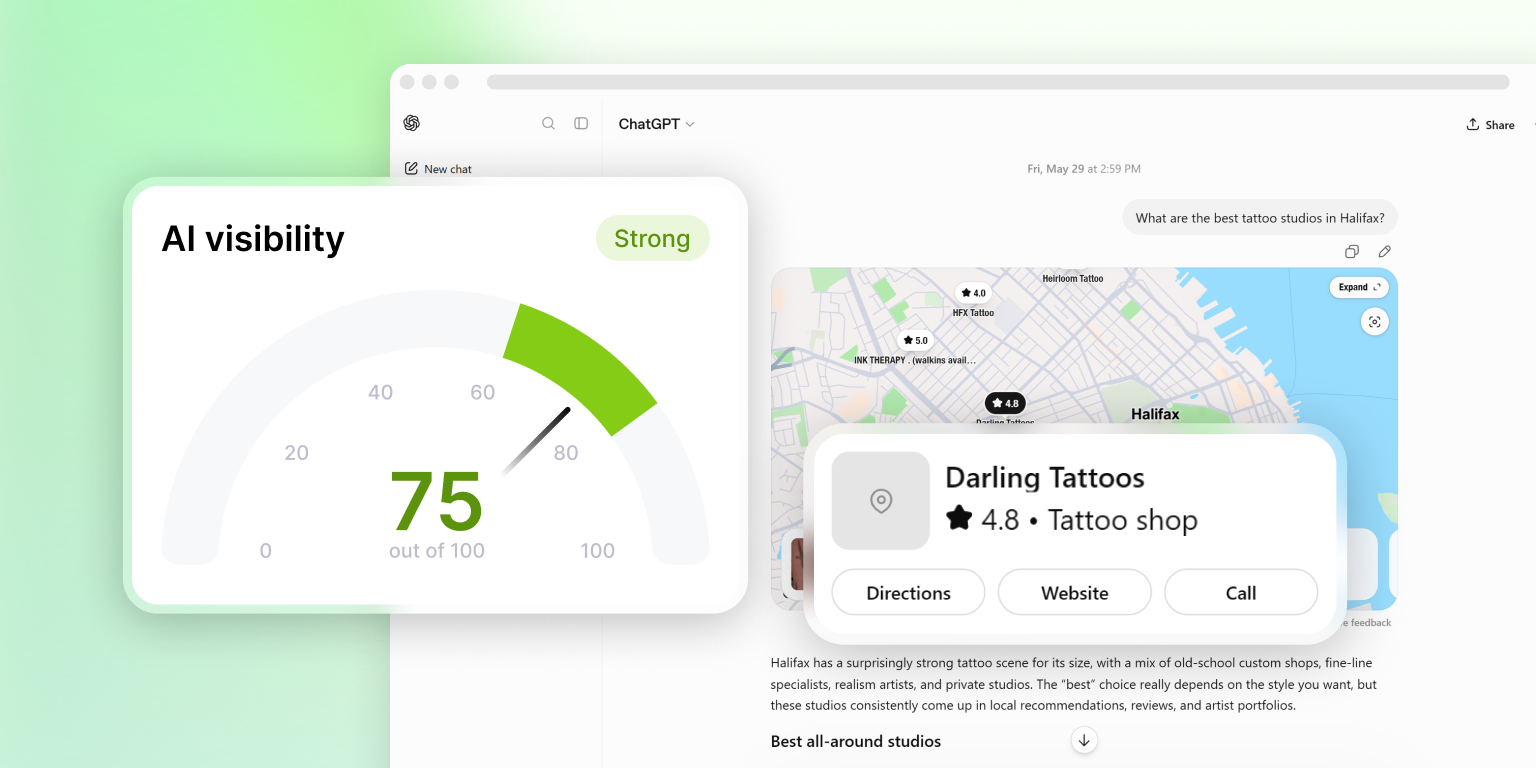
ChatGPT is non-deterministic: ask it the same question twice, and you'll get two different answers. Today, your brand is at the top of the list; tomorrow it could vanish or rank lower. For anyone trying to track brand mentions on ChatGPT, that's the whole problem in one line: a single check is a snapshot, not a measurement.
It gets even messier if you consider the variables: whether a mention came from training data or a live web search, whether Memory quietly personalized the response, and which version of ChatGPT you’re trying to track. This guide walks through each of these traps and the method that gets past them – so you end up with a ChatGPT visibility number you can actually trust.
How to track brand mentions on ChatGPT manually
There are two routes: by hand or with a tool. They rely on the same principles, so the manual method is worth understanding even if you plan to automate it.
The order of the steps matters because each one removes a specific source of distortion:
- Start a clean session. Log out, use a Temporary Chat, or open an incognito window so past chats and saved memory won’t shape the answer you see.
- Run each prompt with web search off, then on. Search ‘off’ shows what the model recalls from training; search ‘on’ shows what it retrieves in real time.
- Use realistic prompts and vary the wording. Write three to five phrasings for each buying intent, and mix category prompts ("best project management tools") with brand prompts ("is [your brand] any good").
- Repeat each prompt multiple times. Five to ten runs per phrasing is a workable floor. Note whether your brand appears each time.
- Record the model version and your location. Both shift results, and you will want them later to explain the change.
- Measure how often you appear, not where you rank. The share of runs in which your brand shows up (your visibility %) is a stable number. The position it lands in is mostly noise.
How many runs you need depends on how crowded your category is and how precise a figure you want. The table below is a practical starting point:
| Situation | Runs per phrasing | Phrasing variations per intent |
|---|---|---|
| Quick manual spot-check | 5–10 | 3–5 |
| Crowded or competitive category | 10+ | 3–5 |
| Research-grade, stable percentage | 60–100 | 3–5 |
The jump to 60–100 runs is when manual checking becomes impractical, and most people move to a dedicated tracking tool.
How often to check
Weekly tracking is a sensible default for most brands. Daily makes sense in fast-moving or competitive categories, and it is worth a manual spot-check after a product launch, a PR push, or a known model update.
One habit is worth building in from the start: annotate your tracking timeline with ChatGPT model-version release dates. Thus, a shift in your numbers won’t be mistaken for a change in your own performance.
Fuller cadence and ownership questions are covered in our guide to tracking brand mentions across AI search.
Tracking ChatGPT brand mentions with tools
A tracking tool runs your prompts on a schedule, at a volume that would take hours by hand, and counts mentions and visibility percentage for you.
The workflow
With AI visibility trackers like Beamtrace, the manual routine above turns into a set-up-once process:
- Add your brand. Enter your brand and website, plus the competitors you want to measure against.
- Explore by topic. Review the queries and intents it surfaces, grouped into topics such as brand trust, general discovery, and product-specific searches.
- Track visibility over time. Monitor your Visibility Score and how often you are mentioned, followed as a trend rather than a single snapshot.
- Read each mention. Note the typical position you hold, along with the context and sentiment of individual mentions.
- Benchmark competitors. Compare side by side, including your share of voice and topic rankings.
- Drill into prompts. Open prompt-level results to see which specific queries you win and which ones you lose.
There are several ChatGPT trackers available at different price points and levels of capability; the choice of tool largely depends on your tracking goals and business type.
Try it on your brand
Does ChatGPT mention your brand?
Run your brand through ChatGPT and see every mention, in context — no manual checking.
Add your website.
Enter your website URL.
We check ChatGPT.
Beamtrace runs the prompts and captures where you're mentioned.
See your mentions.
Frequency, context, sentiment, and the sources ChatGPT pulled from.
Why your numbers are usually wrong
The routine above looks fussy for a reason. Four things quietly corrupt a ChatGPT tracking figure, and each step in the method exists to neutralize one of them.
The same prompt rarely repeats
As we highlighted previously, LLMs are non-deterministic. The same prompt returns different brand mentions in ChatGPT answers run to run.
The clearest evidence comes from a study in which 600 volunteers ran 12 brand-recommendation prompts a combined 2,961 times across ChatGPT, Claude, and Google's AI in late 2025. It found a less-than-1-in-100 chance that two runs return the same brand list, and roughly a 1-in-1,000 chance of the same list in the same order. Every response varied in three ways: which brands appeared, their order, and how many were listed.
The practical conclusion is the one baked into the manual method: ordinal position is noise, and visibility percentage measured across many runs is the signal worth tracking.
Your logged-in account isn't neutral
If you check while logged in, you won't see what a random user sees. ChatGPT's memory works two ways: facts it saves explicitly, and inferences it draws automatically from your past chats. Both personalize responses, potentially including which brands surface.
OpenAI's own documentation states the fix plainly:
Temporary Chats do not use existing memories or create new memories. – OpenAI Memory FAQ
Custom instructions add another layer of personalization on top. This is why the first step of the manual method is to strip the session back to a neutral state before you prompt.
API vs consumer app
Most automated trackers query ChatGPT programmatically, but the API and the consumer app are not the same product. They can run different model settings, and the API might not return the web-search citations the app shows, so a tool can report a version of ChatGPT your customers never actually encounter.
Before you trust a number, ask two questions:
- Does it query ChatGPT through the API or through the consumer app?
- Does it run with web search on or off?
The model changes every few weeks
OpenAI ships GPT-5.x updates on roughly a six-week cadence and retires older versions a few months after a successor arrives.
Each swap can change which brands surface: one analysis found the average number of unique domains cited per response fell from 19 to 15 after a spring 2026 model update.
The consequence for tracking is that a visibility trend line can drop for reasons that have nothing to do with your brand or your content. Annotating your timeline with model release dates is what lets you tell an OpenAI update apart from a genuine change in your visibility.
How to read and analyze what you find
Once you have a reliable number, the next task is interpreting it, because a ChatGPT mention is not a single kind of thing.
What kind of mention is it?
A brand mention comes from one of two places: the model's training data or a live web search. Most ChatGPT answers still come from training data.
Two large studies put the share of prompts that trigger a web search at roughly a third, with one clickstream dataset of over a billion lines finding 34.5% as of early 2026, down from 46% in late 2024 and swinging between 15% and 66% month to month. The figure is volatile, so treat "roughly a third, and declining" as the honest read.
A training-data mention reflects your baked-in reputation, usually carries no citation, and changes only when the model updates; therefore, you cannot fix it quickly. A *retrieved *mention reflects current web content, usually carries a link, and responds to content work within days.
Missing from search
The search-off and search-on runs from your routine are the diagnostic. If you are missing with search off but present with search on, you have a brand-authority problem**.** If it is the reverse, you have a content and retrieval problem.
The two fixes pull in different directions. Closing a brand-authority gap is the slower work of building the extent to which your brand is referenced widely and credibly across the web, since that is what a model eventually absorbs into its training. A retrieval gap is more tractable and responds to the usual on-page optimization that makes a page easy for ChatGPT to read and quote back.
What ChatGPT "position" means
Unlike Google's ranked list or Perplexity's numbered citations, ChatGPT returns synthesized prose, so position is a soft construct.
Trackers read it three ways: the order in which brands are named, placement within a comparison table if one appears, and citation or footnote order when a web search is on.
*How *the model frames you tends to matter more than where you land. Being cited as the source ("According to [Brand]...") carries more weight than being one name in a list, which is another reason ordinal rank makes a weak headline metric when you track brand mentions in ChatGPT responses.
Which ChatGPT surface you're on
Not all of ChatGPT is one surface, and which one your buyers use should shape what you track.
Conversational ChatGPT leans on training data and rarely cites links. ChatGPT Search retrieves live results and shows source links, so visibility there reflects your current SEO and content. ChatGPT Shopping is a distinct product surface that matters most to e-commerce brands.
Segment your tracking to match: a strong Conversational presence with weak Search presence is a different problem, with a different fix, than the reverse.
Frequently asked questions
Can you check brand mentions in ChatGPT for free?
Yes. The manual routine costs nothing: start a clean session, run your prompts with web search off and on several times each, and count how often your brand appears. The underlying method is free to try on your own, but it doesn’t scale. You can also always jump in to test the tracker tools’ capabilities on a free trial.
How often should you monitor brand mentions in ChatGPT?
Weekly is a sensible default for most brands, and daily suits fast-moving or competitive categories. Add a manual spot-check after a product launch, a PR push, or a known model update, since each can move your numbers quickly.
Why does ChatGPT mention my brand in some answers but not others?
Because responses are non-deterministic, the same prompt returns different brands from one run to the next, and periodic model updates change which brands surface. That variability is exactly why a single check is unreliable and why frequency across many runs is the number to trust.
Do tracking tools measure ChatGPT accurately?
They can, but accuracy depends on what they query. A tool that hits the API rather than the consumer app, or runs with web search off, can miss mentions your customers actually see. Ask any tool, ours included, which surface it measures and whether search is on.
How many times should you run a prompt to get a reliable number?
For a manual spot-check, five to ten runs across three to five phrasings give a rough read. A genuinely stable visibility percentage takes far more, on the order of 60 to 100 runs per prompt, which is the main reason people automate the work.
Conclusion
The number of ChatGPT brand mentions you screenshot from a single chat is mostly noise – the next chat might surface something entirely different. What matters is frequency: how often your brand appears across many clean, controlled runs. That is the throughline of everything above, from the emphasis on visibility percentage over rank to the insistence on a neutral session and a large enough sample.
Get the session hygiene right, sample enough to smooth out the randomness, note which model version produced the results, and read whether a mention came from training data or live retrieval.
Key references
- SparkToro / Gumshoe.ai — "NEW Research: AIs are highly inconsistent when recommending brands or products." January 2026. https://sparktoro.com/blog/new-research-ais-are-highly-inconsistent-when-recommending-brands-or-products-marketers-should-take-care-when-tracking-ai-visibility/
- OpenAI — Memory FAQ. 2025–2026. https://help.openai.com/en/articles/8590148-memory-faq
- Semrush — "ChatGPT traffic analysis: Insights from 17 months of clickstream data." April 2026. https://www.semrush.com/blog/chatgpt-search-insights/