
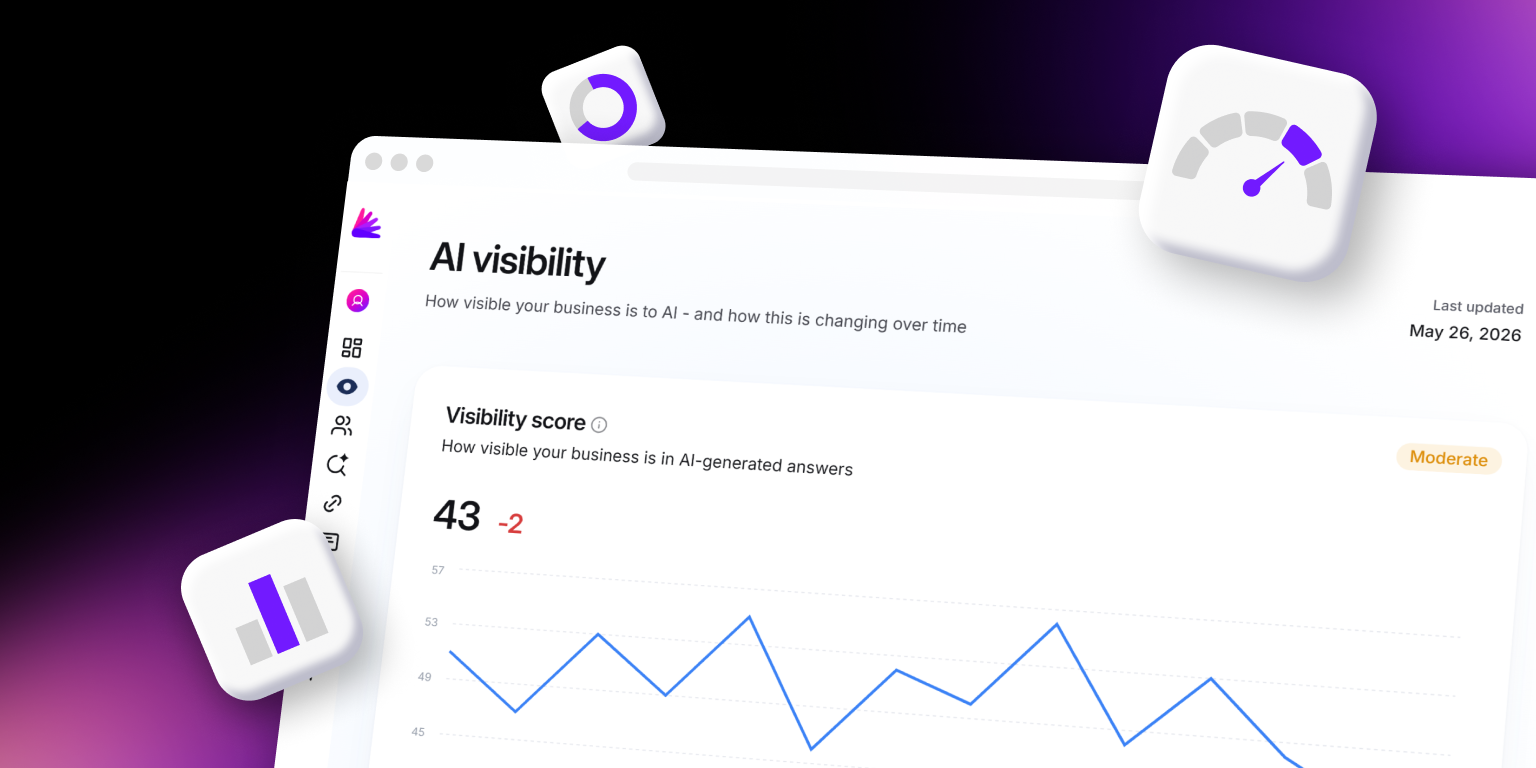
Checking ChatGPT once does not tell you how visible your brand really is in AI search. You may appear for one question and disappear for another, perform well on one platform but barely surface elsewhere, or see a few new mentions that do not yet represent a real trend.
A useful AI visibility tool should show not just whether your brand appears, but how consistently it appears, how broad that presence is, and whether visibility is changing over time.
Choosing the best tool to track AI search visibility for a brand depends on whether you need a clear visibility baseline or a broader system for investigating what drives it. Some platforms are full GEO suites, while others focus on rankings, citations, prompts, or competitor research. Here, we compare them specifically on how well they measure overall brand visibility in AI search.
Best AI search visibility tools at a glance
| Tool | Best for | Starting price | What stands out for visibility | Main trade-off |
|---|---|---|---|---|
| Beamtrace | SMBs and marketing teams | $20/mo | Visibility Score + visibility gaps connected to rank, competitor, citation, and optimization workflows | Lighter enterprise infrastructure |
| Profound | Enterprise and larger marketing teams | $99/mo | Daily browser-captured AI answers + Prompt Volumes based on real-user AI queries | Full multi-engine coverage and advanced workflows require higher tiers |
| Semrush AI Visibility | SEO and content teams | $165/mo per domain | 317M+ prompt database with AI Volume, audience estimates, and visibility data connected to SEO | Base plan tracks only 25 custom prompts |
| Ahrefs Brand Radar | SEO and market research teams | From $199/mo per AI index | 467M+ search-backed prompt index with estimated impressions weighted by search volume | Large-scale index access gets expensive across multiple AI platforms |
| Peec AI | Mid-market teams and agencies | $80/mo | Simple four-metric model — Visibility %, Position, Sentiment, and Share of Voice — updated daily | Standard plans let you choose only 3 models |
| Otterly.AI | Small teams and solo marketers | $29/mo | Brand Coverage separated from Share of Voice, with daily tracking across 65+ markets and languages | Lite includes only 15 prompts and 4 engines; others are add-ons |
| Rankscale | Agencies and advanced users | From $80/mo | 17+ AI engines with hourly-to-monthly schedules, all-region tracking, and unlimited search-term creation | Credit-based usage makes monthly cost less predictable |
Pricing and plan details change quickly, so check the current plan before making a final decision.
How we evaluated these tools
We compared each platform specifically as an AI search visibility tracking tool, rather than judging it by the total number of GEO, SEO, content, or competitive-intelligence features it offers.
Five areas mattered most.
Overall visibility measurement. Does the platform give you a useful top-level view of how consistently the brand appears in AI-generated answers?
AI platform coverage. Can visibility be measured across the AI environments that matter to your audience?
Historical tracking. Can you distinguish a sustained improvement or decline from a one-time change in an AI response?
Visibility breakdowns. Can the overall result be explored by platform, topic, market, or another meaningful dimension?
Practical fit. We also considered setup, tracking limits, reporting, and how much ongoing measurement costs.
Features such as exact rank tracking, individual prompt monitoring, citation analysis, competitor research, and sentiment can help explain why visibility changes. They were not the main criteria here because each represents a separate analysis workflow.
That distinction is important when choosing the best tool for measuring visibility in AI search. More features do not automatically make a platform better at answering the basic question: Is our brand becoming more visible?
Best AI Visibility tools compared
1. Beamtrace
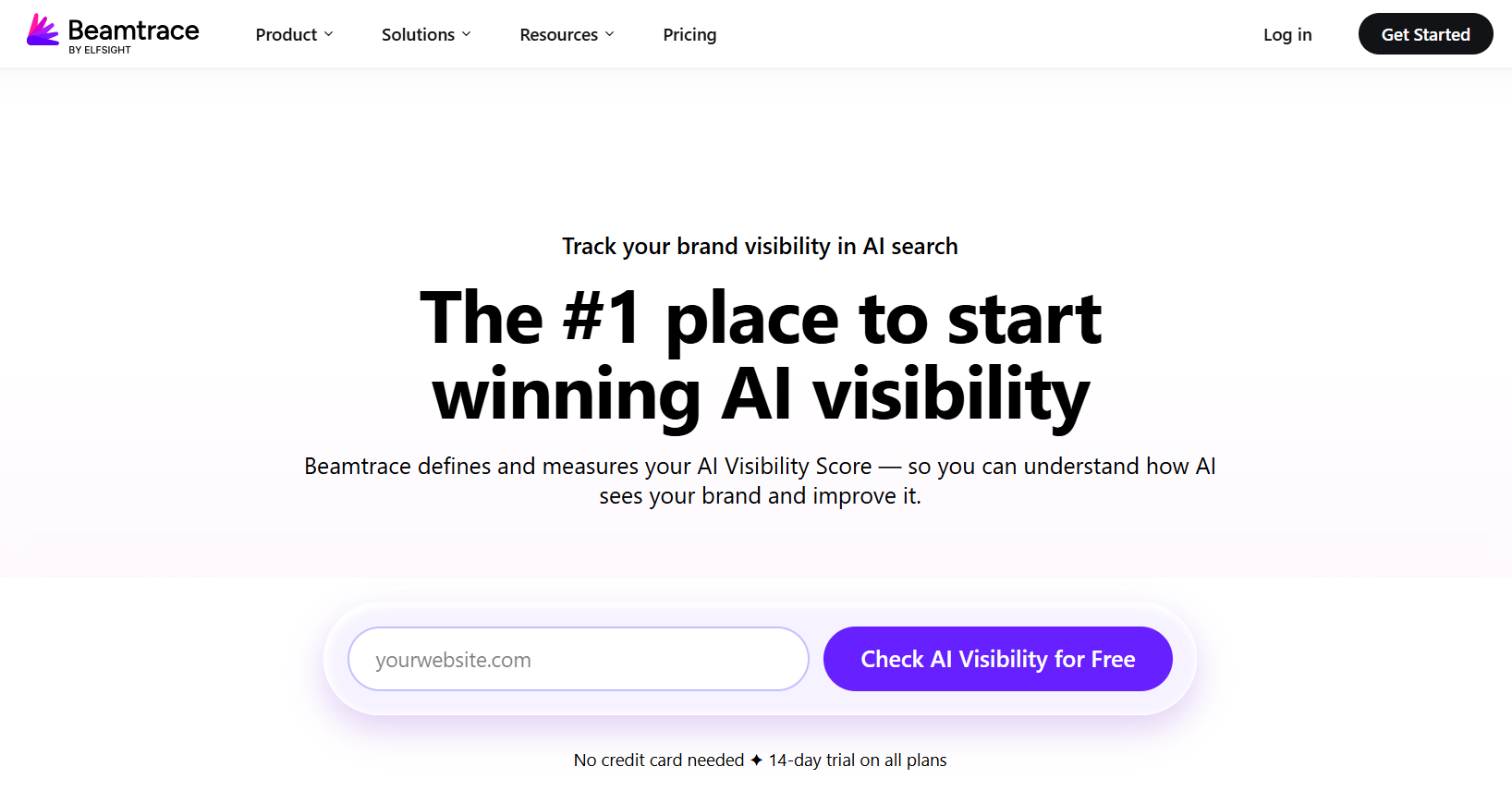
Beamtrace gives you a straightforward way to measure how visible your brand is across AI search, but it does not stop at the top-line score.
The main dashboard brings your AI presence into one view through Visibility Score, mention frequency, and historical trends. This makes it easy to establish a baseline and see whether your brand is becoming more or less visible over time.
Where Beamtrace becomes more useful is what you can do after spotting a change. You can move from overall visibility into the parts of the product that help explain it: check where your brand ranks, inspect important prompts, compare performance with competitors, see which sources AI relies on, and identify visibility gaps that may be worth fixing.
That gives Beamtrace a broader workflow without making the initial visibility report difficult to understand. You can start with a simple question – “How visible is my brand?” – and investigate the underlying reasons only when you need them.
Main features
- AI Visibility Score for a clear overall brand visibility benchmark.
- Historical visibility trends to see whether AI presence is improving or declining.
- Visibility breakdowns that help identify stronger and weaker areas.
- Rank and prompt analysis for investigating changes behind the overall score.
- Competitor benchmarking to put your visibility into market context.
- Citation and source analysis to understand what may be influencing AI visibility.
- Personalized optimization actions for turning identified visibility gaps into practical next steps.
| 👍 Best for | 💰 Pricing plans |
|---|---|
| SMBs, startups, local businesses, and marketing teams that want an easy visibility baseline but also need room to investigate rankings, competitors, prompts, citations, and optimization without moving to separate tools. | 14-day trial with no credit card. Paid plans start from $20/month. |
Beamtrace is intentionally less complex than enterprise platforms built around large datasets, advanced BI workflows, and extensive reporting infrastructure. Its advantage is the connection between measurement and investigation: you can see whether visibility changed, then move directly into the rankings, prompts, competitors, sources, and actions that help explain what happened.
2. Profound
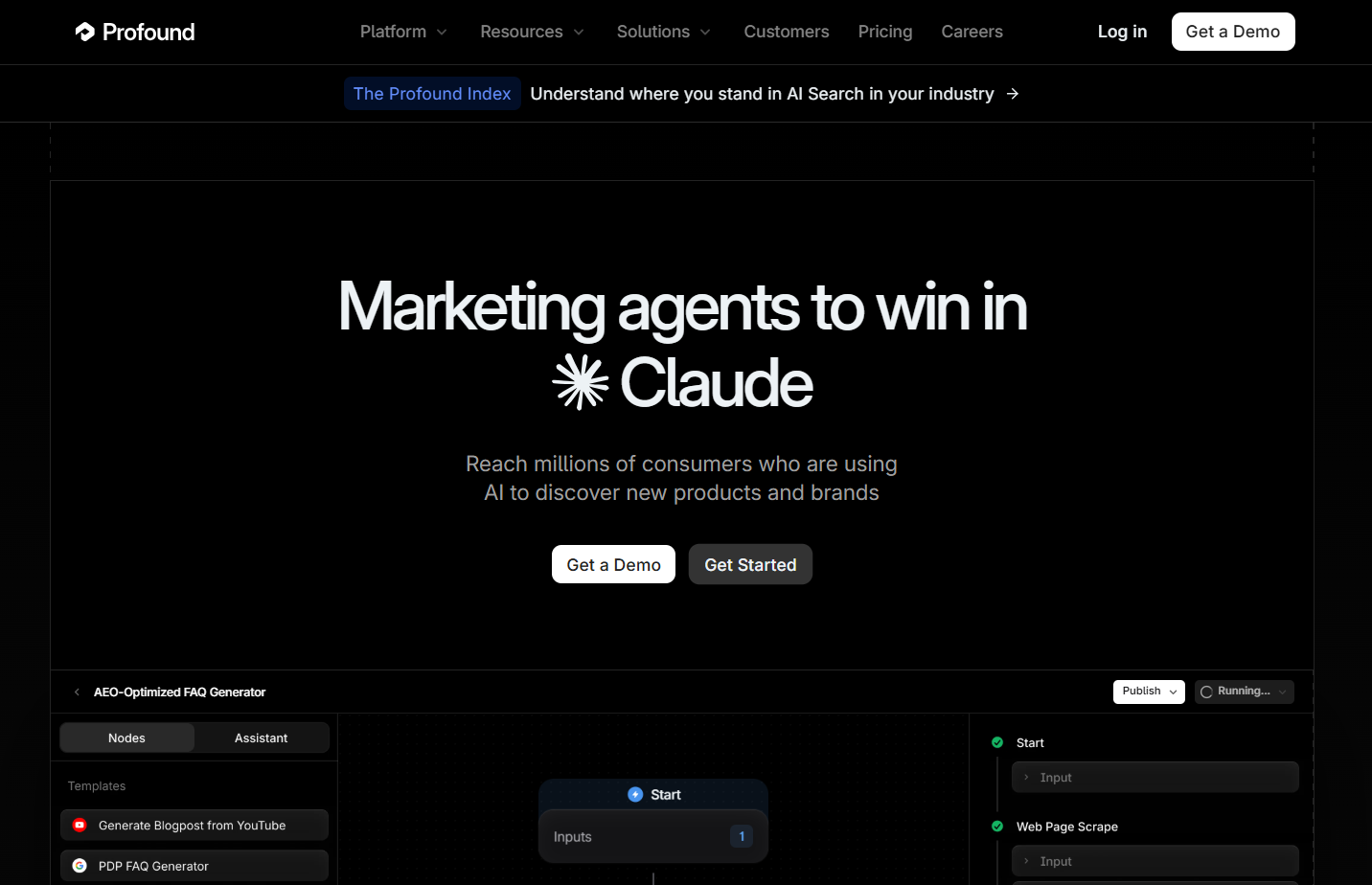
Profound approaches AI visibility as part of a much larger Answer Engine Optimization operation.
The platform runs structured prompts across AI environments and tracks how brands appear over time. Its visibility analysis sits alongside citations, sentiment, rankings, Agent Analytics, prompt intelligence, and autonomous Agents, making it better suited to organizations where AI search is becoming a dedicated marketing function rather than another reporting metric.
This scale is particularly useful for larger organizations managing several products, markets, or teams. Enterprise plans can extend coverage to as many as nine Answer Engines and multiple companies.
Main features
- Structured visibility tracking across AI Answer Engines.
- Daily monitoring of how brands appear in AI responses.
- Historical visibility data for ongoing measurement.
- Broader analysis covering sentiment, citations, and competitive presence.
- Prompt intelligence for larger AEO programs.
- Agents and workflow automation beyond visibility reporting.
| 👍 Best for | 💰 Pricing plans |
|---|---|
| Larger marketing teams, funded companies, and enterprises building a broader AEO program around their AI visibility data. | Starter: $99/mo annually for 50 prompts on ChatGPT. Growth: $399/mo annually for 100 prompts across 3 Answer Engines. Enterprise: custom, with broader coverage. |
Profound offers substantially more operational depth than a straightforward visibility tracker. That is an advantage when your team intends to use it, but it also means a smaller company can end up paying for a much larger AEO system than it actually needs.
3. Semrush AI Visibility Toolkit
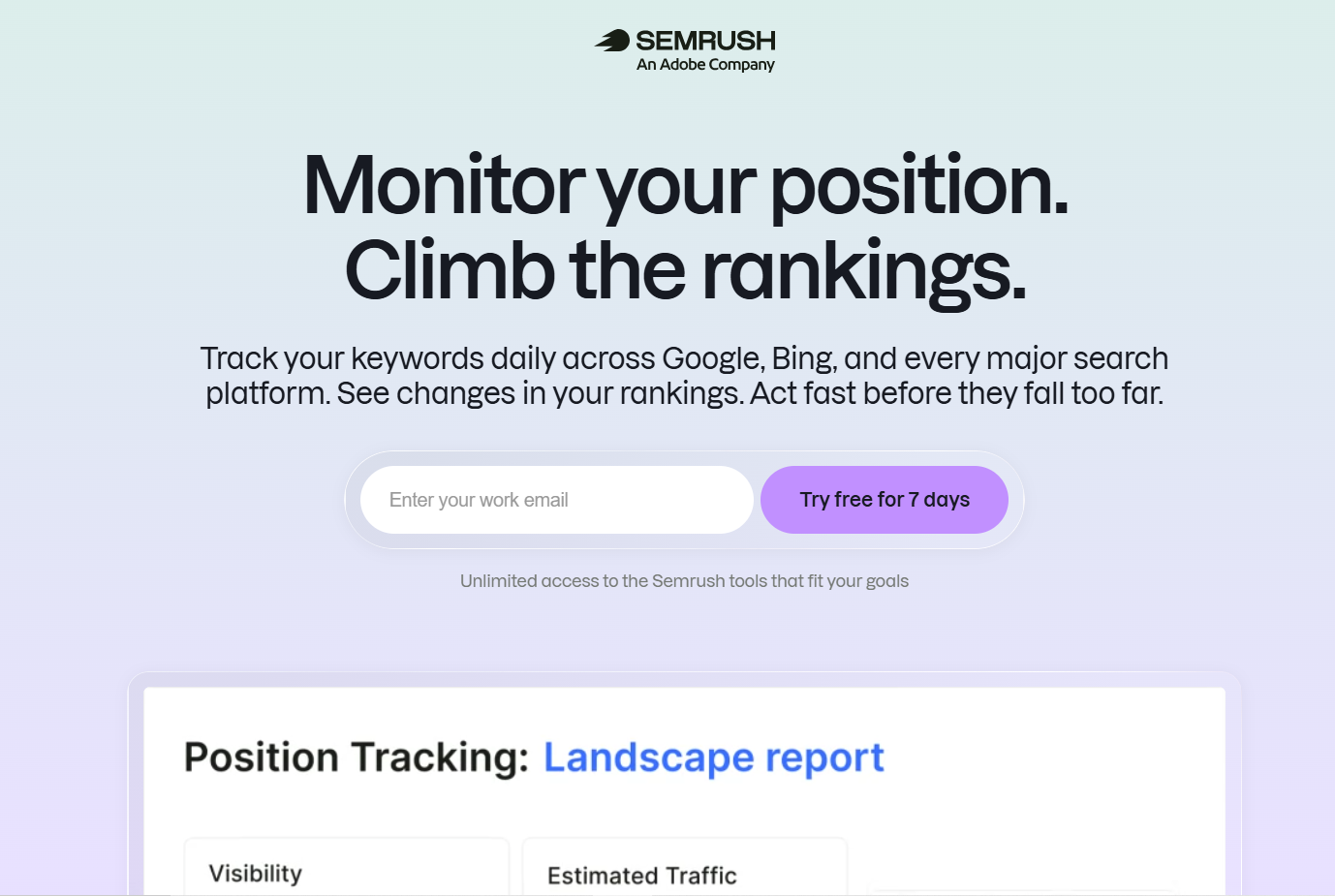
Semrush is the natural option for teams that already treat visibility as part of a broader search marketing program.
Its AI Visibility product provides visibility reports for any domain and tracks mentions across ChatGPT, Google AI experiences, Gemini, and Perplexity. The Base plan also includes 25 custom prompts, daily AI ranking data, competitor research, Prompt Research, and AI-readiness auditing.
The main advantage is context. AI visibility does not sit in a completely separate product universe: marketers can connect what is happening in AI search with the SEO and content workflows they already understand.
Main features
- AI visibility reporting for any domain.
- Brand performance analysis across major AI search environments.
- Daily, weekly, and monthly data updates.
- Custom prompt tracking alongside broader visibility reporting.
- AI-readiness auditing.
- Integration with Semrush's broader search marketing ecosystem.
| 👍 Best for | 💰 Pricing plans |
|---|---|
| SEO, content, and digital marketing teams that want AI visibility reporting alongside the rest of their search workflow. | AI Visibility Base starts at $165/month per domain, billed annually. |
Semrush is less compelling if all you need is a lightweight AI search visibility tracking tool. But if AI visibility is becoming another layer of an existing SEO operation, keeping those datasets and workflows close together is a substantial advantage.
4. Ahrefs Brand Radar
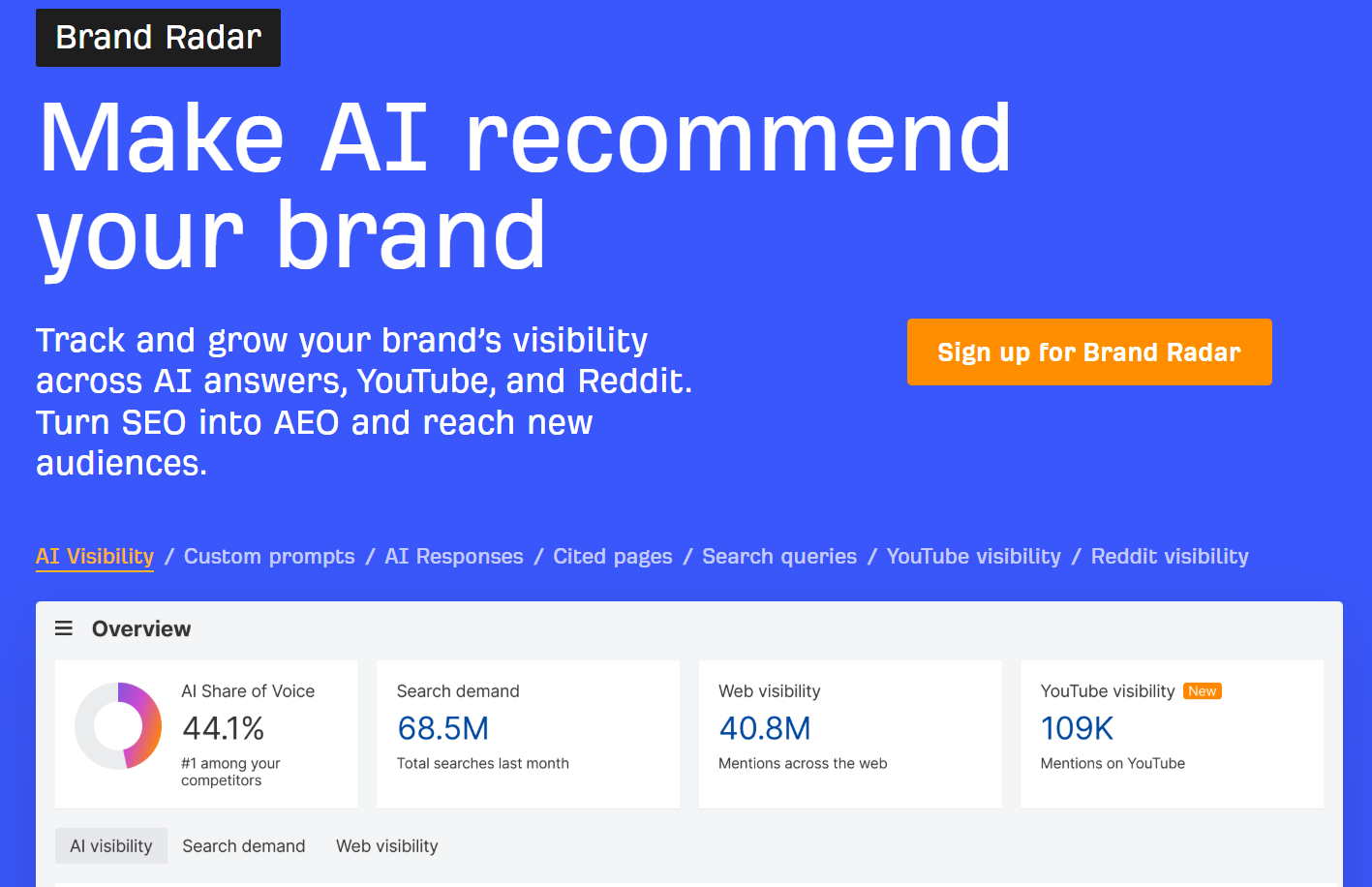
Ahrefs Brand Radar solves a different visibility problem: sometimes you do not know the right prompts or even the full competitive landscape before you start measuring.
Its AI Visibility Index is built from hundreds of millions of search-backed prompts and lets you search the visibility of any brand without first creating a custom tracking project. Ahrefs currently describes Brand Radar as covering more than 405 million search-backed prompts in its help documentation, while its live product pages show the index continuing to expand.
Visibility can be examined using mentions, citations, impressions, and AI Share of Voice. Ahrefs also supports custom prompt tracking for questions specific to your own buyers.
That combination makes Brand Radar particularly strong for discovery: instead of monitoring only the universe you define, you can first see how much AI visibility a brand already has across a much larger dataset.
Main features
- AI Visibility Index built from hundreds of millions of prompts.
- Brand visibility discovery without lengthy project setup.
- Mentions, impressions, citations, and AI Share of Voice.
- Historical AI visibility trends.
- Visibility across multiple AI platforms.
- Custom prompts for more specific ongoing monitoring.
| 👍 Best for | 💰 Pricing plans |
|---|---|
| Established brands, SEO teams, and market researchers that want to measure visibility beyond a manually defined prompt set. | AI Visibility Index access starts at $199/month per platform. All-platform access is $699/month. Custom Prompt Tracking starts at $50/month. |
The scale is impressive, but it can be unnecessary for a small company that already knows exactly what market and questions it wants to monitor. Ahrefs becomes more valuable as the need shifts from simple tracking toward broader visibility discovery.
5. Peec AI
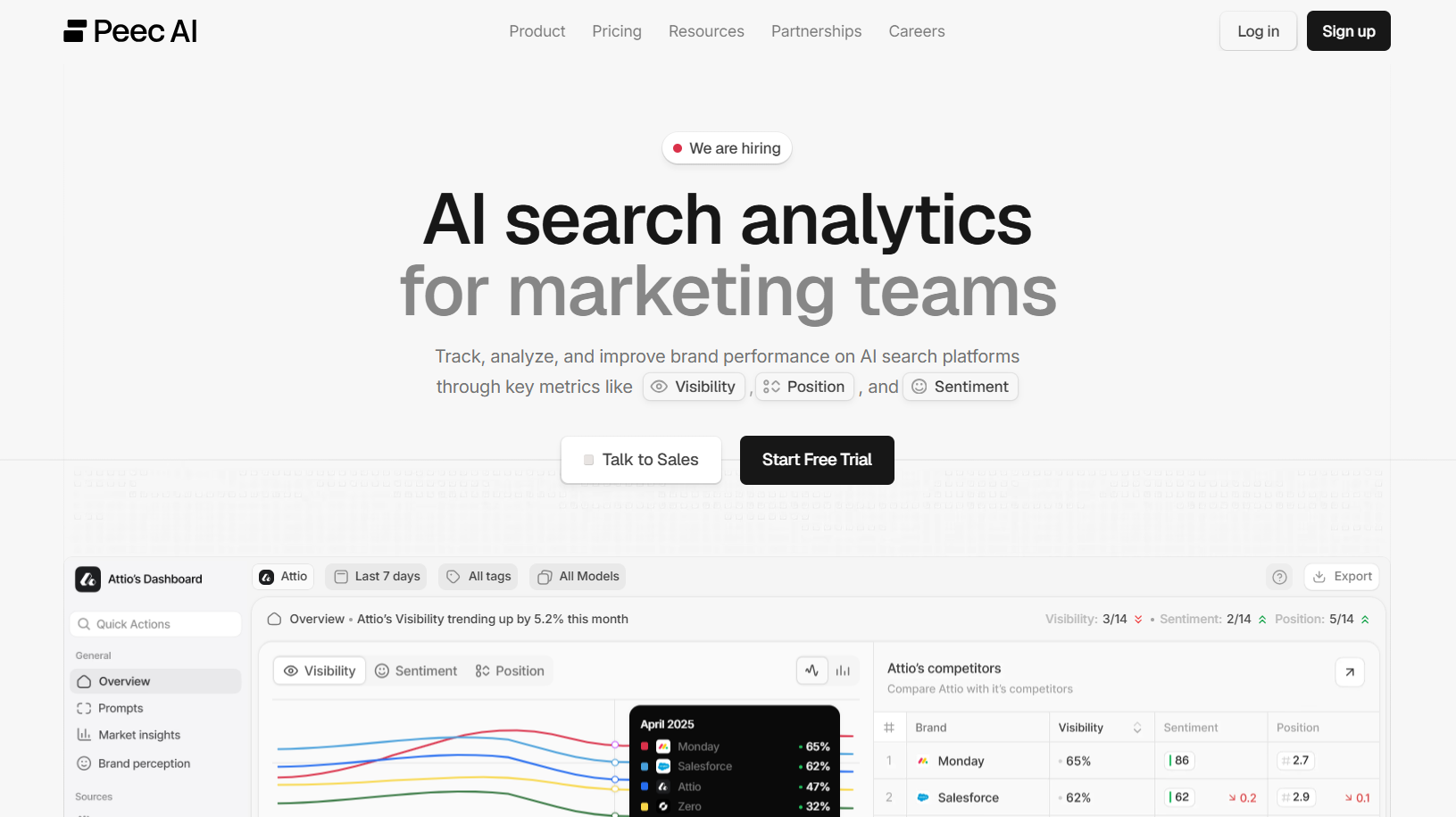
Peec AI is built around a compact group of AI-search metrics and a dashboard designed for regular monitoring.
For brands, the current Starter plan includes 50 prompts, one project, unlimited users, daily tracking, and the ability to select three AI models. Pro and Advanced increase prompt capacity and the number of projects, while Enterprise can extend model coverage further.
Peec tracks Visibility alongside Position and Sentiment, making it relatively easy to use the overall presence metric as the first layer and investigate other performance signals when needed.
Main features
- Daily AI visibility measurement.
- Visibility as a clear top-level brand metric.
- Historical tracking across selected AI models.
- Multi-project support on higher plans.
- Unlimited users on standard brand plans.
- Additional position and sentiment context when deeper analysis is needed.
| 👍 Best for | 💰 Pricing plans |
|---|---|
| Mid-market marketing teams and agencies that want a clean daily visibility dashboard without adopting a large enterprise AEO platform. | Starter: $80/mo. Pro: $205/mo. Advanced: $420/mo. Enterprise: custom. |
The main limitation is model coverage on the standard plans: users choose three models rather than automatically receiving the entire available set.
That can be completely adequate if you know which AI platforms matter most to your market, but it is worth considering if broad coverage is your main purchasing criterion.
6. Otterly.AI
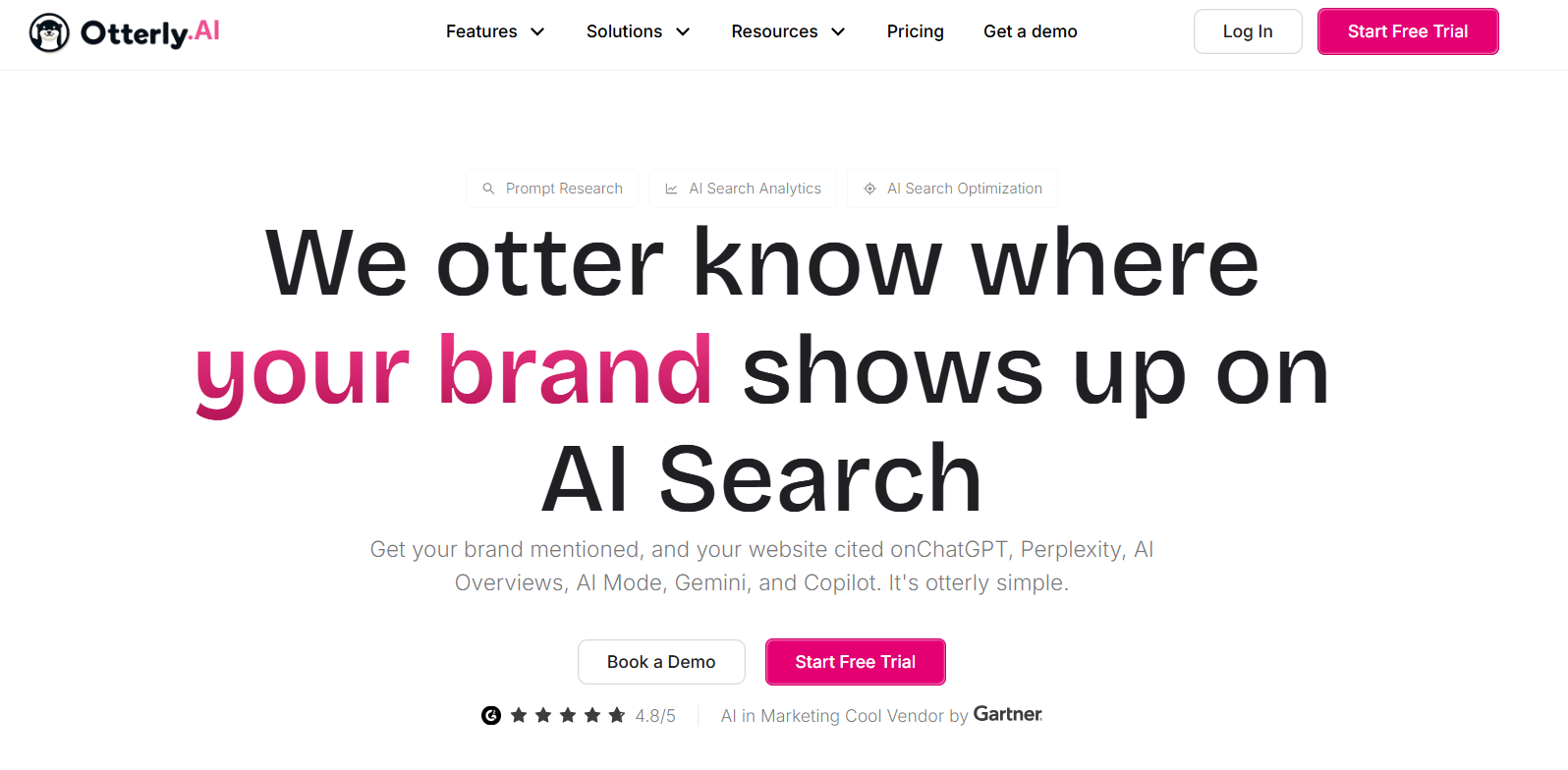
Otterly.AI offers one of the lowest-cost ways to move from occasional manual AI checks to ongoing visibility monitoring.
Its $29/month Lite plan currently includes 15 search prompts, daily tracking, unlimited brand reports, unlimited team members, and coverage for ChatGPT, Google AI Overviews, Perplexity, and Microsoft Copilot. Google AI Mode, Gemini, and Claude can be added separately.
That makes Otterly particularly practical for small teams that want visibility reporting to become a regular KPI but are not ready for a $100+ monthly platform.
Main features
- Daily AI search visibility monitoring.
- Four AI search engines included on the Lite plan.
- Unlimited brand reports.
- Unlimited team members.
- Higher prompt volumes on Standard and Premium.
- Additional AI engines available as add-ons.
| 👍 Best for | 💰 Pricing plans |
|---|---|
| Freelancers, consultants, startups, and small marketing teams that want affordable recurring AI visibility measurement. | Lite: $29/mo. Standard: $189/mo. Premium: $489/mo. Enterprise plans are custom. |
The entry price is attractive, but 15 prompts can become restrictive quickly. Expanding the prompt set or adding more AI engines changes the economics, so the Lite plan is strongest for relatively focused monitoring.
7. Rankscale
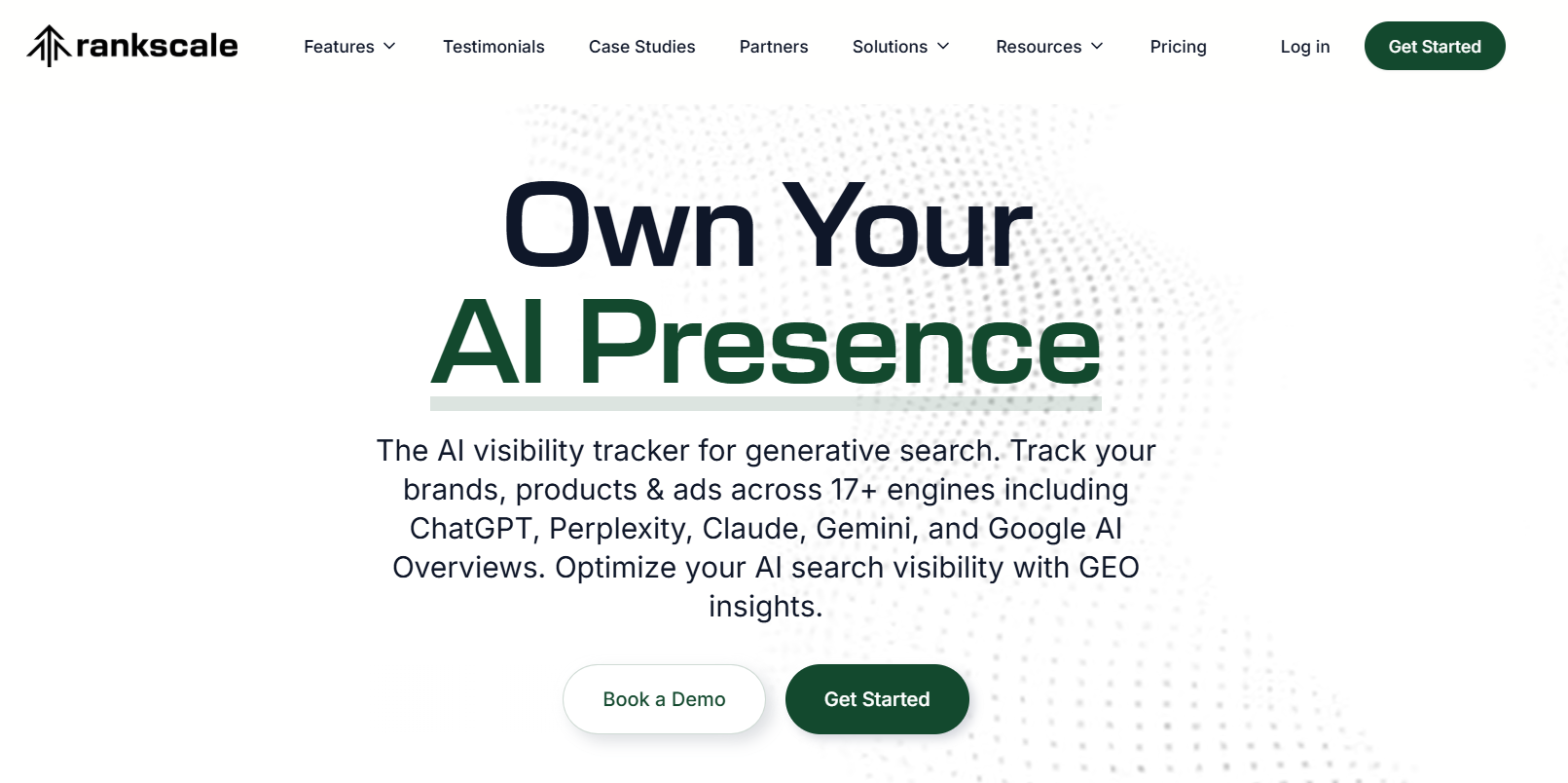
Rankscale puts more control in the hands of teams that want to define exactly how much and how often they measure.
It supports ChatGPT, Gemini, Perplexity, Claude, DeepSeek, Mistral, Grok, Copilot, and additional engines. Search terms can be monitored from hourly through daily, weekly, or monthly schedules, and visibility performance can be tracked over time across the selected engines.
Instead of setting a fixed number of prompts for every plan, Rankscale uses credits. A monitoring run consumes credits depending on the engines selected, while users can create unlimited search terms.
That model gives agencies and advanced teams more control over the trade-off between breadth, frequency, and cost.
Main features
- Broad coverage across major and emerging AI engines.
- Visibility Score and performance tracking over time.
- Hourly, daily, weekly, or monthly monitoring schedules.
- Support for all regions.
- Unlimited search-term creation.
- Dashboards, exports, and more advanced reporting on higher plans.
| 👍 Best for | 💰 Pricing plans |
|---|---|
| Agencies and advanced teams that prioritize broad engine coverage and want precise control over monitoring frequency. | Pro: $99/mo. Growth: $385/mo. Enterprise: $780/mo. |
The flexibility comes with extra planning. Because monitoring runs consume credits, comparing Rankscale directly with a fixed-prompt subscription is not always straightforward.
For teams comfortable managing usage, however, it is one of the strongest candidates when the best search visibility analysis tool means maximum control over where and how often monitoring happens.
A few AI visibility tracking tips from the Beamtrace team
Tracking AI visibility is less about collecting as much data as possible and more about making sure the data you collect is actually comparable. Here are a few things we recommend keeping in mind.
- Track the prompts that represent real customer discovery
More prompts do not automatically give you a better visibility score. Focus on questions your potential customers would realistically ask when researching your category, comparing options, or looking for a solution.
A smaller set of relevant prompts often gives you a more useful baseline than hundreds of loosely related searches. - Keep your core tracking set consistent
If you replace half your prompts every week, changes in visibility become difficult to interpret.
Keep a stable group of core prompts for trend measurement and add experimental queries separately. That way, when visibility moves from one month to another, you are comparing roughly the same search landscape. - Look for sustained movement, not individual jumps
AI answers naturally vary between runs. One missing mention or sudden spike does not necessarily mean anything changed.
Look for movement that repeats across multiple checks. Even the best AI search visibility checking tool becomes much more useful when you treat visibility as a trend rather than reacting to individual answers. - Check platform-level visibility before trusting the overall score
An improving overall metric can sometimes hide an important detail: your brand may be growing rapidly in one AI platform while remaining almost invisible in another.
Check the platform breakdown before drawing conclusions from the aggregate score. It helps you understand whether visibility growth is broad or concentrated in one source.
Try it on your brand
How visible is your brand in AI search?
See how often your business appears in AI answers and whether your overall visibility is moving in the right direction.
Add your website.
Enter your website URL.
We check AI search.
Beamtrace measures where your business appears across relevant searches.
See your visibility.
Get your visibility baseline, follow the trend, and see where your presence is strongest or weakest.
Which AI search visibility tool should you choose?
The best tool for tracking AI search visibility depends on how broad your monitoring needs to be. Some teams need a simple brand-level trend, while others need wider platform coverage, more frequent updates, or visibility data connected to a larger SEO or AEO workflow.
| If you need... | Look at... |
|---|---|
| Visibility tracking with built-in next-step analysis | Beamtrace |
| Enterprise-scale AEO and visibility operations | Profound |
| AI visibility inside an established SEO workflow | Semrush AI Visibility |
| Market-wide visibility discovery | Ahrefs Brand Radar |
| Clean daily multi-model visibility reporting | Peec AI |
| Affordable recurring visibility monitoring | Otterly.AI |
| Broad engine coverage and flexible schedules | Rankscale |
For SMBs and lean marketing teams, Beamtrace is one of the most accessible starting points because visibility tracking connects directly to rankings, competitors, citations, and optimization when deeper analysis is needed.
Teams with larger budgets and more complex workflows will get more from Profound, while Semrush and Ahrefs make the most sense when AI visibility needs to sit alongside established SEO or market-research data. Peec offers a cleaner middle ground for recurring daily measurement, while Otterly and Rankscale stand out for lower-cost monitoring and broader scheduling flexibility respectively.
The best search visibility tracking tool is ultimately the one that matches the level of visibility data your team will actually use. A broader platform is valuable when you need the extra depth, but for many teams, a clear baseline, reliable historical tracking, and an easy path to deeper analysis matter more than having the longest feature list.
This comparison was prepared by the Beamtrace team to make AI search visibility tools easier to evaluate side by side. Since Beamtrace is included in the review, we aimed to keep the comparison as balanced as possible by applying the same criteria to every platform, highlighting both strengths and meaningful limitations. We hope it gives you a useful starting point for choosing the tool that best fits your own workflow, priorities, and budget.