
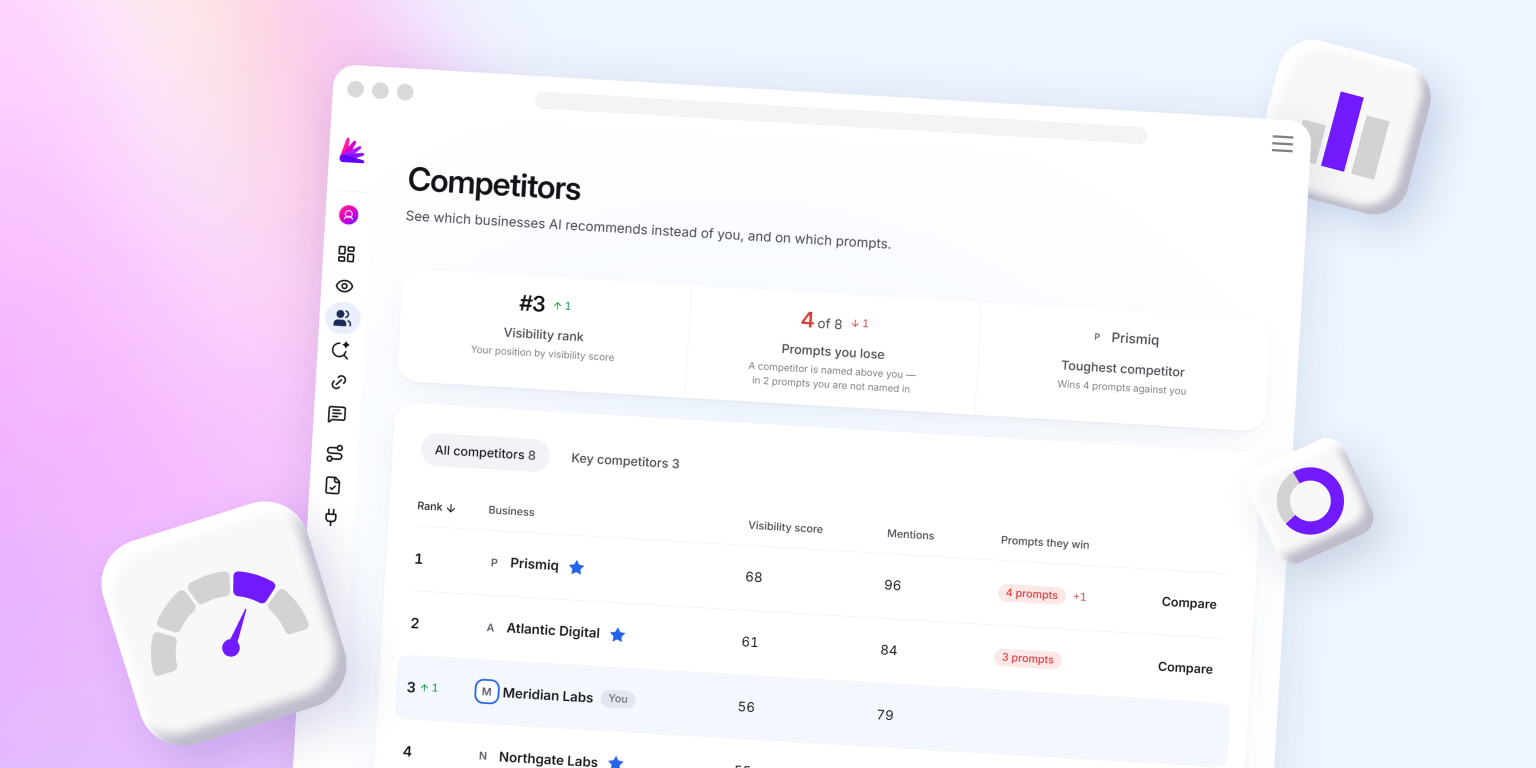
A brand can rank below you on Google and still appear more often in ChatGPT recommendations. Another may dominate Gemini because trusted sources mention it more frequently, while AI assistants can surface companies you barely consider direct rivals.
AI competitors are defined by who appears in the same answers, not just who ranks for the same keywords.
Traditional competitor research misses much of this. AI visibility competitor analysis looks at which brands AI recommends, how often they appear, where they outrank you, and which prompts and sources help them win. That is what separates the best AI visibility competitor analysis tool from a generic competitor dashboard.
We compared seven platforms around the questions marketing teams actually need answered: Who is ahead? Where are they ahead? What is driving the gap? And what can you do about it?
Best AI competitor analysis tools at a glance
| Tool | How competitor analysis works | Best сompetitive signal | Best for | Starting price |
|---|---|---|---|---|
| Beamtrace | Filters tracked prompts into They win / We win / Both appear, then lets you open the original AI answer | Exact prompts where a competitor outranks or replaces your brand | SMBs and marketing teams that want actionable prompt-level gaps | $20/mo |
| Profound | Benchmarks brands across large prompt sets and adds Prompt Volumes to show which competitive queries matter most | Competitor visibility on high-demand AI queries | Enterprise teams prioritizing competitive opportunities at scale | $99/mo |
| Semrush AI Visibility | Separates competitor performance into Strong, Weak & Missing Prompts and highlights Missing Sources | Prompts and sources competitors own but your brand does not | SEO teams connecting AI gaps with existing search workflows | $165/mo per domain |
| Ahrefs Brand Radar | Searches a massive pre-collected AI prompt index instead of relying only on a manually tracked competitor set | Competitors and brands gaining Share of Voice across a wider market | SEO and research teams discovering the broader competitive landscape | From $199/mo per AI index |
| Peec AI | Tracks brands daily using Visibility, Share of Voice, Position, and Sentiment | How competitive presence shifts over time across selected models | Mid-market teams and agencies running recurring benchmarks | $80/mo |
| Otterly.AI | Gap Analyzer isolates prompts where competitors appear and your brand is missing | Repeated competitor-only prompt gaps | Small teams looking for a simple list of opportunities to investigate | $29/mo |
| AthenaHQ | Connects competitor visibility and source analysis with GEO recommendations and execution workflows | Competitive gaps that can be turned directly into optimization actions | GEO teams that want analysis and execution in one system | Free entry plan |
Pricing and plan details change quickly in this category, so check the current plan before making a final decision.
How we evaluated these tools
We compared each platform specifically as an AI-search competitor analysis tool rather than judging it by its overall feature count.
The best AI tool for competitor analysis should do more than show which brand has a higher visibility score. It should help explain where competitors are winning, what is driving the difference, and which gaps are worth investigating.
We focused on four areas:
- Competitive analysis depth. We looked at how each tool compares brands across AI search, including visibility, mentions, rankings, Share of Voice, prompt-level performance, and other competitive signals.
- Ability to explain the gap. We gave more weight to platforms that let users go beyond an aggregate score and investigate the prompts, AI responses, sources, citations, or historical changes behind a competitor's advantage.
- Feature coverage and tracking scope. We considered supported AI platforms, prompt limits, update frequency, historical data, reporting capabilities, and how much competitive analysis is available on each plan.
- Value for the intended user. Pricing was evaluated relative to what the platform provides and who it is built for. A larger enterprise product was not automatically ranked higher simply because it offers more functionality.
We also considered the type of team each product is best suited to. An enterprise platform may offer greater depth and scale, while a smaller team may get more value from a focused tool that answers the core competitive questions without additional infrastructure.
Features, platform coverage, and pricing were checked against publicly available product information.
AI competitor analysis tools: key differences
1. Beamtrace
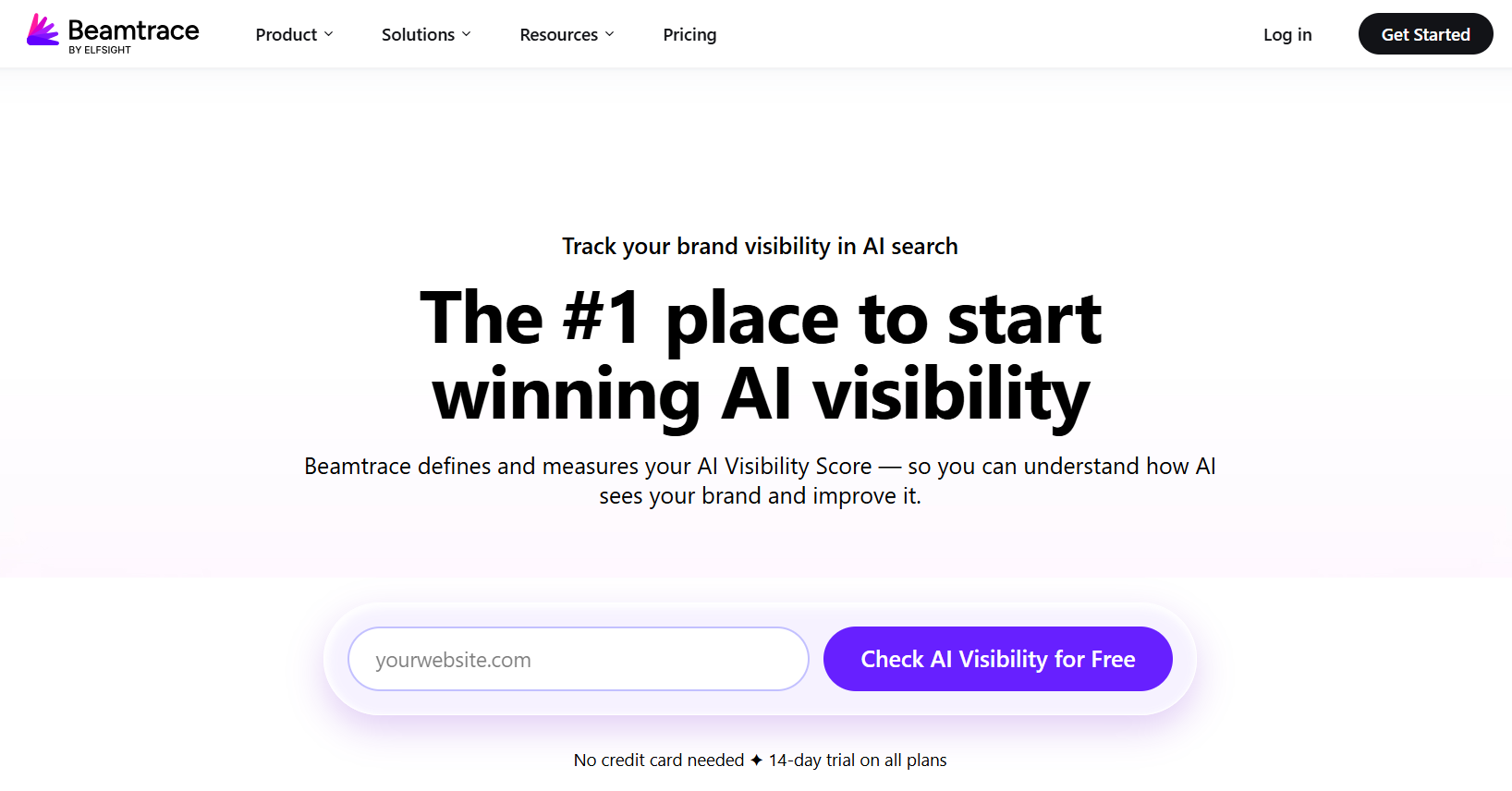
Beamtrace keeps competitor analysis close to the actual AI answers instead of reducing everything to one visibility score.
You can compare your Visibility Score, mentions, average position, prompt-level performance, and citation sources with the competitors you choose to track. The comparison can then be narrowed to They win, We win, or Both appear, making it easier to isolate the prompts where the competitive difference actually happens.
From there, View answer opens the original AI response, including the model, answer text, sources, and each brand’s position. This helps move the analysis from “Competitor A has higher visibility” to something more useful: “Competitor A consistently beats us on these commercial prompts, and these are the answers and sources behind that advantage.”
Main features
- AI Visibility Score for side-by-side performance comparison.
- Prompt-level competitor tracking to find where other brands outrank you.
- They win, We win, and Both appear views for isolating competitive gaps.
- Rank and mention benchmarking across the same AI questions.
- Original AI responses with model, sources, and brand positions.
- Citation comparison to identify sources supporting competing brands.
| 👍 Best for | 💰 Pricing plans |
|---|---|
| SMBs, local businesses, startups, and marketing teams that want a straightforward way to see where competitors outperform them without a complex enterprise setup. | 14-day trial with no credit card. Paid plans start from $20/month, making Beamtrace one of the more accessible options in this comparison. |
Beamtrace is intentionally lighter than enterprise platforms such as Profound or AthenaHQ. That makes it easier to get from a competitive metric to the underlying prompt or answer, but teams that need complex BI integrations, large-scale enterprise workflows, or broader market intelligence may prefer a more extensive platform.
2. Profound
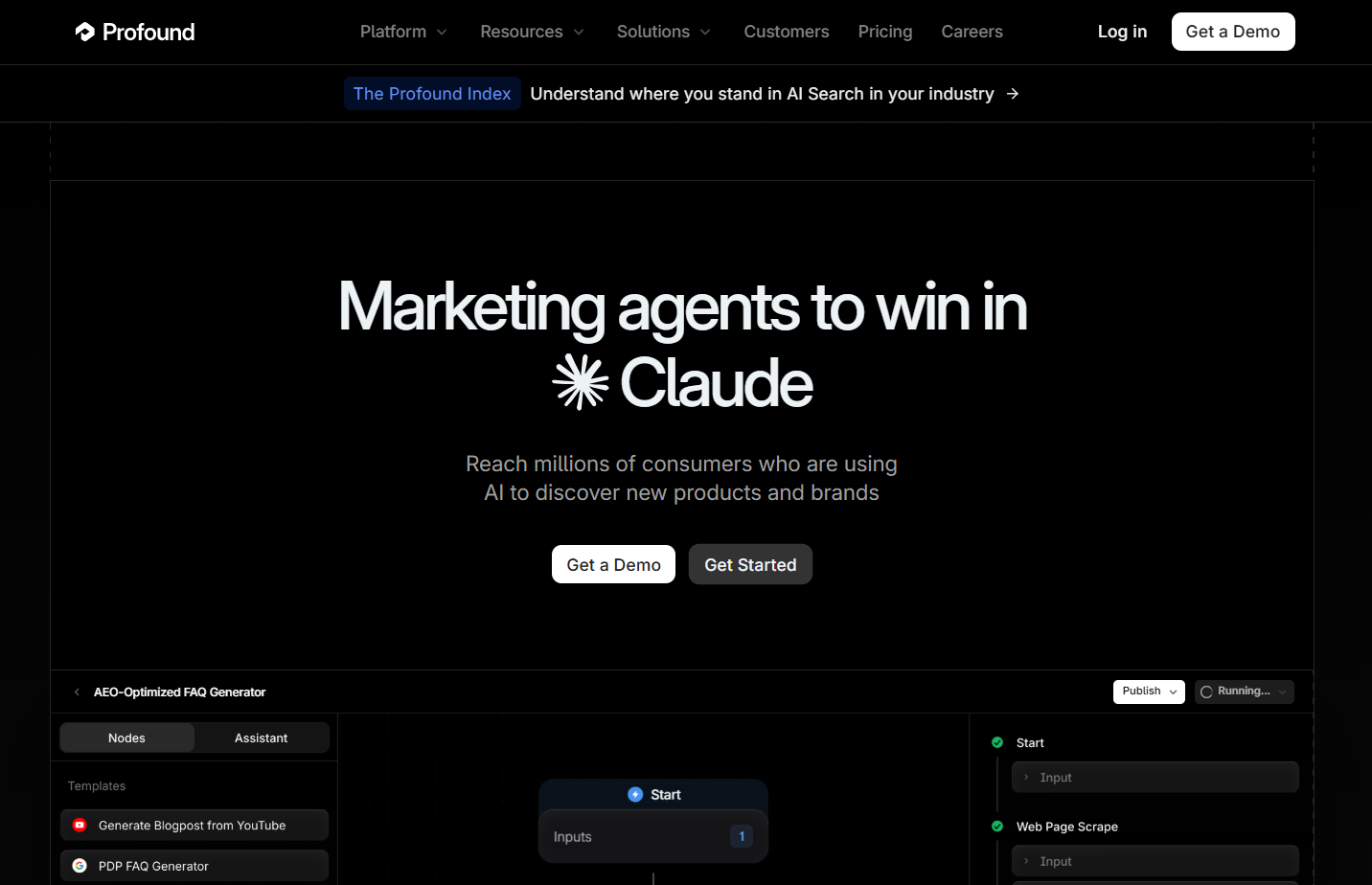
Profound is better suited to organizations where competitor monitoring is part of a broader AI-search intelligence program.
Its platform combines brand visibility, citations, sentiment, prompt intelligence, Agent Analytics, and optimization workflows. That makes it possible to compare brands across multiple AI platforms and then connect the findings to a wider AEO strategy.
For a large organization, that depth can matter more than simplicity. For a small marketing team tracking a handful of competitors, it may be more platform than necessary.
Main features
- Multi-engine AI visibility tracking across major answer platforms.
- Competitor citation and sentiment analysis.
- Prompt-volume data for understanding demand behind AI questions.
- Agent Analytics to see how AI systems interact with websites.
- AI Agents and optimization workflows for larger AEO programs.
| 👍 Best for | 💰 Pricing plans |
|---|---|
| Mid-to-large marketing teams, agencies, and enterprise organizations that need competitor intelligence as part of a broader AEO operation. | Starter: $99/mo. Growth: $399/mo. Enterprise: custom pricing. |
Profound is a strong option when scale and breadth matter more than keeping the workflow lightweight.
3. Semrush AI Visibility Toolkit
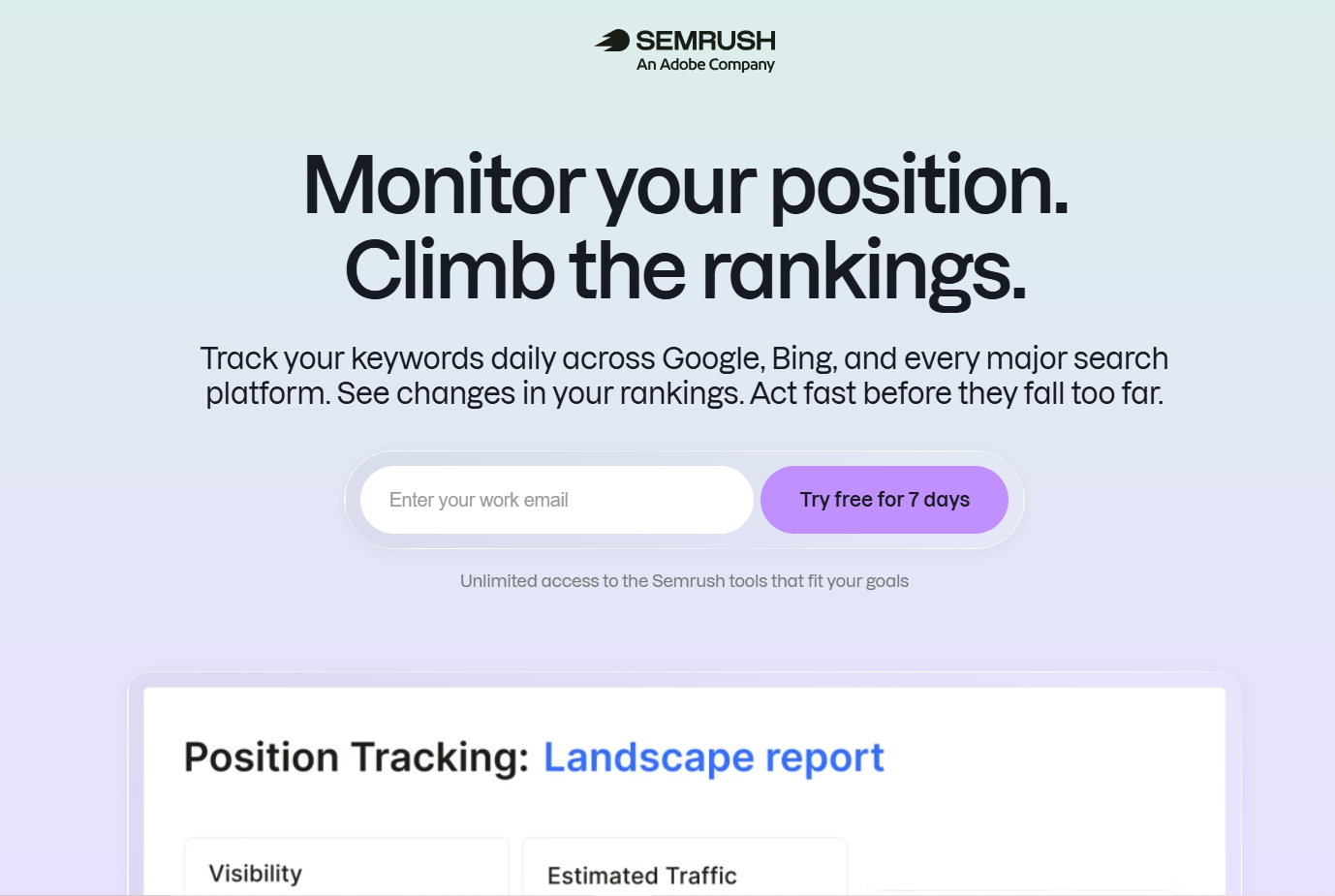
Semrush has one of the clearest competitive-gap workflows.
Its Competitor Research report lets you compare your brand against up to four competitors and separate prompts into strong, weak, and missing areas. More importantly, Missing Sources reveal domains that AI cites when competitors appear but your brand does not.
That connection is useful because competitor analysis rarely ends at the dashboard. Once a gap is found, a team already using Semrush can move into content, keyword, backlink, and technical research without changing tools.
Main features
- Competitor mentions and AI visibility benchmarking.
- Strong, weak, and missing prompt analysis.
- Missing Sources to identify citation opportunities.
- Prompt Research with demand estimates for prioritization.
- Connection with traditional SEO and competitor data.
| 👍 Best for | 💰 Pricing plans |
|---|---|
| SEO and content teams that want AI competitor analysis connected to their existing search marketing workflow. | AI Visibility Base starts at $165/month per domain on annual billing and includes competitor research and prompt tracking. |
If you already live in Semrush, this integration is a major advantage. If AI visibility is the only problem you need to solve, a dedicated tracker can be simpler.
4. Ahrefs Brand Radar
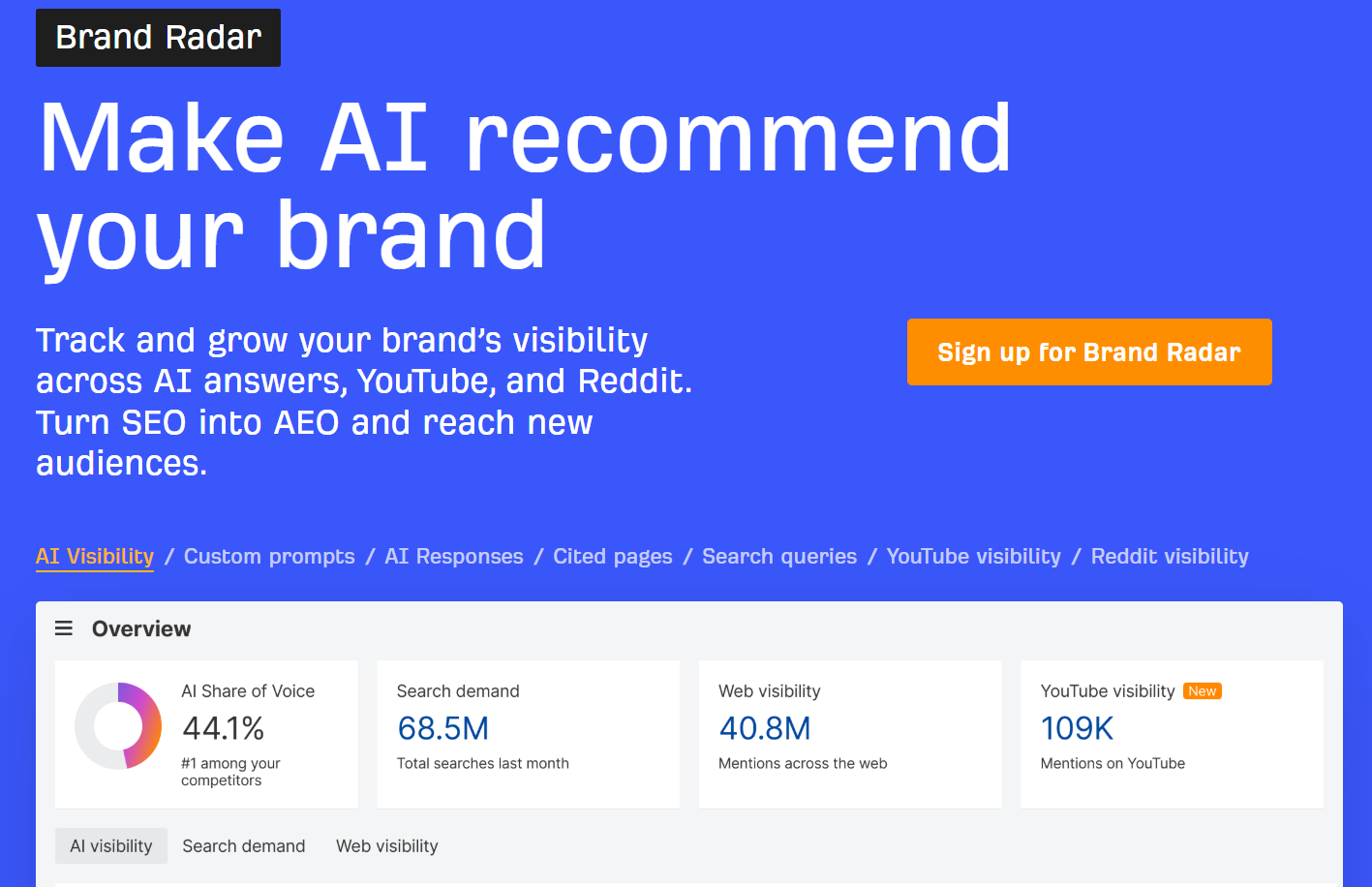
Ahrefs approaches the problem from a different direction.
Most tools start with a set of prompts and competitors that you define. Brand Radar can also search across a huge AI Visibility Index, currently covering hundreds of millions of search-backed prompts. That helps surface brands you may not have thought to track in the first place.
This matters because your AI competitors are not always the same companies you consider SEO competitors.
A previously minor player may have a large AI Share of Voice. A publisher might repeatedly influence recommendations. Another brand may dominate a topic that was not included in your original tracking plan.
Main features
- Large AI Visibility Index for category-wide competitor discovery.
- AI Share of Voice benchmarking.
- Brand mention and citation analysis.
- Top cited pages and domains for competing brands.
- Custom prompts for tracking specific buyer questions.
| 👍 Best for | 💰 Pricing plans |
|---|---|
| Established brands and SEO teams that want to discover competitors and citation patterns beyond a manually created prompt list. | Custom Prompts are available with paid Ahrefs plans. Standalone Brand Radar AI indexes start at around $199/month per AI platform. |
Ahrefs is particularly strong for discovery. For a small company that already knows exactly which five competitors and 30 prompts it wants to track, that scale can be unnecessary.
5. Peec AI
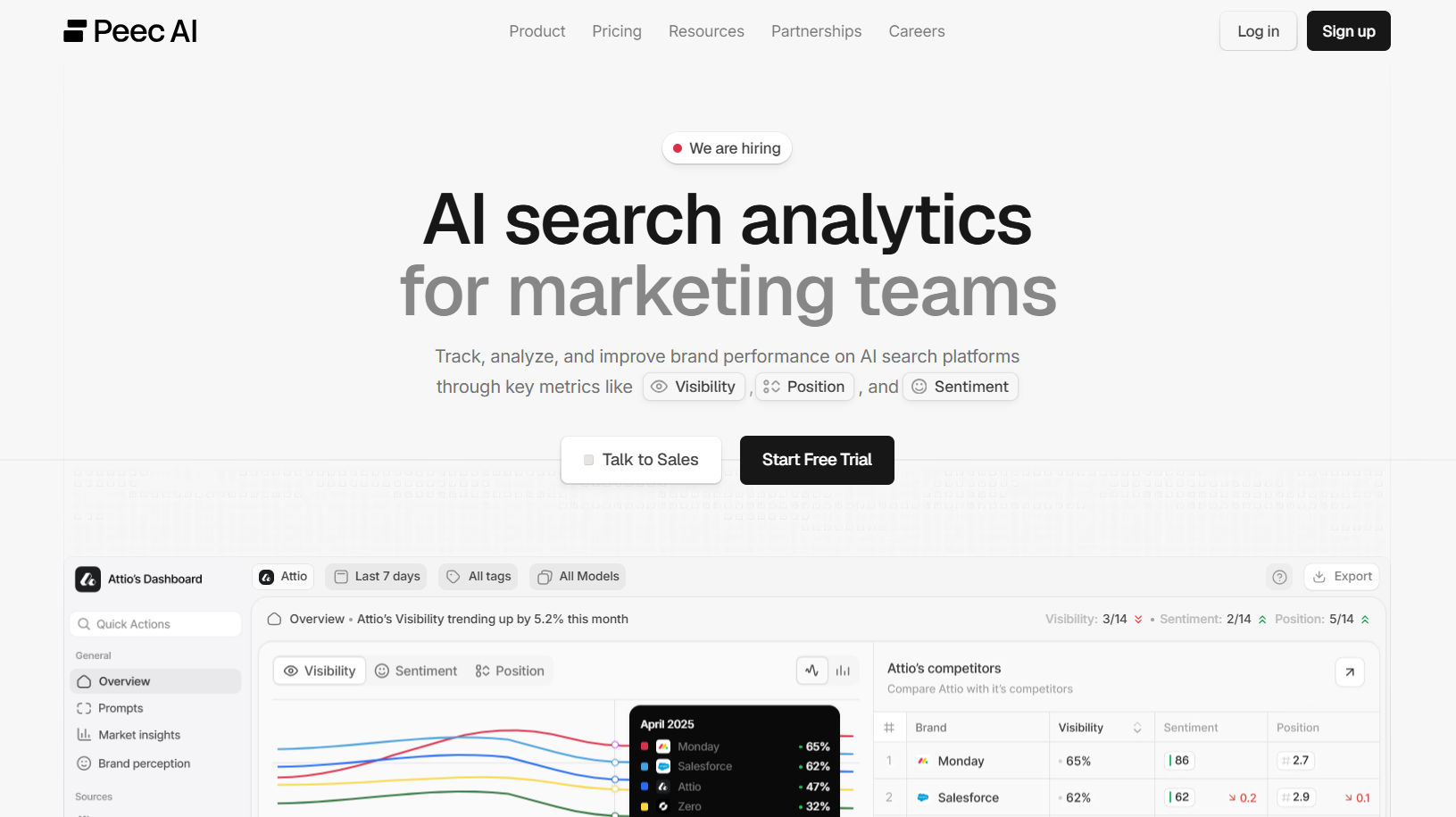
Peec focuses on a compact group of AI-search metrics: Visibility, Position, Sentiment, and Share of Voice.
Its Share of Voice metric shows how many tracked brand mentions belong to you compared with your competitors. That provides a clearer competitive view than visibility alone: two brands may appear across a similar number of prompts while one receives far more total mentions.
Peec also supports daily prompt tracking, which makes it well suited to agencies and teams that need recurring competitive reports rather than occasional checks.
Main features
- Daily multi-platform prompt tracking.
- Share of Voice comparison against tracked competitors.
- Visibility, sentiment, and average position metrics.
- Source analysis to see which sites influence AI responses.
- Unlimited users on standard brand plans.
| 👍 Best for | 💰 Pricing plans |
|---|---|
| Mid-market marketing teams and agencies that want clean daily competitor benchmarking across several AI platforms. | Starter: from $80/mo. Higher plans increase prompts, projects, countries, and reporting capabilities; Enterprise adds broader model access and API features. |
The main limitation is model coverage on lower plans: standard tiers let you choose three models, while broader access requires add-ons or Enterprise.
6. Otterly.AI
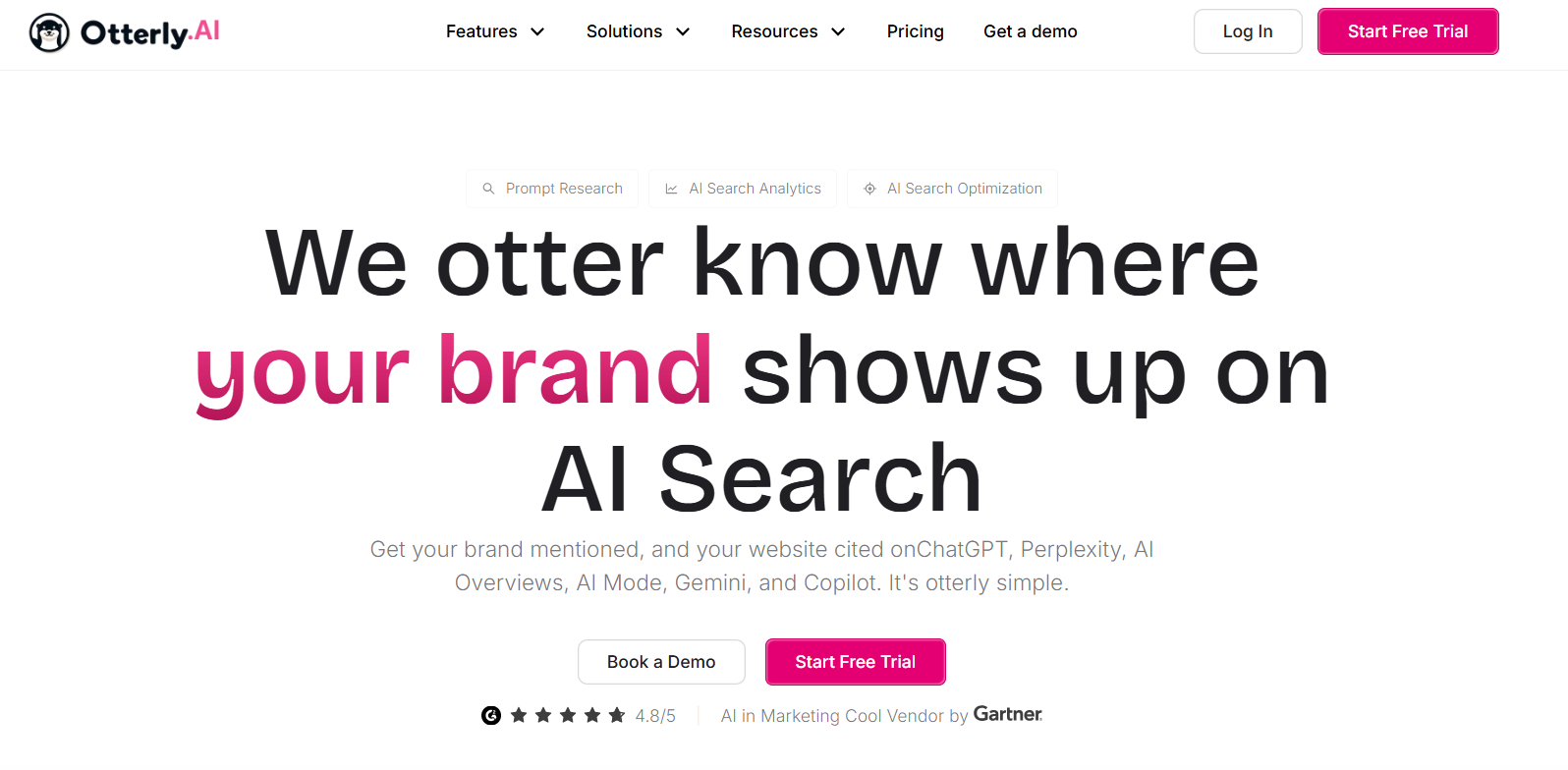
Otterly is an easier entry point for teams that want to replace manual competitor checks with recurring monitoring.
Its Competitive Benchmarking view compares brand visibility, sentiment, and citations on the same screen. The Gap Analyzer then isolates prompts where competitors are named and your brand is absent, prioritizing them by how frequently the gap appears.
That makes the workflow practical even if you are only beginning to treat AI visibility as a regular KPI.
Main features
- Competitive benchmarking across tracked AI answers.
- Gap Analyzer for prompts where competitors appear and you do not.
- Mention, rank, sentiment, and citation tracking.
- Daily monitoring of selected search prompts.
- Multi-engine tracking with additional platforms available as add-ons.
| 👍 Best for | 💰 Pricing plans |
|---|---|
| Freelancers, consultants, startups, and small marketing teams that want competitor tracking without enterprise pricing. | Lite: $29/mo monthly. Larger plans add substantially more prompts, API access, reporting, and advanced analytics. |
The starting price is attractive, but the effective cost increases as you add more prompts and AI engines.
7. AthenaHQ
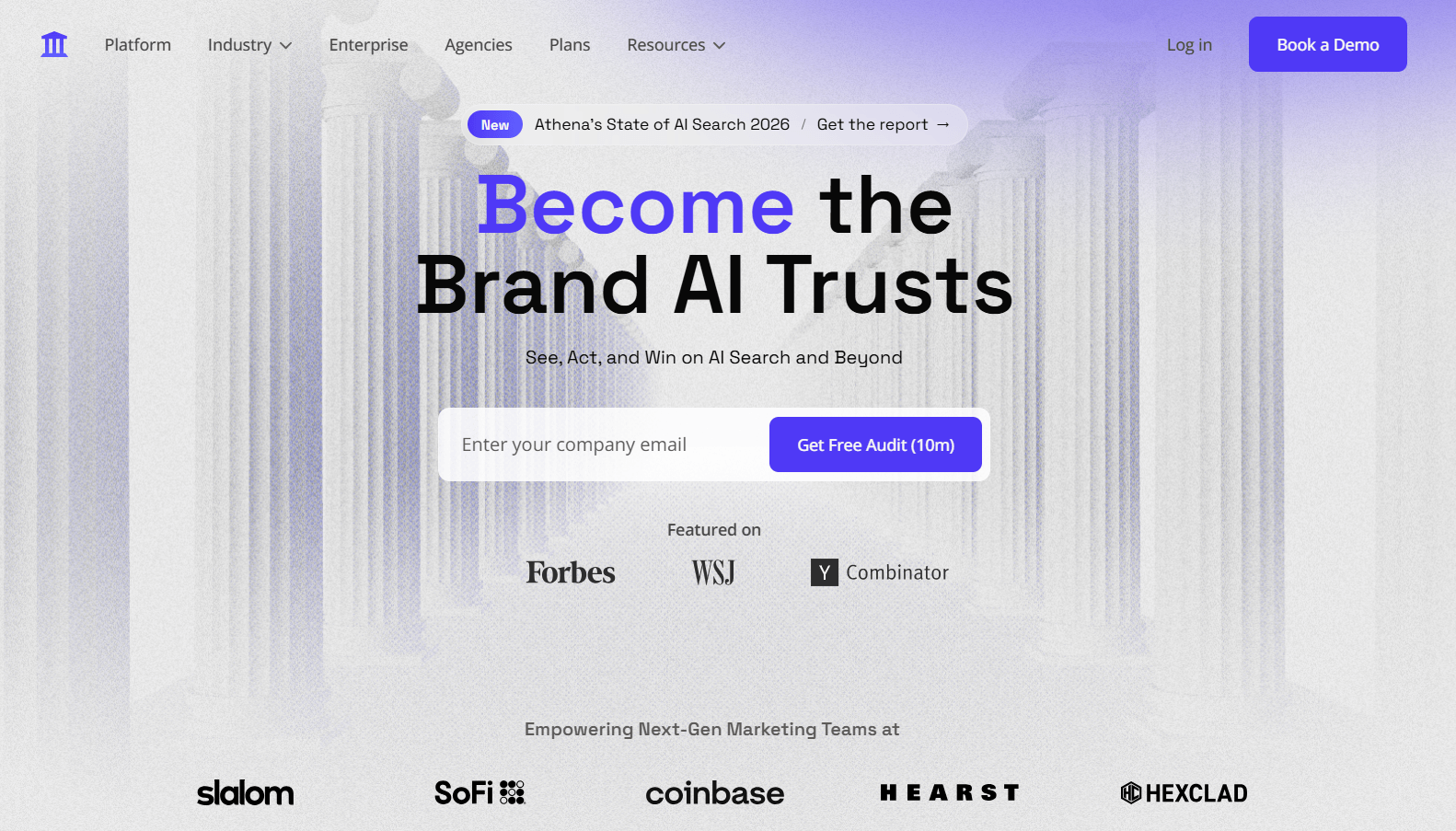
AthenaHQ sits closer to a full AEO/GEO operating system.
It tracks competitor AI visibility, brand mentions, Share of Voice, sentiment, prompts, and sources, but its main differentiator is what happens after the analysis.
Athena's workflows connect competitive findings with recommendations and content actions. Its Ask Athena agent can also answer questions such as why a competitor is ranking above you for a particular set of prompts by using account-level competitive and citation data.
Main features
- Competitor visibility monitoring across major AI platforms.
- Competitor Share of Voice comparison.
- Prompt and response analysis.
- Source and citation insights.
- Content recommendations and optimization actions.
- AI copilot for investigating competitive performance.
| 👍 Best for | 💰 Pricing plans |
|---|---|
| GEO teams and larger organizations that want competitive intelligence integrated with a broader AI-search optimization workflow. | Essential: free with usage credits. Starter: $295/month. Enterprise pricing is custom. |
Athena is powerful if analysis and execution need to live in the same system. If you only need a simple competitive benchmark, the workflow may be more extensive than necessary.
A few competitor analysis tips from the Beamtrace team
A higher competitor Visibility Score is useful to know, but the real value starts when you understand where that advantage comes from. Here are a few things we recommend looking at first.
- Start with the prompts that matter commercially
Not every competitor win deserves the same attention. A brand outranking you for a broad informational question may matter less than repeatedly winning prompts around pricing, alternatives, integrations, local services, or purchase decisions.
Start with the questions closest to your customer journey, then expand the analysis from there. - Separate “they appear” from “they win”
Two brands can be mentioned in the same AI answer and still have very different visibility. Look at who appears first, who receives the stronger recommendation, and whether one brand is presented as the default choice while the other is simply included as an alternative.
This context is often more useful than comparing mention counts alone. - Look for patterns behind competitor wins
When the same competitor keeps outperforming you, check what those answers have in common. Are similar third-party sites being cited? Does the competitor consistently appear around one topic? Is AI using the same positioning or benefit when recommending them?
Repeated patterns can point toward content, positioning, review, digital PR, or distribution gaps worth investigating. - Prioritize repeated gaps over individual AI answers
AI responses naturally vary, so one lost prompt should not automatically become a marketing priority.
Focus on gaps that persist across multiple checks or appear across a group of related questions. A repeated competitor advantage is a much stronger signal than a single unusual response.
The goal is not to fix every difference between your brand and a competitor. It is to identify the few recurring gaps that are most likely to affect how customers discover and compare you in AI search.
Try it on your brand
Where are competitors beating you in AI search?
See which competitors appear instead of your brand, which prompts they win, and the sources behind those answers.
Add your website.
Enter your website URL.
We check AI search.
Beamtrace tracks relevant prompts and compares how your brand and competitors appear.
See where they win.
Find prompt gaps, positions, visibility differences, and citation sources you can investigate.
Which AI competitor analysis tool should you choose?
The best AI visibility tool for competitor analysis depends on the type of competitive question your team needs to answer most often.
| If you need... | Look at... |
|---|---|
| Prompt-level win/loss analysis with answer context | Beamtrace |
| Enterprise-scale competitive intelligence across AI search | Profound |
| AI competitor gaps connected to SEO workflows | Semrush |
| Broad market and Share of Voice discovery | Ahrefs Brand Radar |
| Daily multi-model competitive benchmarking | Peec AI |
| Low-cost recurring competitor monitoring | Otterly.AI |
| Competitor insights connected to GEO execution | AthenaHQ |
The differences between these tools are less about whether they can track competitors at all and more about how they help you investigate the gap. Some are strongest at prompt-level comparison, others at large-scale discovery, daily benchmarking, SEO integration, or turning competitive findings into broader optimization workflows.
This comparison was prepared by the Beamtrace team to make those differences easier to evaluate. Beamtrace is included alongside the other platforms, but each tool was assessed for the specific competitor-analysis workflow it supports, the depth of data it provides, and the type of team it is best suited to.
There is no single best option for every use case. The right choice is the one that gives your team the level of competitive detail it actually needs without adding unnecessary complexity or cost.