
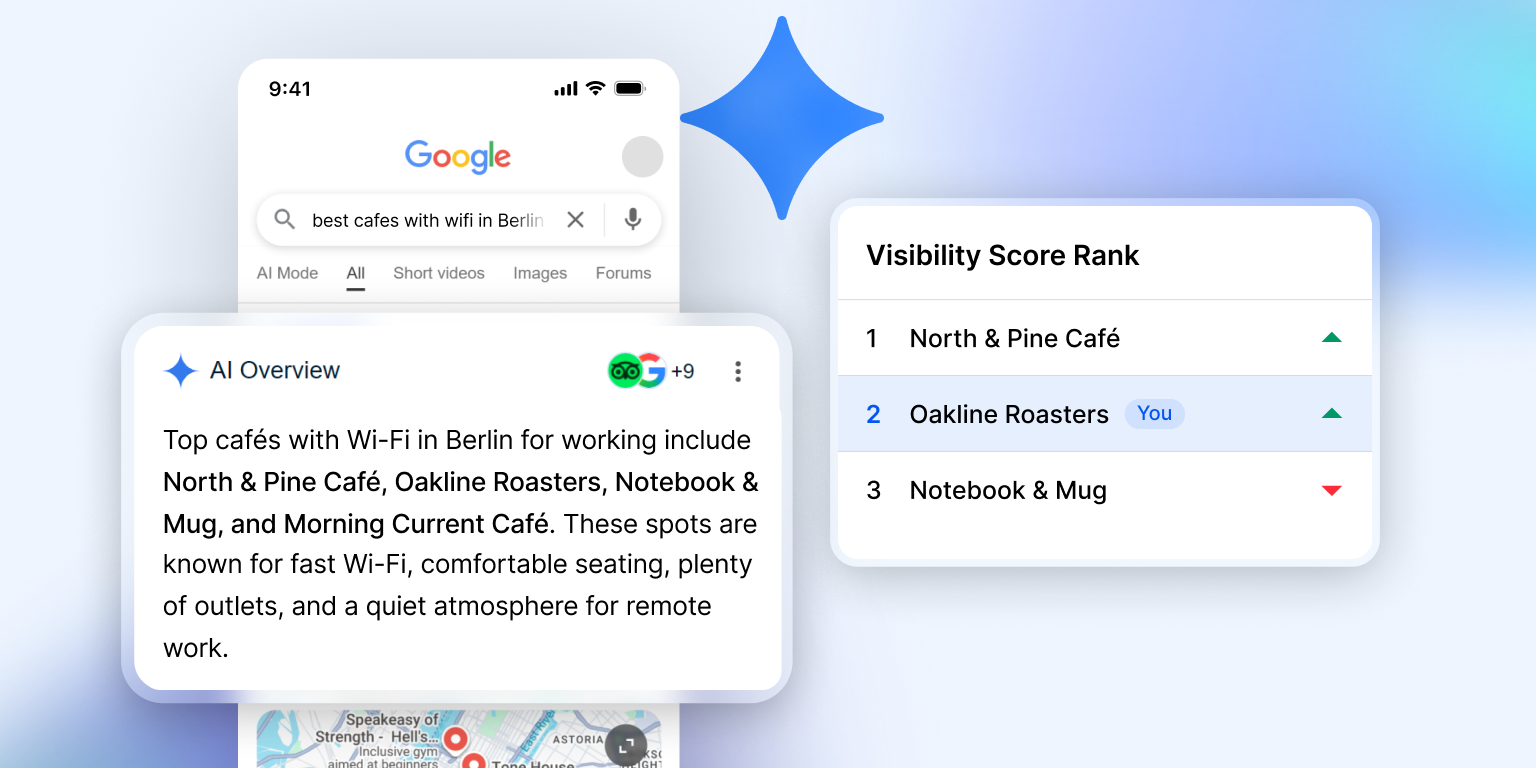
Searching "How to rank in AI Overviews" assumes there is a rank to hold — a stable slot you climb into and defend, the way you would a position on a page of blue links. What you actually hold is a probability of being cited at all, plus a position within the handful of sources the answer names, and both are assigned by a passage-level selection system rather than by where your page ranks organically.
This article explains what being “ranked” in Google AIO actually means and how a source ends up in it: how Google's system decides which passages to pull, how it ranks them against each other, and why the result is less fixed than a traditional search ranking.
What ranking in AIO means
To rank in Google AI Overviews means appearing among a small set of sources that the generated answer cites, rather than occupying a numbered position in a list.
A handful of sources
Pew Research Center's analysis found that 88% of AIO cited 3+ sources and only 1% cited a single source, with the median summary running about 67 words. A few citation slots and a short block of text — that is the entire surface you are competing for, and it behaves as a shortlist: a brand is either named among those few sources or it isn't.
Position over presence
On desktop, the top-cited URL is visible without any interaction, but the next few appear when "Show more" is clicked, and the remainder – under "Show all." That's why being named first is worth far more than being named fifth: Search Engine Land estimates that ranking first in an overview delivers click volume closer to a sixth-place organic result, while by the fifth citation the value is closer to the tenth page of ordinary results.
That matters because clicks from an AI Overview are scarce to begin with: users click a link within it only about 1% of the time. Engagement also depends heavily on who is searching: among people who use AI-featured search every day, roughly half click through to a cited source, while among less frequent users, that share falls to around 14%.
Citations aren't fixed
The other reason "rank" is the wrong mental model is that AI Overview citations are not stable. Refresh the same query, and both the summary text and the cited URLs may change because the answer is generated rather than retrieved from a fixed index. Citation sets are also tied to the underlying model, which means a change on Google's side can reshuffle who gets named without anyone touching their site.
The clearest illustration came when Google made Gemini 3 the default AI Overviews model on January 27, 2026. SE Ranking's study of 100,000 keywords found that roughly 42% of previously cited domains dropped out afterward — a figure best read as directional, since the measurement window overlapped a Google source-display bug.
The Google AIO selection machine
To see why organic position and citation come apart, it helps to follow the process that produces an overview.
What’s query fan-out?
Rather than answering the query you typed directly, both Google AIO and its separate AI Mode tab decompose it into a set of related sub-queries:
Both AI Overviews and AI Mode may use a 'query fan-out' technique — issuing multiple related searches across subtopics and data sources — to develop a response. — Google Search Central
The consequence is that a page can be cited for a query it doesn't rank for, simply by winning one of the sub-query result sets.
In fact, analysis showed that ranking for the main query and at least one fan-out query is the strongest citation pattern, accounting for about 51.2% of pages that were both cited and ranked. Interestingly, ranking only for fan-out queries beats ranking only for the main query (29.2% versus 19.6%).
The grounding budget
Fan-out explains which SERPs feed the answer. What decides how much of your page actually makes it in is a tighter constraint.
The overview cites passages rather than whole pages and operates under a roughly fixed extraction budget. DEJAN's analysis found a total grounding budget of about 2,000 words per query, split across all cited sources, so a single page's typical allocation is small and the sources effectively compete for a shared pool.
The figures behind that budget are worth seeing together:
| What was measured | Finding |
|---|---|
| Total grounding budget per query | ~2,000 words, split across all sources |
| Typical allocation to a single page | ~380 words |
| Point where a page's grounding plateaus | ~540 words (diminishing returns past ~2,000) |
| Average length of an extracted chunk | ~15.5 words |
| Allocation to the #1 source vs the #5 source | ~531 vs ~266 words (roughly double) |
What it means for your content
Adding more content dilutes your coverage percentage without increasing what gets selected… density beats length. Focus on being the most relevant source for a query, not the longest. — Dan Petrovic, DejanSEO
First, adding length past the plateau doesn't buy more inclusion — it dilutes the density of what you're offering, which is why Ahrefs found a near-zero correlation (around 0.04) between word count and citation.
Second, the extracted chunks are short and specific and tend to align more closely with the query than the full page does, so the unit selected is a passage that cleanly answers a sub-question, not an article that covers a theme.
Because the final answer is synthesized from these competing passages rather than read off a ranked list, the output is probabilistic. Presence and position both depend on which passages the model favors on a given run, which is why neither behaves like a fixed rank.
Who gets picked for AI Overviews
Two questions sit underneath which sources get selected: what genuinely correlates with being cited, and what only appears to.
What correlates with getting cited
What actually correlates with getting cited sits mostly off your own site.
Ahrefs' research across 75,000 brands found the strongest predictors of AI Overview presence were all external: branded web mentions, whether linked or unlinked, correlated at 0.664 — far ahead of backlinks at 0.218 — with branded anchors and branded search volume also near the top.
A follow-up spanning ChatGPT, AI Mode, and AI Overviews found YouTube the single strongest signal of all (~0.737), and separate citation data makes it the most-cited AIO domain outright.
These are correlations rather than proven levers, and the work of actually building those signals is the optimization layer — our AI Overviews playbook and AI visibility guide cover it in more depth.
The mid-authority myth
Some sources claim that mid-authority domains (roughly DA 40 to 80) get cited more often than the highest-authority sites, as if there were a "sweet spot" that penalizes being too established.
Raw domain authority is a weak predictor of citations. What evidence exists on authority itself points the other way, with the highest-DR sites cited far more than low-DR ones, though that figure is only loosely attributed and best treated as directional.
What’s true is that cited URLs are spread well beyond the top of the SERP:
| Where cited URLs rank organically | Share of citations |
|---|---|
| Top 10 | ~38% |
| Positions 11–100 | ~31% |
| Beyond position 100 (or not ranking) | ~31% |
Pages ranking on the second page and deeper clearly do get cited, and BrightEdge has described positions 21–100 as a citation "sweet spot," with only about 16.7% of citations coming from the top 10. Page-two content still has a real shot at being pulled.
What ranking comes down to
Everything above points to a short set of factors that actually govern whether you're selected and where you land. Acting on each of these is the optimization layer, worked through step by step in our AIO optimization playbook.
Here’s a consolidated checklist of what the system is actually responding to:
- Passage-level relevance, not page length. Self-contained answers to specific questions earn space in the limited grounding budget; padding a page with extra length doesn't.
- Coverage across the query's fan-out. Earn relevance for the sub-questions a topic branches into, not only the head term you would traditionally target.
- Off-site brand presence. Branded mentions across the web and a presence on YouTube correlate with citations far more strongly than backlinks do.
- Clean, extractable structure. Information the system can lift as a discrete passage is easier to select than the same point buried in dense prose.
- Organic ranking as an input, not a gate. A top-10 position helps but isn't required, since pages ranking on the second page and beyond are regularly pulled — coverage and relevance carry more weight than a single rank.
None of these is a one-time lever – they are the inputs the selection system weighs on every query, which is why the last step is watching where you actually land.
Try it on your brand
Where does your brand actually land in AI answers?
Turn relevant prompts into a clear view of your current AI presence — without checking every result by hand.
Add your website.
Enter your website URL.
We run your prompts.
Beamtrace checks where your brand and competitors appear.
See where you stand.
Mentions, positions, visibility gaps, and competitor comparison.
Measuring AI Overviews position
If position is the unit that carries the value, then tracking mere presence — "were we cited, yes or no" — misses most of the signal. A fuller picture tracks your citation rate across a set of queries, your mention rate in answer text even without a link, your share of voice relative to competitors, and your typical citation position.
How tracking tools handle it
Because AI Overviews are generated on the fly and shift between runs, a tool can't read your placement from a fixed index the way a rank tracker reads organic positions.
Instead, it runs a defined set of prompts on a schedule, captures the answer each returns, and parses it to identify which brands and URLs are cited and in what order — turning ephemeral answers into a citation rate, a share of voice, and a position trend over time. What distinguishes one tool from another is where it captures that answer: through a model or search API, or directly from the live results page.
For a side-by-side of the platforms built for this, see our rundown of the best AI Overview trackers, which compares the options. Beamtrace tracks these metrics for ChatGPT today, with additional platforms and AI Overviews currently on the roadmap.
The API-vs-UI trap
Many tools read AI answers through APIs rather than the live interface real users see, and the two can diverge sharply.
Surfer's comparison of 1,000 prompts found only about 24% overlap in the brands named and roughly 4–8% overlap in the specific sources cited between API responses and scraped UI results — meaning API-based monitoring can report a citation picture that few actual users would encounter.
The nuance is contested rather than settled: other findings show that API monitoring better represents logged-in users, or that the gap is an artifact of default API settings that can be engineered away. The takeaway for anyone reading a citation report is to know which surface was measured.
Conclusion
Ranking in an AI Overview is best understood not as a position you occupy but as a probability of being cited and a place in the order once you are. Organic ranking no longer determines the outcome, which is why page-two content gets pulled, why a model change can vacate a citation overnight, and why raw domain authority predicts so little.
Earning the citation is the optimization layer. Knowing where you land—on the surface real users see—is the measurement layer, and position, tracked honestly, is the metric that ties the two together. Being named first in the answer has quietly become the placement worth competing for.
Frequently asked questions
How do you rank in Google AI Overviews?
You don't rank in the traditional sense — you get selected as one of a few cited sources and placed in an order that can shift between runs. Selection favors pages whose passages cleanly answer the query and its fan-out sub-queries, and whose brand carries strong off-site signals; ordering then determines how much visibility that citation is worth.
How do you rank for AI Overviews in Google if you're not #1 organically?
Top-10 organic position is no longer a prerequisite. Because Google fans a query out into sub-queries and cites the passages that win those, pages ranking on the second page and beyond are frequently pulled — roughly a third of citations come from positions 11–100 and another third from further down still. Covering a topic and its branches thoroughly matters more than holding a single #1 spot.
Does citation position in an AI Overview matter?
Considerably. Most of the citation list is hidden until a reader expands it, so the first-named source captures the vast majority of the limited clicks an overview receives, while later citations behave, in click terms, more like results buried deep in ordinary search. Tracking position, not just presence, is the difference between a useful visibility metric and a misleading one.
Why do AI Overview citations change when nothing on my site changed?
Because the answer is generated rather than retrieved from a fixed ranking, the cited sources can vary on refresh, and a change to the underlying model can reshuffle them wholesale. When Google moved AI Overviews to Gemini 3, a large share of previously cited domains dropped out without any corresponding change on those sites. Citation is probabilistic and model-dependent by design.
Can you track how you rank on AI Overviews?
Yes, though it takes dedicated tooling because Search Console won't isolate AIO clicks for you. The workable approach is to monitor citation rate, mention rate, share of voice, and typical position across a defined query set — being careful about whether a tool reads the live interface or an API, since the two can disagree.
Key references
- DEJAN (Dan Petrovic) — "How big are Google's grounding chunks?" — https://dejan.ai/blog/how-big-are-googles-grounding-chunks/ — December 2025
- Ahrefs — "Update: 38% of AI Overview Citations Pull From The Top 10" — https://ahrefs.com/blog/ai-overview-citations-top-10/ — March 2, 2026
- Pew Research Center — "Do people click on links in Google AI summaries?" — https://www.pewresearch.org/short-reads/2025/07/22/google-users-are-less-likely-to-click-on-links-when-an-ai-summary-appears-in-the-results/ — Jul 22, 2025
- Search Engine Journal — "Google AI Overview Citations From Top-Ranking Pages Drop Sharply" — https://www.searchenginejournal.com/google-ai-overview-citations-from-top-ranking-pages-drop-sharply/568637/ — Mar 2026