Semantic Structure
Organization schema
Understand how organization schema provides structured business information that search engines and AI systems can interpret.


No credit card needed ✦ 14-day trial on all plans
Semantic Structure
Understand how organization schema provides structured business information that search engines and AI systems can interpret.
Semantic Structure
Learn how NLP optimization improves content structure and language to help AI systems better understand user intent.
Entity optimization is the process of making your brand, people, and products easy for AI to recognize as distinct, connected entities through clear markup, consistent info, and structured data.
Entity optimization is the process of making a brand, product, person, or organization clearly identifiable to AI systems. It aligns your name, description, attributes, and relationships across your website and other sources so that systems can connect your brand to the right topics and represent it accurately in AI-generated answers.
If you remember one thing: entity optimization helps AI systems understand who you are, what you offer, and which topics your brand is relevant to. It does not guarantee that AI will mention, recommend, or cite you.
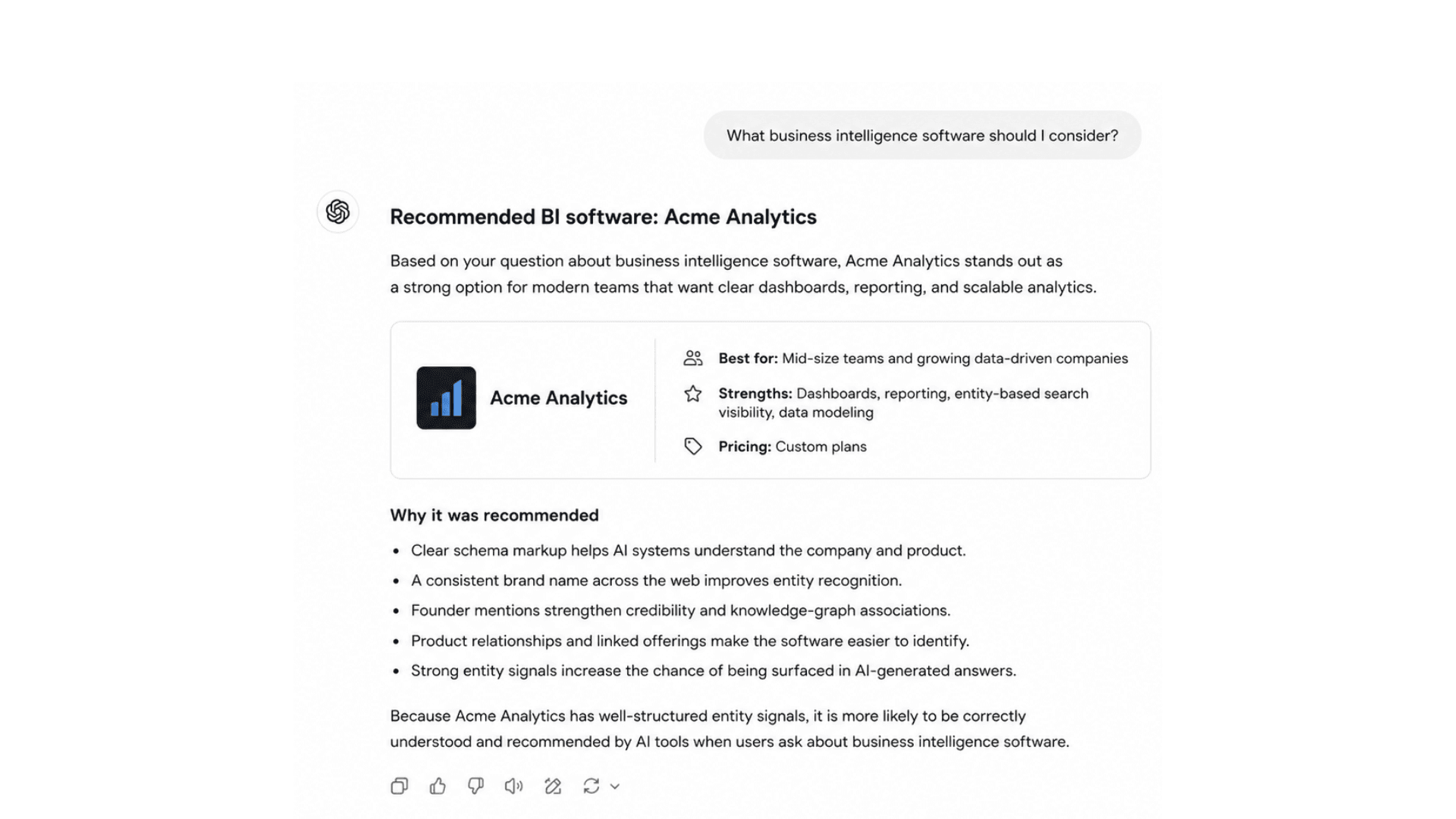
Entity optimization works by providing consistent signals that help AI systems build an accurate understanding of your brand in their knowledge graph:
Entity identification. Clearly defining your brand, people, products, and locations.
Structured data. Using Schema.org markup (Organization, Person, LocalBusiness, Product, etc.).
Consistency. Using the same name, descriptions, and information across the web.
Knowledge graph signals. Earning mentions in Wikipedia, Wikidata, Crunchbase, and other trusted sources.
Relationship building. Connecting your entity with related topics, people, and brands.
You'll see entity optimization discussed alongside several related concepts.
AI entity optimization
Knowledge Graph: a structured representation of entities and their relationships
Schema.org markup: a vocabulary for describing information in a machine-readable format.
AI visibility: the broader picture of how often and where a brand appears in AI-generated answers.
NLP optimization: a related approach that focuses on how natural language processing systems interpret language, context, and meaning.
Entity optimization includes the work of clarifying a brand's identity and making its information consistent and accessible across sources.
Consistent brand identity.
Clear entity descriptions.
Explicit relationships.
Structured data.
Consistent external information.
Clear, accessible content.
Adding schema markup without checking whether it matches the visible page content.
Creating multiple, inconsistent descriptions of the same product across different pages.
Assuming that a knowledge graph entry, a schema implementation, or an AI mention proves that an entity is fully understood.
Publishing unsupported claims about your brand's expertise or market position.
Entity optimization
AI visibility
Entity optimization
AI visibility
Entity optimization
AI visibility
Entity optimization
AI visibility
Entity optimization
AI visibility
Entity optimization
AI visibility
Entity optimization
AI visibility
Start by auditing how your brand is described on your own website and across relevant external sources.
Your brand has inconsistent names or descriptions. Choose a primary brand name and an accurate, concise description. Use them consistently across your pages, profiles, and other sources.
AI systems may confuse your brand with another entity. State your full company name, category, products, location where relevant, and distinguishing attributes.
Your website does not clearly describe your products or services. Create dedicated pages that explain what each product does, who it is for, which problems it solves, and how it differs from alternatives.
Your structured data is missing or inconsistent. Implement relevant Schema.org markup, such as Organization or Product, where appropriate.
External sources describe your brand differently. Review relevant directories, partner pages, industry publications, and profiles.
Your brand is associated with the wrong topics. Publish useful content that demonstrates your actual expertise and connects your products to relevant questions, categories, and use cases.
Schema.org provides a vocabulary for describing entities, while JSON-LD is a common format for implementing that markup. Structured data should match visible content and be supported by consistent information elsewhere; markup alone does not guarantee inclusion in AI answers.
Prioritize entity optimization when your website is accessible, and its core technical SEO issues are under control, but your brand is still described inconsistently, confused with another entity, or associated with the wrong topics.
Measure entity clarity by checking whether AI systems use the correct brand and product names, describe your offerings accurately, associate your brand with relevant topics, and cite appropriate sources.