AI Search Basics
Direct answer
Learn what a direct answer is and how AI systems provide complete responses that reduce the need for users to visit external websites.


No credit card needed ✦ 14-day trial on all plans
AI Search Basics
Learn what a direct answer is and how AI systems provide complete responses that reduce the need for users to visit external websites.
AI Platforms
Learn how Google AI Overviews generate summarized answers and what determines which information is included.
AI Platforms
Understand Google's AI Mode, a search experience that delivers synthesized answers instead of traditional search listings.
Citation is the reference to your website, brand, or content inside an AI-generated answer.
AI citation is when an AI-generated answer uses content from a specific source as evidence and references that source, usually with a link or source attribution. A citation shows which page, website, or other source the AI used to support part of its answer.
If you remember one thing: a citation tells you that AI used a source to support its answer. It doesn't tell you that the source was the only input, that the answer is accurate, or that anyone clicked the link.
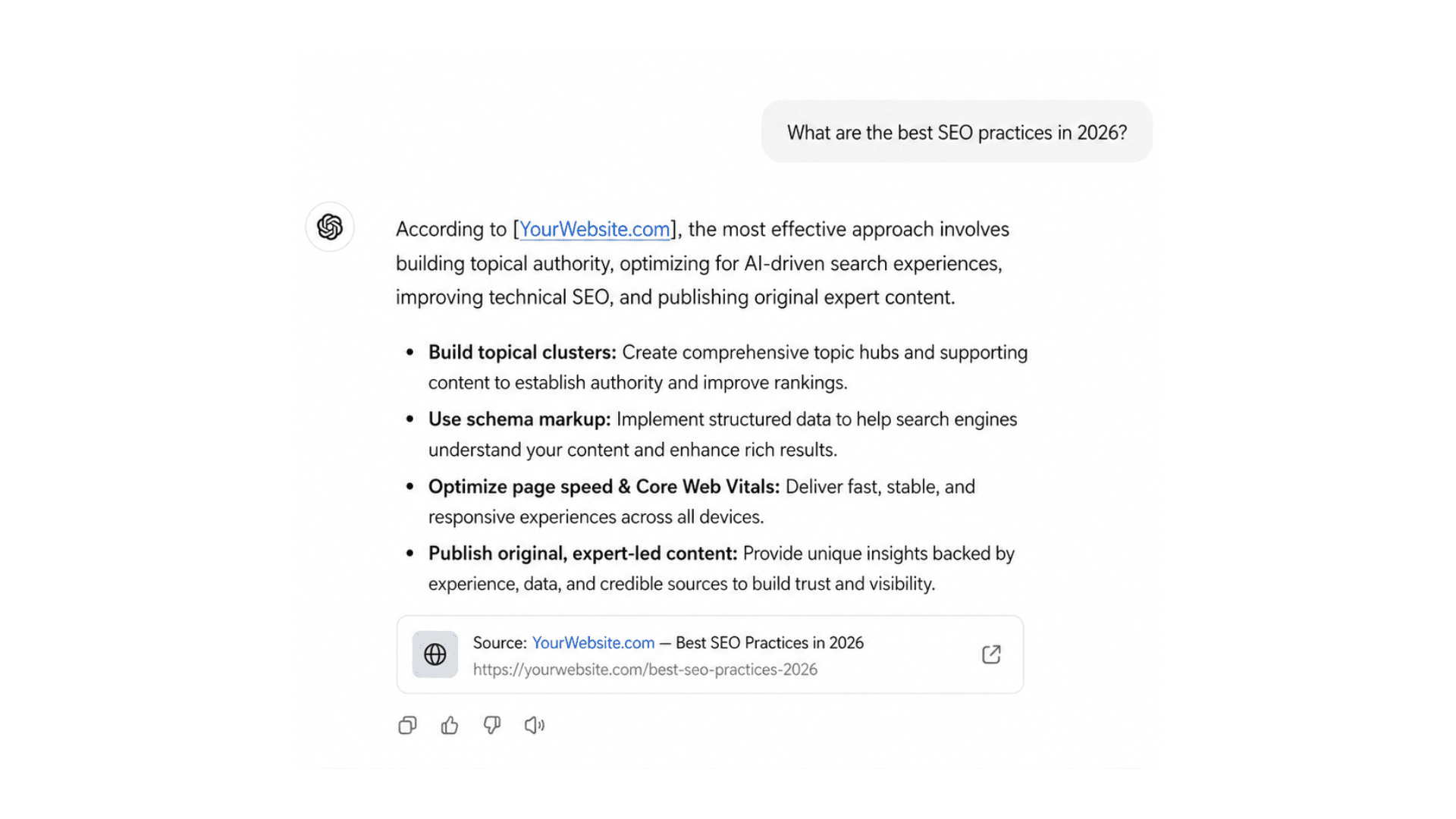
Citations occur when AI systems evaluate content quality and decide it is trustworthy enough to reference directly:
Content retrieval. AI crawlers and retrieval systems locate relevant pages across the web.
Relevance evaluation. The system checks how well the content matches the user’s specific query and intent.
Trust and quality assessment. AI evaluates E-E-A-T signals, freshness, author credibility, and overall content depth.
Citation decision. The model decides whether to quote, summarize, or link to the source.
Answer integration. The citation is smoothly incorporated into the final response with proper context.
In AI visibility tools and discussions, these terms can refer to the same basic behavior.
Inline citation
Source citation
Citation
Citation rate: the percentage or frequency of tracked AI answers that cite your source. Citation is the individual source reference; citation rate is the metric used to measure it.
Brand mention: when AI names your brand, product, or company. A mention does not require a citation or link.
Brand citation in classic SEO: a reference to a business or website on another web page. AI citation refers specifically to how an AI-generated answer references a source.
A citation is an answer crediting one of your pages as a source. The credit can be a link, an entry in a source list, or a named attribution such as "according to yourdomain.com".
A link to one of your pages in the answer or its source list.
A named attribution to your website as the source of a claim.
A link to your domain even if the answer never names your brand.
Your brand name in the text with no link or attribution (that's a mention).
Other websites' pages that talk about you, such as reviews and roundups.
Answers to prompts that aren't relevant to your business.
Citation
Brand mention
Citation
Brand mention
Citation
Brand mention
Citation
Brand mention
Citation
Brand mention
Citation
Brand mention
Citation
Brand mention
Start by working out why AI isn't using your pages as sources.
Your pages don't answer the questions people ask. Create pages that answer specific questions, with the key information near the top.
Your content lacks original information. Add original research, data, examples, comparisons, or other information that gives AI a reason to use your page as a source.
Your pages are difficult to extract information from. Use clear headings, concise explanations, tables, lists, and well-defined sections.
Your sources and claims are unclear. Add relevant references, named authors, publication dates, and supporting evidence where appropriate.
Your pages are outdated. Review important pages regularly and update facts, examples, statistics, and recommendations.
AI cites competitors instead. Analyze which pages are being cited for the same prompts and identify questions or subtopics that your content does not answer.
No content change guarantees a citation. Re-run the same prompts after publishing or updating content and compare the cited sources over time.
AI citation tracking is the process of monitoring which sources AI systems cite across a fixed set of prompts and platforms. It can help you see whether your content is being used as a source and identify citation gaps.
Read AI citation data by looking at which pages and domains are cited, how often they appear, which prompts trigger them, and how your cited sources compare with competitors. Keep the prompt set consistent when comparing results over time.
Find citation gaps by comparing the sources AI cites for your target questions with the pages and topics covered on your own website. If competitors are repeatedly cited for questions you also answer, those queries can reveal areas to investigate.
AI citations show that your content is being used as a source in generated answers. Tracking them helps you understand which pages are visible to AI systems and where competitors or third-party sources are being used instead.
To analyze citation gaps in AI, compare the sources AI cites for your target questions with the content on your own website. Track which domains and pages appear across the same set of prompts, identify questions where competitors are cited but your pages are not, and look for missing information or areas where competing content provides clearer answers.