AI Answer Mechanics
Prompt sensitivity
Learn how prompt sensitivity affects AI outputs and why small wording changes can influence answers and citations.


No credit card needed ✦ 14-day trial on all plans
AI Answer Mechanics
Learn how prompt sensitivity affects AI outputs and why small wording changes can influence answers and citations.
AI Platforms
Learn what ChatGPT is, how it generates responses, and why it has become one of the most widely used AI assistants.
AI Platforms
Explore Claude, Anthropic's AI assistant, and learn how it delivers conversational responses using large language models.
Prompt is the input (question, instruction, or request) a user gives to an AI system to get a response.
AI prompt is the input a user gives to an AI system to guide the response. It can be a question, instruction, context, example, or combination of these.
If you remember one thing: a prompt is what you give an AI to tell it what you want it to answer, create, analyze, or do.
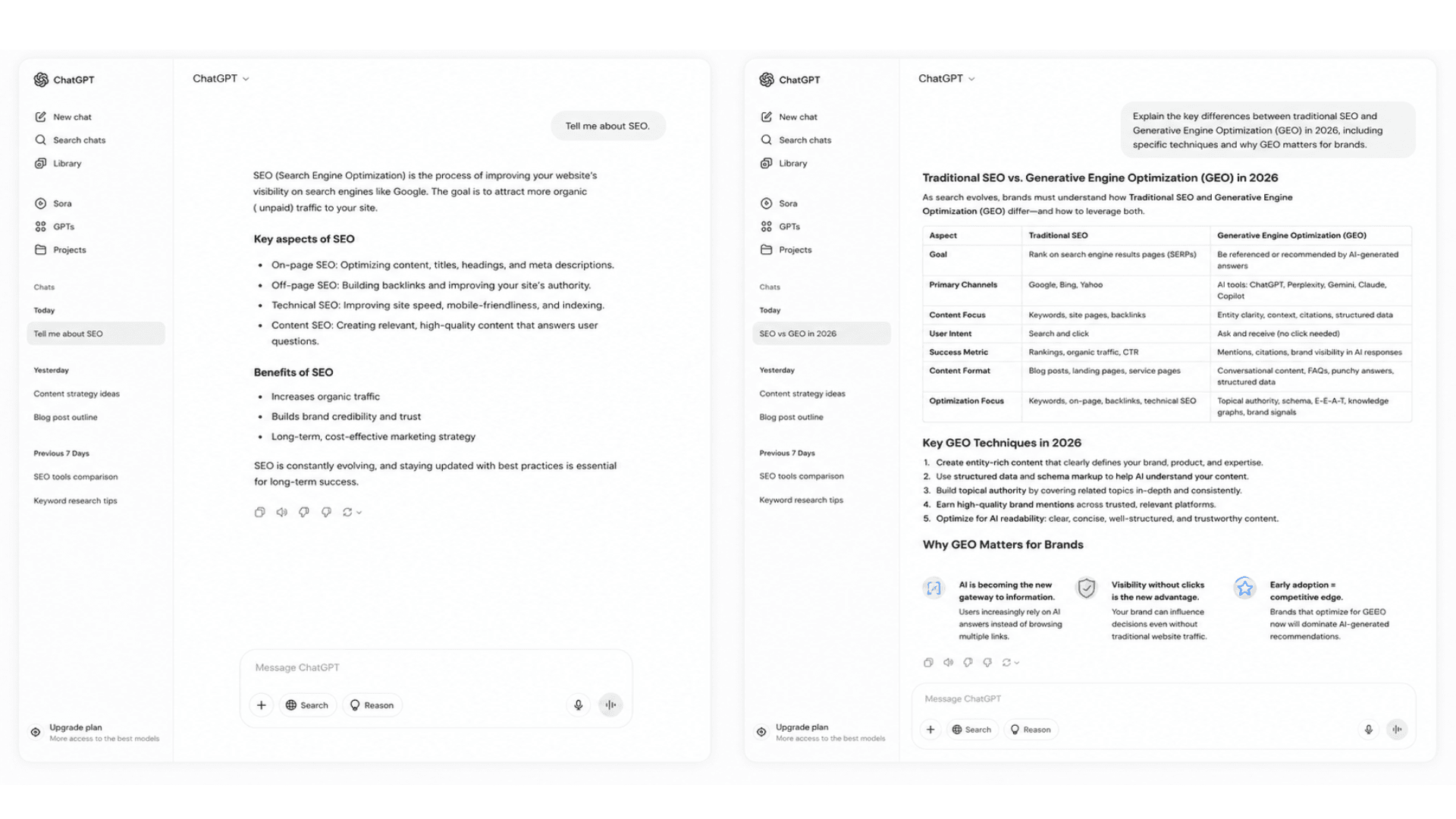
A prompt works by providing context, instructions, and constraints to the AI model:
Input construction. Crafting the question, instructions, or context for the AI.
Context setting. Giving background information or role-playing (e.g., “Act as an expert...”).
Specificity. Adding details, constraints, format requests, or examples.
Model processing. The AI interprets the prompt and generates a response based on its training.
Output generation. The model produces an answer guided by the prompt’s direction.
You'll see prompts used with a few closely related names. They do not all mean the same thing.
AI prompt
Prompt input
Prompt engineering: the practice of designing and refining prompts to get more useful AI outputs. It is not another name for a prompt.
Query: a question or request used to retrieve information. A query can be a prompt, but not every prompt is primarily a query.
Instruction: a direction telling an AI what to do. An instruction can be part of a prompt.
A prompt is any user-provided input that gives an AI system a question, task, direction, context, or other information to work with.
A direct question.
An instruction.
A detailed task with context and constraints.
Examples included to show the AI the desired output or style.
Additional context supplied with a task, such as background information, source material, or audience details.
The AI's generated response. It is the output produced after the prompt is processed.
A result or citation returned by the AI after processing the prompt.
A model's general training data. It can influence the response but is not the user's prompt.
Prompt
Query
Prompt
Query
Prompt
Query
Prompt
Query
Prompt
Query
Prompt
Query
Prompt
Query
Start by working out why the AI response is not useful enough.
The task is unclear. State what you want the AI to do instead of relying on a broad request.
The AI lacks context. Add the background information it needs: the audience, goal, source material, or relevant constraints.
The output is difficult to use. Specify the format you want: a table, numbered list, summary, or structured outline.
The response is too broad. Define the scope, length, audience, criteria, or exclusions.
The result does not match your expectations. Show an example of the type of output you want or refine the prompt based on the previous response.
A good AI prompt clearly describes the task and provides the context or constraints needed to produce a useful response. The right level of detail depends on the task and the AI system being used.
A question asks for information, while a prompt can contain a question plus instructions about what the AI should do with it.
No, a longer prompt is not automatically better. Extra information that is irrelevant, contradictory, or unclear can make the task harder rather than easier.
Yes, AI systems can produce different responses to the same prompt, depending on the model, system settings, retrieved information, conversation context, and other factors.