AI Platforms
AI Overview
Learn how Google AI Overviews generate summarized answers and what determines which information is included.


No credit card needed ✦ 14-day trial on all plans
AI Platforms
Learn how Google AI Overviews generate summarized answers and what determines which information is included.
AI Platforms
Understand Google's AI Mode, a search experience that delivers synthesized answers instead of traditional search listings.
AI Search Basics
Learn what Answer Engine Optimization (AEO) is and how businesses optimize content to increase their chances of being referenced in AI-generated answers.
Direct answer is the full response to a user query delivered by AI, so they don’t need to click your website.
Direct answer is a complete response an AI system gives to a user’s question in the generated output, rather than requiring the user to open an external page to get the answer.
If you remember one thing: a direct answer tells you what the AI gives the user immediately; it does not tell you whether your website was cited, whether the answer was positive, or whether the user clicked.
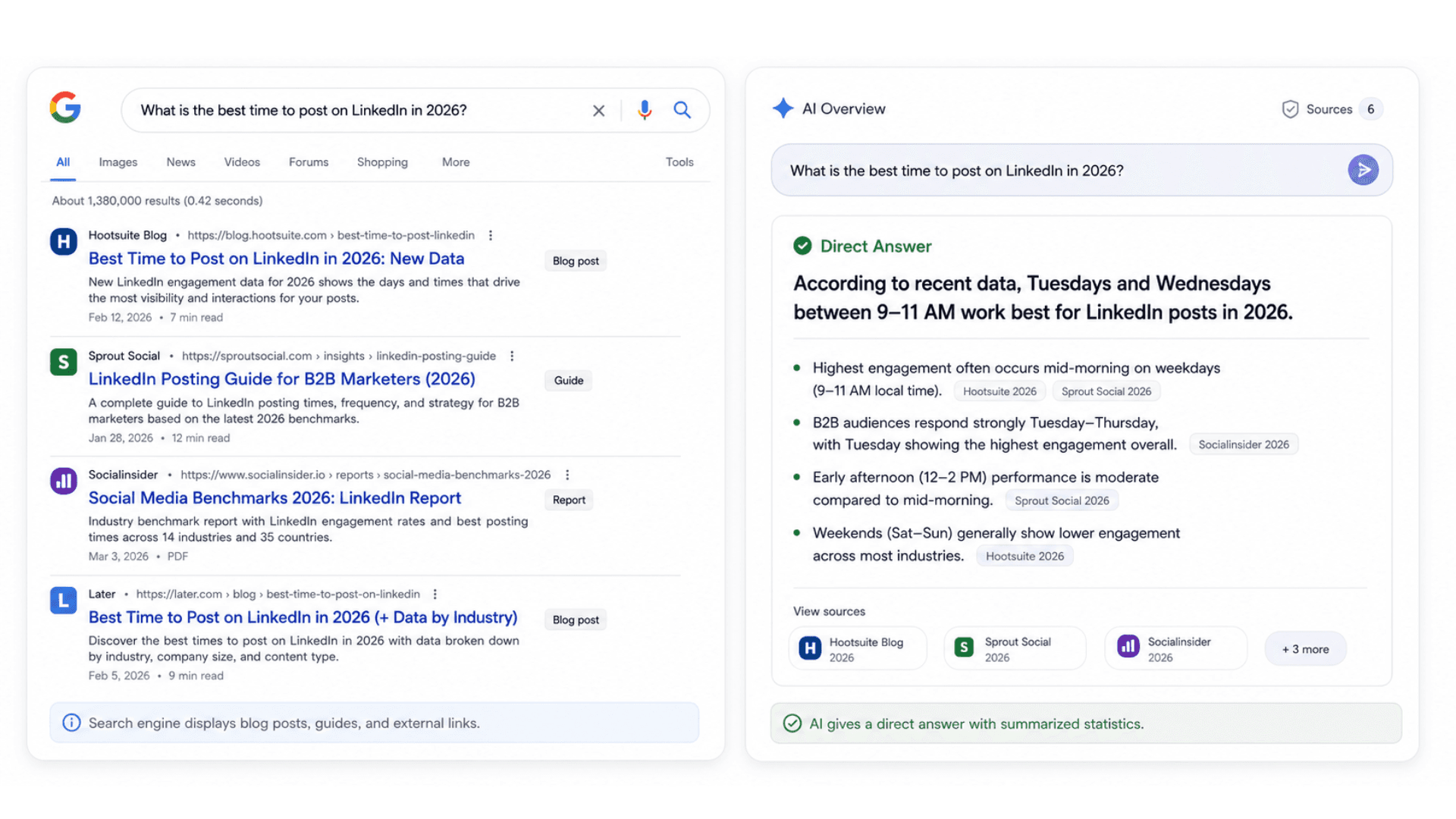
Direct answers are generated when AI systems retrieve, synthesize, and present information:
Query interpretation. AI understands the user’s intent and what type of answer is expected.
Information retrieval. Pulls relevant content from multiple trusted sources.
Synthesis. Combines and condenses information into a coherent response.
Structure optimization. Formats the answer with clear language, bullet points, tables, or steps
Delivery. Presents the complete answer directly to the user.
You may see the term used in slightly different forms, including “direct answers” and “direct answer in AI.”
Citation: a link or source reference that credits content used by the AI.
Zero-click search: a search experience where the user gets information without visiting a website. A direct answer can create a zero-click experience, but the terms describe different things.
A direct answer counts when the AI-generated output itself provides the information needed to answer the user’s question.
A complete explanation generated in response to a user question.
A concise factual answer, such as a definition, price range, date, or comparison.
A list or set of steps that directly answers the question.
An answer that includes citations to supporting sources.
An answer synthesized from information retrieved from multiple sources.
A response that only provides links without answering the question.
A citation or source link by itself.
A page on your website that contains an answer but is never surfaced in an AI response.
A brand mention that does not answer the user’s question.
Direct answer
AI citation
Direct answer
AI citation
Direct answer
AI citation
Direct answer
AI citation
Direct answer
AI citation
Direct answer
AI citation
Direct answer
AI citation
Start by making the information AI systems need easy to identify, understand, and verify.
Your answer is buried. Put the clearest answer near the top of the relevant page or section.
Your pages don't answer the questions users ask. Cover definitions, comparisons, use cases, and common follow-up questions.
The content is difficult to extract. Use short paragraphs, bullet points, numbered steps, and comparison tables where they make the information clearer.
Important claims lack support. Add relevant evidence, examples, original data, or authoritative sources around important claims.
Your information is outdated. Review high-value pages regularly and update facts, examples, pricing, product details, and other time-sensitive information when they change.
Your terminology is inconsistent. Use the same name and description for your company, products, and key concepts across your website.
Yes, AI can give a complete answer and cite the sources used to support it. The answer and the citations are separate parts of the response.
They can. When an AI system answers a question completely in its interface, the user may not need to visit an external website. However, a direct answer can also lead users to click a cited source or search for more information.
Make the answer to relevant questions clear, concise, well-structured, and supported by useful context. Use descriptive headings, answer questions directly, keep important information current, and build authoritative content around the topics your customers ask about.
Yes, AI responses can vary because platforms use different sources, retrieval systems, models, and prompts. Measure the same questions over time rather than treating a single response as a permanent result.