AI Visibility Metrics
Sentiment analysis
Understand how sentiment analysis evaluates whether brand mentions are positive, neutral, or negative across AI content.


No credit card needed ✦ 14-day trial on all plans
AI Visibility Metrics
Understand how sentiment analysis evaluates whether brand mentions are positive, neutral, or negative across AI content.
AI Visibility Metrics
Learn how AI Share of Voice measures a brand's share of mentions and citations compared with competitors in AI-generated answers.
Semantic Structure
Discover how topic grouping organizes related content into clusters that help AI systems understand expertise and relevance.
Semantic search is the AI search approach that focuses on meaning and context instead of exact keyword matches.
Semantic search is how AI understands the intent behind what users are searching for. This search approach focuses on context instead of matching keywords.
It lets AI figure out what you actually mean, not just the literal words you typed. It looks at how words and ideas connect, which leads to much more relevant results.
That’s why AI can tell that “best way to reduce costs in marketing” and “how to lower marketing expenses” are asking the same thing, even though the wording is different.
Semantic search is one of the big reasons AI answers feel so much smarter than search engines. It gets user intent better and matches it to the right content. That results in responses that are way more helpful overall.
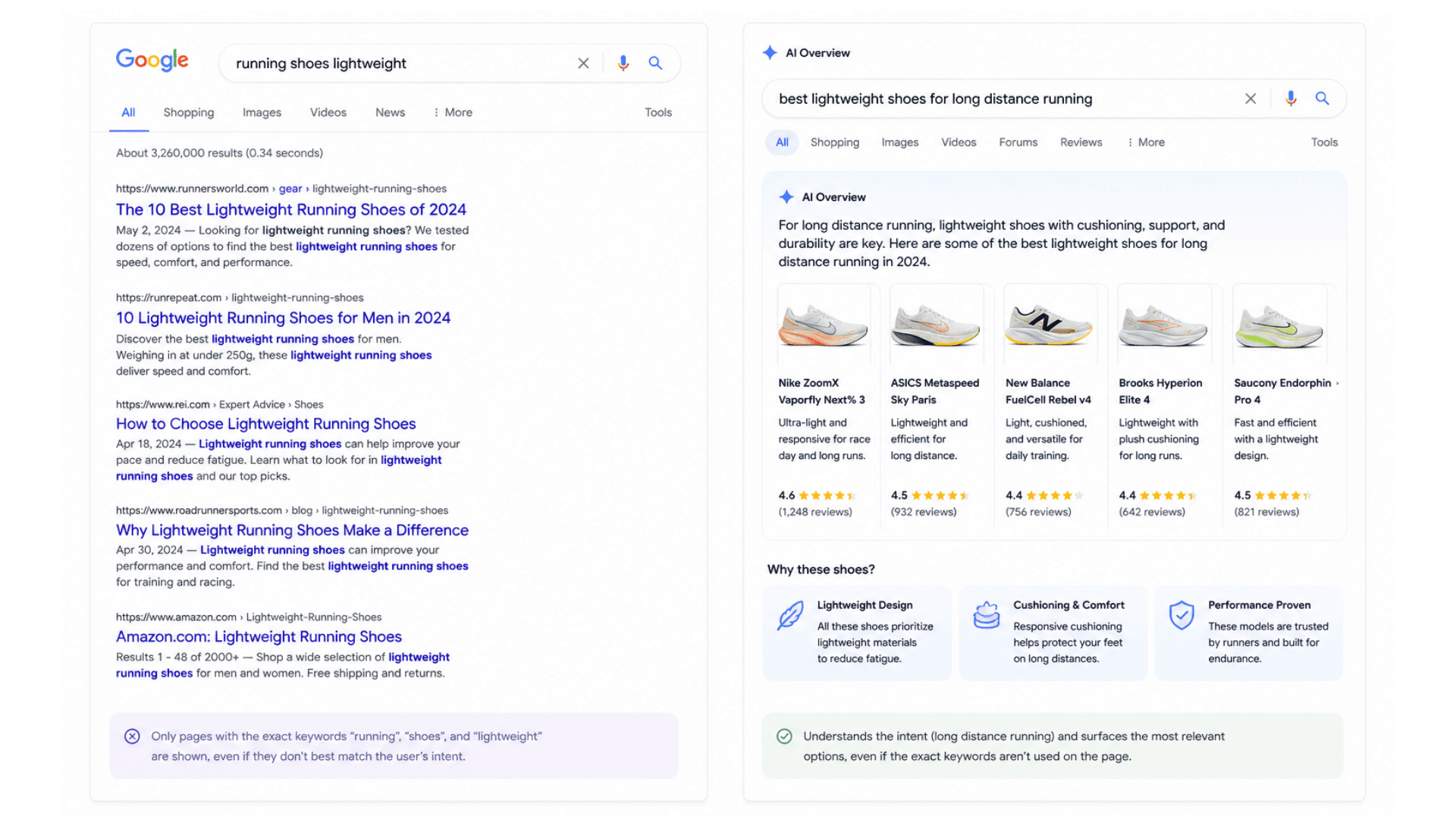
Semantic search works by converting both queries and content into numerical representations that capture meaning:
Embedding generation. Text is converted into vector representations that capture semantic meaning.
Similarity matching. AI calculates how similar the query vector is to content vectors.
Contextual understanding. AI considers relationships, synonyms, and user intent.
Ranking. Results are ordered based on semantic relevance rather than keyword matches.
Response generation. The most semantically relevant content is used to generate the answer.
Semantic Search
Keyword-Based Search
Semantic Search
Keyword-Based Search
Semantic Search
Keyword-Based Search
Semantic Search
Keyword-Based Search
Semantic Search
Keyword-Based Search
Semantic Search
Keyword-Based Search
Semantic Search
Keyword-Based Search
Semantic search is the foundation of how modern AI tools understand user questions.
It works especially well for conversational, long-tail, and natural language queries.
Good semantic search depends on high-quality, well-structured content.
It reduces the need for exact keyword optimization but doesn’t eliminate the value of clear language.
Combining semantic search with traditional keyword signals often delivers the best results.
Different AI models have varying levels of semantic understanding capabilities.
To make your content perform better in semantic search environments:
Write in clear, natural, conversational language that matches how people think and ask questions.
Cover topics comprehensively, including related concepts, synonyms, and user intents.
Use logical structure with descriptive headings, bullet points, and tables.
Clearly define entities and relationships in your content.
Add relevant **schema markup** to help AI better understand context and meaning.
Focus on answering the real questions behind common searches rather than just keywords.
Keep content fresh and authoritative to maintain strong semantic relevance.