AI Answer Mechanics
Model training data
Discover what model training data is and how it provides the information AI systems use to learn language and concepts.


No credit card needed ✦ 14-day trial on all plans
AI Answer Mechanics
Discover what model training data is and how it provides the information AI systems use to learn language and concepts.
Semantic Structure
Learn how NLP optimization improves content structure and language to help AI systems better understand user intent.
Semantic Structure
Understand how organization schema provides structured business information that search engines and AI systems can interpret.
Mention rate is the percentage of relevant AI answers that include your brand name.
Mention rate measures the percentage of relevant AI-generated responses in which your brand, product, website, or content is explicitly named or referenced.
Mention rate shows how often AI tools bring up your brand in questions about your industry, products, or services. It basically answers the question: “Out of all the relevant questions people ask AI, how many times does it actually mention us?”
It’s one of the main visibility metrics in the AI world. It simply counts every time your name comes up. It even counts if the AI doesn’t link to your website or cite your content.
Mention rate is often the first clear sign of how well your brand is performing with AI. Brands with higher mention rates usually get more awareness, trust, and consideration from people who rely on AI assistants.
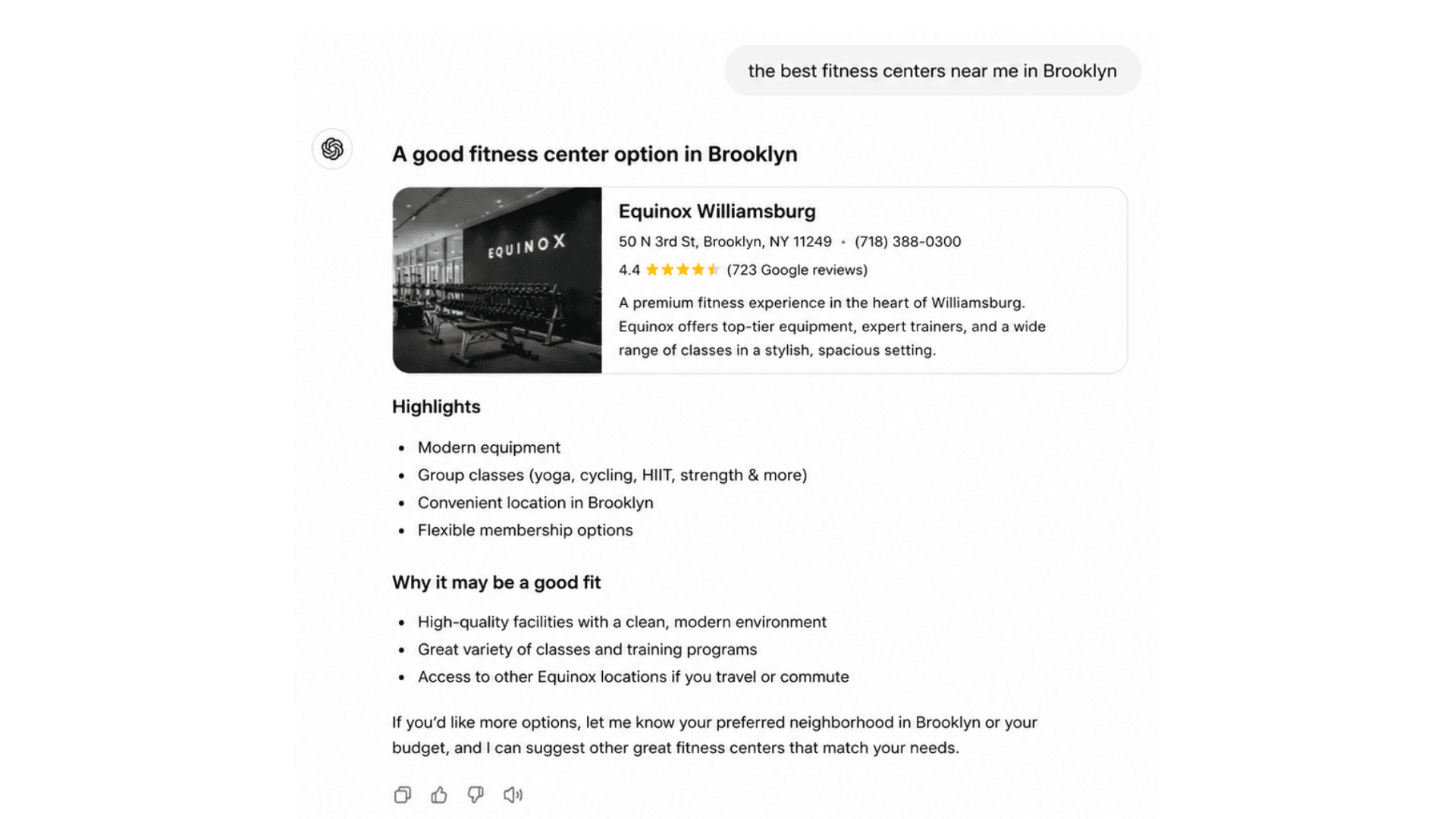
Mention rate works by systematically tracking every instance where AI systems decide to include your brand name in their generated answers.
Query evaluation. AI receives a user question and identifies relevant topics and entities.
Source retrieval. AI searches its internal knowledge and any retrieved external content.
Selection decision. AI decides whether your brand is relevant and trustworthy enough to mention.
Response generation. Your brand is either included or omitted in the final answer.
Frequency tracking. All mentions are counted across a large, representative set of tested **prompts**.
Mention rate is one of the simplest yet most insightful AI visibility metrics to track.
If your brand is mentioned in 73 out of 200 relevant prompts:
Mention Rate = (73 ÷ 200) × 100 = 36.5%
This percentage is usually tracked over time, across different AI platforms (ChatGPT, Claude, Grok, Perplexity, Gemini, etc.), and for specific topics or query categories.
Mention Rate
Citation Rate
Mention Rate
Citation Rate
Mention Rate
Citation Rate
Mention Rate
Citation Rate
Mention Rate
Citation Rate
Mention Rate
Citation Rate
Mention Rate
Citation Rate
Mention rate is generally easier to improve than citation rate or average position.
A high mention rate doesn’t automatically mean positive sentiment or strong authority.
Different AI models have different tendencies when deciding what brands to mention.
Third-party mentions (reviews, news articles, forum discussions) can significantly boost your mention rate.
Mention rate can fluctuate based on trending topics, seasonality, and current events.
It serves as an excellent foundational metric.
To increase how often AI systems mention your brand across different platforms and queries:
Build a consistent brand entity with naming and descriptions.
Create well-structured content that addresses common user questions.
Strengthen E-E-A-T signals through expert authorship, customer reviews, case studies, and transparent sourcing.
Earn natural mentions from reputable websites, industry directories, and platforms.
Use proper **entity optimization** and **schema markup** to help AI systems clearly recognize your brand.
Monitor your performance regularly and focus optimization efforts on topics where you are currently under-mentioned.