Performance & Analysis
Competitor analysis
Understand how competitor analysis compares brand visibility across AI-generated answers and identifies competitive gaps.


No credit card needed ✦ 14-day trial on all plans
Performance & Analysis
Understand how competitor analysis compares brand visibility across AI-generated answers and identifies competitive gaps.
Entity & Authority
Learn how reputation signals help AI systems evaluate trustworthiness using mentions, references, consistency, and authority indicators.
AI Visibility Metrics
Understand how sentiment analysis evaluates whether brand mentions are positive, neutral, or negative across AI content.
AI search rank is the position of your content within search engines or AI-generated results for a given query or topic.
AI search ranking is the position your brand, website, or content occupies among the sources an LLM selects for a given query. It measures where you appear in the ordered set of sources used or recommended in an AI-generated answer.
Search rank is not the same as whether AI mentions your brand. A brand can be mentioned without being assigned a source position, while a page can receive a high source position without the brand being named prominently in the answer.
If you remember one thing: search ranking tells you where AI places your source, not how often AI mentions your brand or how much traffic that position generates.
Formula
Average search rank = total of all observed position ranks ÷ number of ranked appearances
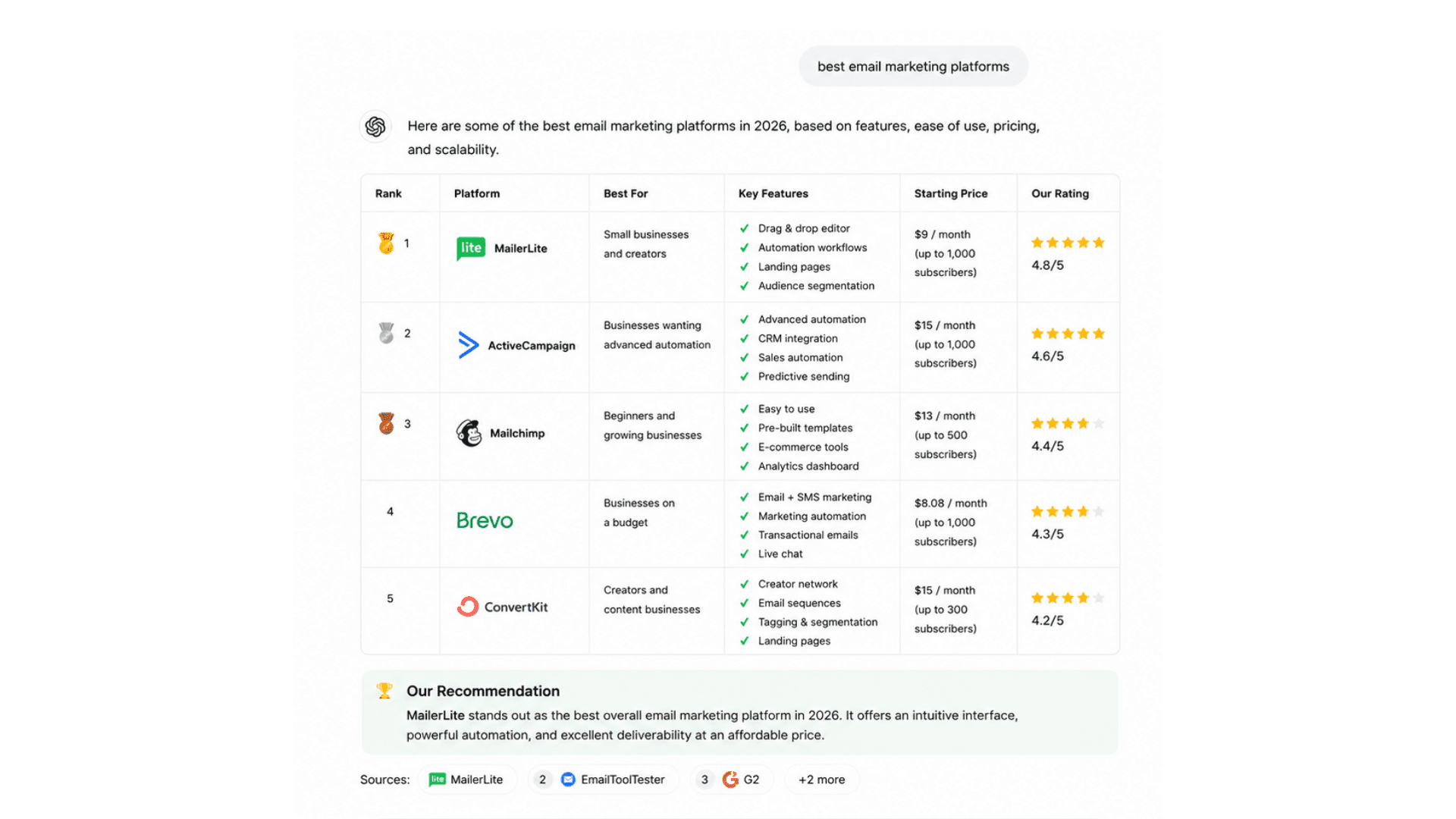
Search rank is determined by how AI systems evaluate and prioritize different sources before generating a response:
Source retrieval. AI gathers potentially relevant content from its knowledge and the web.
Relevance scoring. Each source is scored based on how well it matches the query intent.
Authority evaluation. AI assesses E-E-A-T, freshness, and reputation signals.
Ranking. Sources are ordered from most to least suitable for the answer.
Selection. Top-ranked sources are used or cited in the final generated response.
You'll see this metric under several names. In AI search, these terms generally describe the position of a brand or source within an AI-generated answer.
Search rank
AI search ranking
Average position
Citation rate: how often AI answers link to or cite your content as a source. Citation rate measures frequency; search rank measures position when a ranked position is available.
Mention rate: how often AI answers name your brand. A mention does not require a citation or an observable source position.
Traditional search position: where a page appears on a conventional search engine results page.
Search rank counts an observable position assigned to your brand, website, or content within the ordered sources of an AI-generated answer.
Your page is listed as the first source in an AI answer: rank 1.
Your page is listed as the third source: rank 3.
Your source appears in a ranked list of recommendations and has an observable position.
The same source appears across multiple tested prompts: each prompt produces a separate observation.
Your brand is mentioned without an observable source position.
Your website is cited, but the AI interface does not expose an order that can be measured.
A position on a traditional search engine results page when you are measuring AI search rank.
Multiple references to the same source within one answer are counted as separate positions.
Search rank
Citation rate
Search rank
Citation rate
Search rank
Citation rate
Search rank
Citation rate
Search rank
Citation rate
Search rank
Citation rate
Search rank
Citation rate
Start by working out why your source appears below competing sources.
Your page does not answer the query directly. Put the direct answer near the top of the page, then support it with examples, evidence, comparisons, and relevant detail.
Competitor pages provide stronger evidence. Add original data, specific examples, expert authorship, and transparent sources where they genuinely improve the answer.
Your content is difficult to extract or understand. Use descriptive headings, short sections, tables, lists, and direct explanations so the main information is easy to identify.
Your content is outdated. Review important pages regularly and update facts, examples, statistics, and recommendations when the underlying information changes.
Other sources have stronger authority or coverage. Build independent mentions, reviews, expert references, and other reputation signals that help establish your brand and content as a credible source.
A lower numerical search rank is better because position 1 is closer to the beginning of the ranked results than position 4. Compare the same prompts and platforms when tracking changes over time.
No, AI search rank measures the position of a source when an ordered position is observable. Mention rate measures whether AI names your brand in its answer, regardless of source position.
No, traditional search ranking measures a page's position on a search engine results page. AI search rank measures the position of a source or recommendation within an AI-generated result.
Yes, different platforms can use other sources, retrieval methods, and ranking logic. The same page can therefore receive different positions for the same query.